

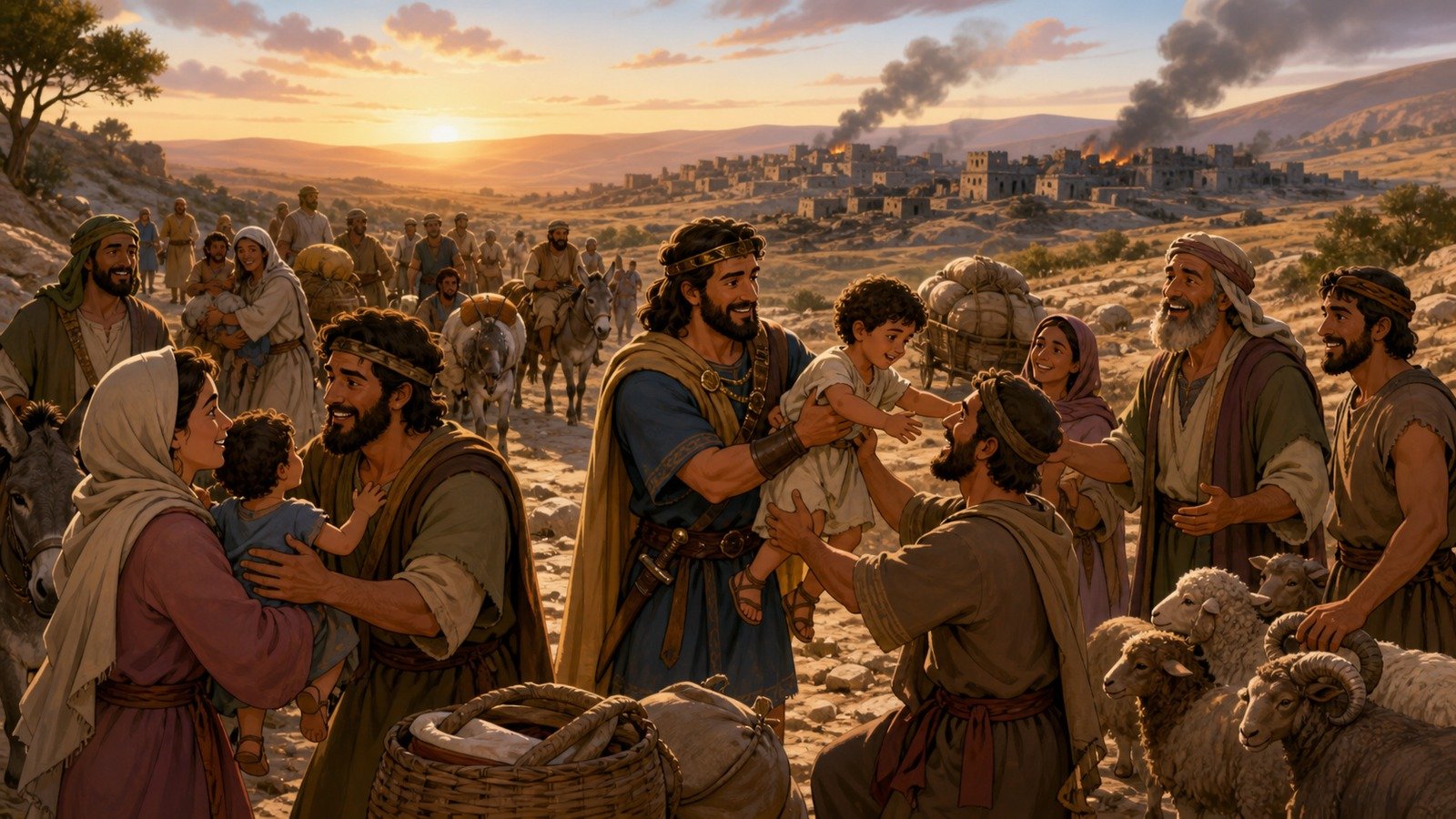
David returns from being dismissed by the Philistine army to find Ziklag burned and the women and children taken by Amalekite raiders; he leads a successful pursuit and rescue, and establishes a rule that those who guarded the supplies share equally in the plunder.
Further context
2 min readDavid and his men come back after a three-day march to find Ziklag burned and everyone gone. The Amalekites had raided while the fighting men were away, taken the women and children and everything else, and not killed anyone, which is the behaviour of slavers rather than raiders.
David and his men wept aloud until they had no strength left to weep. Both his wives are among the captives.
Then the situation turns on him. The men are bitter in spirit because of their sons and daughters, and they talk about stoning him. He has just lost his base, his family and the confidence of the only six hundred men in the world who are loyal to him, in an afternoon. The sentence that follows is the hinge of the episode: but David found strength in the LORD his God.
He calls for Abiathar and the ephod and asks whether to pursue, and is told to go and that he will certainly succeed.
Two hundred of the six hundred are too exhausted to cross the Besor ravine and stay with the supplies. The remaining four hundred continue, and what they find in a field is an Egyptian slave, abandoned by his Amalekite master three days earlier when he fell ill. They give him bread, water, part of a cake of pressed figs and two cakes of raisins, and he revives, having eaten nothing for three days and nights. He then guides them to the raiders on condition that he is neither killed nor handed back.
The whole rescue turns on a dying slave who was left behind by people who did not think he was worth feeding.
They find the Amalekites spread out over the countryside eating, drinking and celebrating, attack from dusk until the evening of the next day, and nothing is missing. Everything and everyone is recovered.
Then comes the quarrel that produces a law. Some of the troublemakers among the four hundred say the two hundred who stayed behind should get nothing but their own wives and children. David's ruling is flat: the share of the man who stayed with the supplies is to be the same as that of him who went down to the battle. All will share alike. It became a statute and ordinance for Israel from that day to this.
He then sends portions of the plunder to the elders of the towns throughout Judah where he and his men had roamed, with a message saying it is a present from the spoil of the LORD's enemies. Twelve towns are listed by name, including Hebron.
The ruling about the two hundred at the ravine is more than a fair-shares policy. It settles, at the start, the question of what an army is for, and it does so against the men who did the fighting and in favour of the men who guarded the baggage. That principle stays in force, and centuries later the same standard is being applied without anyone tracing it back to a quarrel over Amalekite plunder in the Negev.
Three days later he learns that Saul is dead, and those are the towns that make him king.