

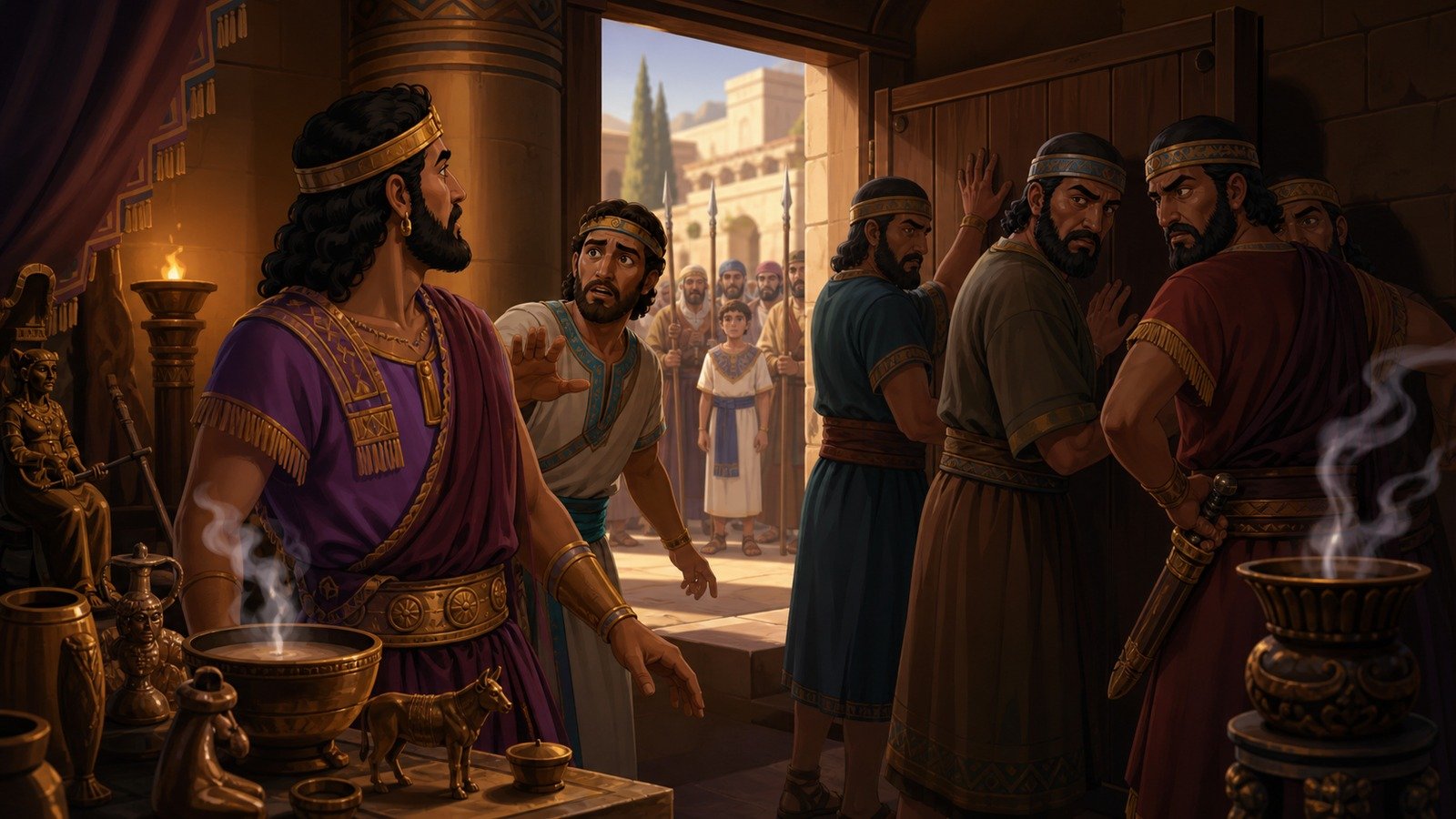
Manasseh's son Amon reverts fully to his father's earlier idolatry and is assassinated by his own officials within two years, who are themselves then executed by "the people of the land" in favour of the child Josiah.
Further context
3 min readAmon reigns two years, and the verdict is that he did evil as his father Manasseh had done, worshipped the idols his father had worshipped and bowed down to them, and forsook the LORD.
If Manasseh's late repentance is accepted as historical, then Amon has watched his father spend the last part of his life dismantling the shrines he had built, and reverses it as soon as he takes the throne. The reforms of an old man do not survive his son.
His officials conspire against him and assassinate him in his palace, and what happens next is more interesting than the murder. The people of the land kill all who had plotted against King Amon, and they make Josiah his son king in his place.
That phrase, the people of the land, appears repeatedly in the southern kingdom's history and it means something specific: the free landowning population of Judah, outside the court and the priesthood. They intervene at several critical moments, always in the same direction, to protect the line of David. They installed Joash after Athaliah's usurpation, they crown Uzziah after his father is murdered, and they do it again here.
Every dynastic crisis in the north ends with the assassins taking the throne. Every dynastic crisis in the south ends with the assassins being killed and the next son of David being crowned, sometimes by a priest and sometimes by a crowd of landowners. Nine dynasties in the north over two centuries. One in the south over four.
Josiah is eight years old.
What the country looks like at that moment is the sum of fifty-seven years under two kings. There are altars to Baal and to the starry hosts in the temple courts, an Asherah pole inside the building, shrine prostitutes housed on the premises, and high places from one end of the country to the other. Manasseh's own reforms, if they happened, had touched Jerusalem and left the rest.
One structural point about the two kingdoms shows up clearly here. The northern throne belonged to whoever could take it, so an assassination was a career move. The southern throne belonged to a family, so an assassination was a crime that a crowd of landowners would avenge. That is the whole difference between nine dynasties and one.
An eight-year-old inherits that, and eighteen years later the temple is being repaired and a scroll is found in it.
The two-year reign is given eight sentences and is the shortest treatment of any Judaean king, and its function in the sequence is to explain how a boy came to the throne and why the country was in the condition Josiah found it in.
Two years, and eight sentences cover the whole of it.
He is assassinated by his own officials in his palace, and then something unusual happens: the people of the land killed all who had plotted against King Amon, and they made Josiah his son king in his place.
That phrase, the people of the land, appears at several points in Judah's history and it describes a body with real power, most probably the landowning free citizens outside the court. Three times in these books they intervene to protect the Davidic succession when the palace has failed, and each time they install a child.
Josiah is eight years old when they put him on the throne.