

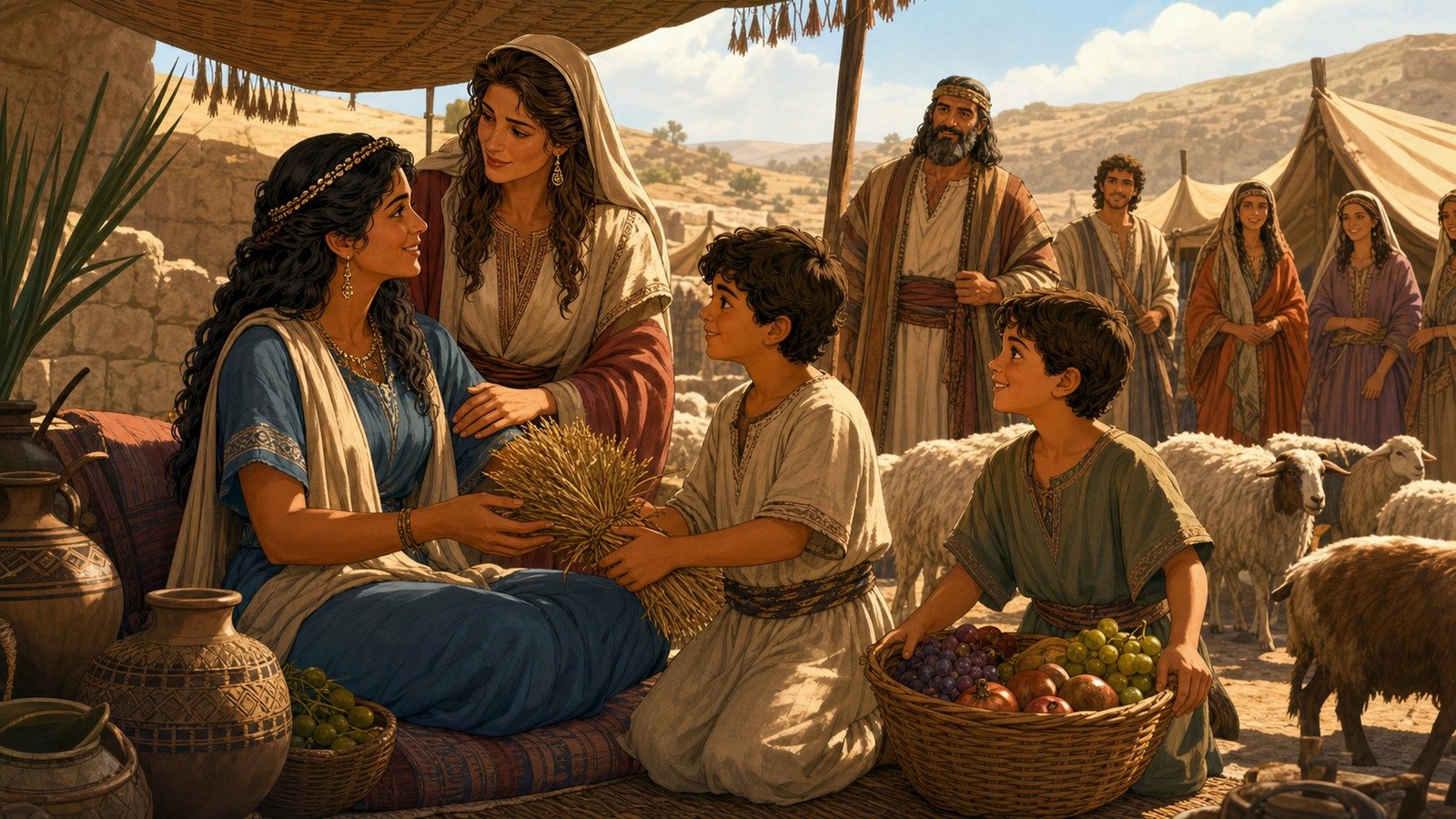
Leah, no longer bearing children herself, gives her servant Zilpah to Jacob in the same way; Gad and Asher are born.
Further context
2 min readLeah stops having children and matches her sister's move exactly. She takes her servant Zilpah and gives her to Jacob as a wife.
The symmetry is the point. Rachel could not conceive and used Bilhah. Leah, who has four sons and cannot have more, uses Zilpah. The competition has passed the stage where either woman is asking for what she lacks and has become a matter of totals.
Zilpah bears a son and Leah says, what good fortune. The name Gad follows from the exclamation, and the word carries a second sense. It means fortune or luck, and Isaiah uses it as the name of a deity when he condemns people who spread a table for Fortune and fill bowls of mixed wine for Destiny. Divine names of that kind were common elements in West Semitic personal names, and their presence indicates the vocabulary of a culture rather than the beliefs of the person using it.
A second son follows and Leah says, how happy I am, the women will call me happy. The name Asher is formed from the same root and the sentence looks outward for the first time. She is thinking about what other women will say.
Four women have now borne children to one man, and the household stands at eight sons with four more people still to come. The arrangement was legal, recognised and stable in its own terms, and it is presented without approval. The rivalry, the bargaining and the naming speeches are all reported in enough detail that the cost of it is visible on the page.
Zilpah is given no words anywhere. Neither is Bilhah. The two women whose sons make up a third of the tribes of Israel are described only by whose servants they were, and every sentence spoken at the birth of their children is spoken by somebody else. The contrast within this stretch is sharp: Leah and Rachel get a speech at each birth, and the two women who actually bore four of the children are silent throughout.
The tribes descended from these sons occupy very different country. Gad settles east of the Jordan in Gilead, sharing that region with Reuben and half of Manasseh, and it is grazing land, which is why those tribes ask for it. The position leaves them exposed on the eastern frontier, and Gad appears repeatedly in the later histories fighting Ammonites and Arameans. The Mesha Stele, a Moabite inscription of the ninth century BC found in 1868, refers to the men of Gad having lived in the territory of Ataroth from of old, which is the earliest mention of an Israelite tribe in any source outside the Bible.
Asher receives the coastal strip in the north-west, running towards Tyre and Sidon. Moses' final blessing wishes that Asher may bathe his feet in oil, which is an accurate description of a region whose hillsides were among the best olive country in the land. The tribe never displaces the Phoenician cities on its coast, and Deborah's song later criticises it for staying by its harbours while others fought.