

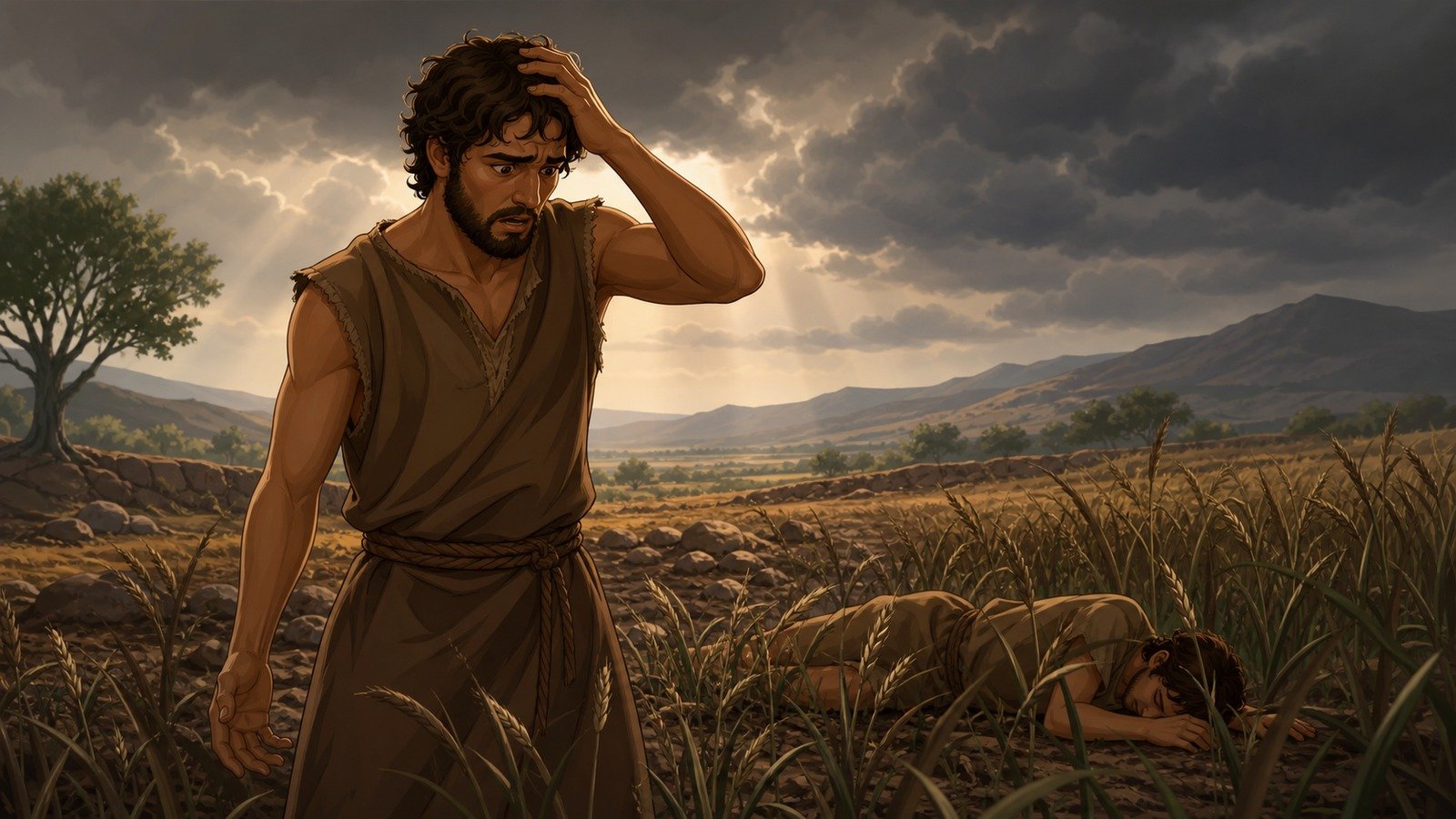
Cain kills Abel in the field and is banished, marked, and sent to wander east of Eden. It is the first death and the first murder recorded in Scripture.
Further context
3 min readSomething was said in a field and the words did not survive. The oldest Hebrew copies break off mid-sentence: Cain spoke to his brother Abel, and then the scene jumps straight to the two of them out in the open. Several other ancient versions, including the Greek and the Latin, supply the missing words as "let us go out to the field", and most modern English Bibles restore them from those witnesses. The difference matters, because with that clause the killing is planned. Cain takes his brother somewhere first.
The question that follows the murder repeats one asked in the garden. There it was "Where are you?"; here it is "Where is your brother Abel?" Cain's answer, "I do not know. Am I my brother's keeper?", contains a piece of wordplay that survives in Hebrew. The word for keeper comes from the same root as the verb used when the man was put in the garden to work it and take care of it. Cain is denying the responsibility his father was handed.
What comes next is unusually physical. Abel's blood is said to cry out from the ground, and the Hebrew noun is plural, a form used for bloodshed rather than for blood as a substance. The ground, already cursed once, is described as having opened its mouth to receive it. The punishment follows from Cain's own trade: the soil he farms will no longer yield its crops for him, and he will be a restless wanderer.
He protests that the sentence is more than he can bear, and names two fears: being cut off from God's presence, and being killed by whoever finds him. The answer is protective. Anyone who kills Cain will suffer sevenfold vengeance, and a mark is put on him to prevent it.
What that mark was, nobody knows. No description is offered, no location on the body is indicated, and its stated purpose is to keep him alive rather than to shame him. This matters because of what was later done with it. From the fifteenth century onwards, and with increasing force through the Atlantic slave trade, preachers and slaveholders claimed the mark was black skin and that Africans carried a curse through Cain. Every step of that argument fails on the story itself: the mark is a safeguard, not a punishment, its content is never specified, and Cain's line is wiped out in the Flood, so nobody alive descends from him.
He settles east of Eden in a place called Nod, a name built from the root meaning to wander, so that the man sentenced to wandering settles in Wandering.
His descendants then do something unexpected. Civilisation begins in this line. The first city is built in it and named after Cain's son. One descendant is named as the ancestor of everyone who lives in tents and keeps livestock, another of everyone who plays stringed instruments and pipes, and a third as a forger of tools out of bronze and iron. Settlement, music and metalworking all start with the family of a murderer, and no comment is offered on the fact.
The line closes with Lamech, who gathers his two wives and boasts to them in verse that he has killed a man for wounding him and a young man for injuring him, and that if Cain is avenged seven times, he will be avenged seventy-seven. A limit set to stop a killing has been turned, in five generations, into a claim to unlimited revenge.