

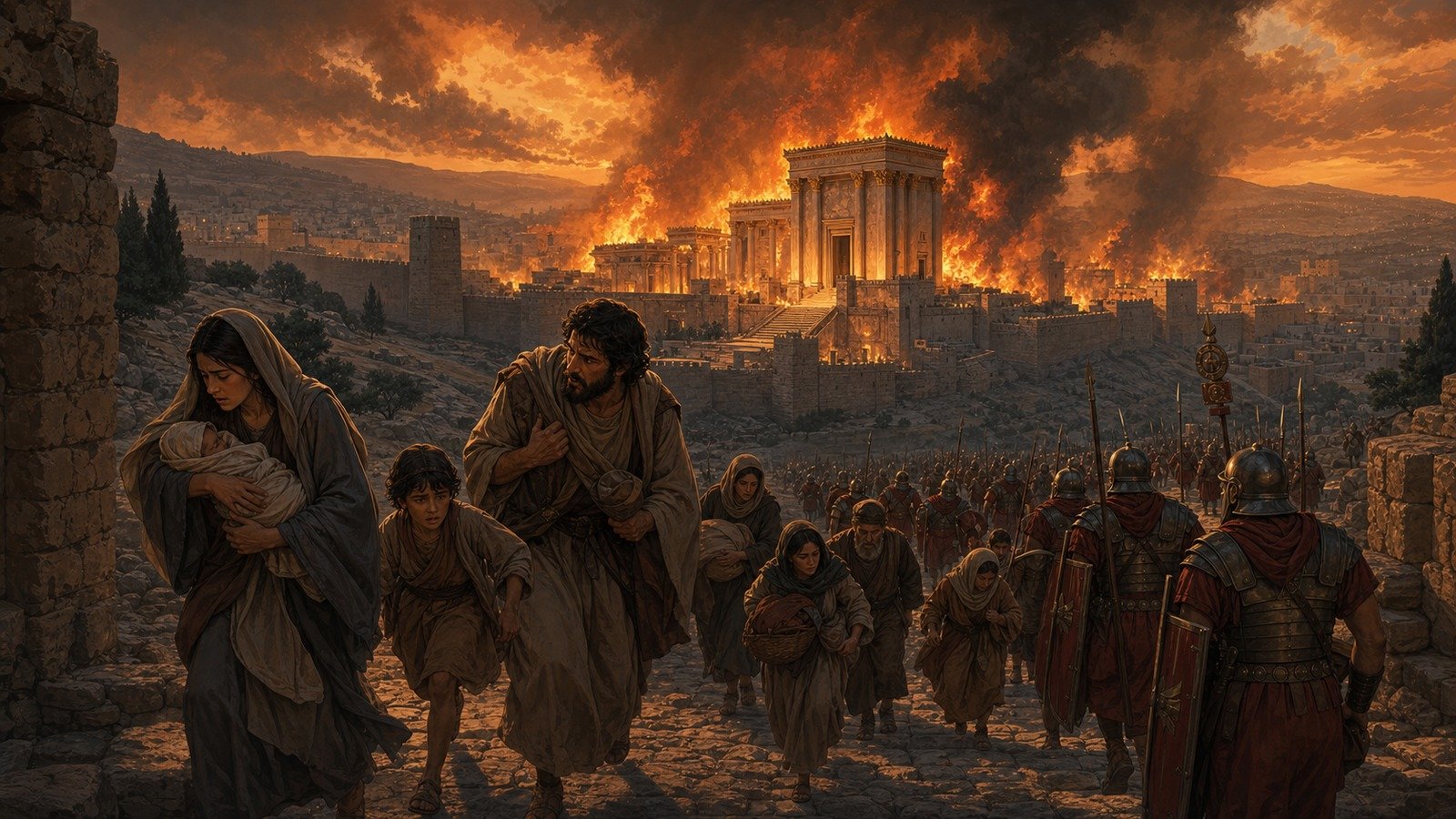
Roman legions under Titus destroy Jerusalem and the Temple after a prolonged Jewish revolt, an event the Gospels present Jesus as having foreseen and that permanently ended the Temple sacrificial system central to first-century Jewish and early Christian life.
No single canonical reference (see Mark 13, Luke 21 for Jesus' predictions of this event)
Further context
2 min readThe revolt began in AD 66, after years of misgovernment under a succession of Roman procurators, a dispute over money taken from the temple treasury, and a massacre at Caesarea. The priests stopped the daily sacrifice offered for the emperor, which was a formal declaration of rebellion, and the Roman garrison in Jerusalem was killed after surrendering.
Rome sent Vespasian with three legions. He worked methodically through Galilee, and in the middle of it the commander of the Jewish forces at Jotapata surrendered and went over: Joseph ben Matityahu, who took the Roman family name and became Josephus, and whose account of the war is the reason so much is known about it.
When Nero died in 68 and the empire fell into civil war, Vespasian left for Rome to become emperor and handed the siege to his son Titus.
Titus surrounded Jerusalem in the spring of AD 70, at Passover, with the city full of pilgrims. He built a wall of circumvallation right round it, which Josephus says took three days, and after that nobody got out.
Inside, three rival Jewish factions had been fighting each other, and one of them had burned the grain stores. The famine that followed is described by Josephus in terms that are difficult to read.
The walls were taken in stages, the Antonia fortress fell, and in August the temple burned. Josephus says Titus had wanted the building preserved and that a soldier threw a firebrand through a window against orders; other ancient writers say the destruction was deliberate. The gold in the structure melted and ran into the joints between the stones, which is one of the explanations offered for why the platform was afterwards levered apart block by block.
The city was destroyed, its population killed, enslaved or dispersed, and the sacrificial system ended permanently. It has never resumed.
The Arch of Titus still stands in Rome, and its relief shows soldiers carrying off the seven-branched lampstand and the trumpets from the sanctuary.
What survived was the retaining wall of Herod's platform, part of which is the Western Wall.
Two things grew out of the ruins. Judaism reorganised itself around the law, the synagogue and the household, which is why the Pharisaic tradition survived and the priestly one did not. And Christians, by then a largely Gentile movement, read the event through what Jesus had said about not one stone being left on another.
Josephus gives the number killed as over a million and the captives as ninety-seven thousand. Both figures are certainly too high; the city could not have held that many. Modern estimates of the dead run to a few tens of thousands, which is bad enough.
The menorah taken from the sanctuary and carried in the triumph disappears from the record after the sack of Rome in the fifth century.
Josephus dates the burning of the temple to the ninth or tenth of the Hebrew month Ab, the same date on which the first temple had fallen to Babylon, and that day is still kept as a fast.