

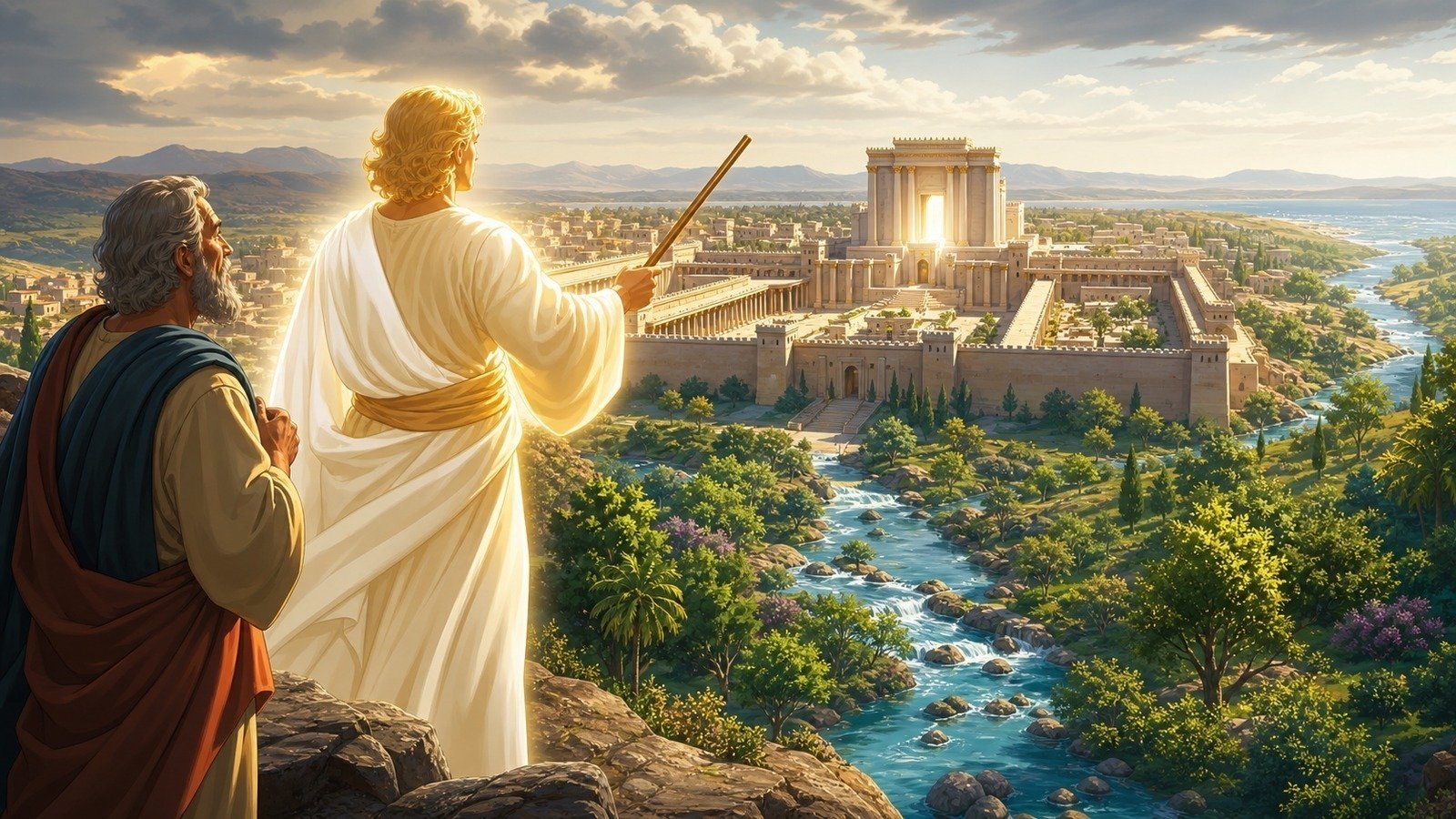
In extensive detail, Ezekiel is shown the measurements of a future temple, the return of God's glory to dwell in it, and a river flowing from it that brings life wherever it goes, closing the book on a note of restored worship and divine presence.
Further context
3 min readTwenty-five years into the exile, on the tenth day of the month at the beginning of the year, fourteen years after the city fell, he is taken in vision to a very high mountain in the land of Israel and shown a building.
What follows is nine chapters of measurements. A man whose appearance was like bronze stands at the gate with a linen cord and a measuring rod, and works through the whole complex: the east gate, the outer court, the thirty rooms, the inner court, the north and south gates, the temple itself, the side rooms, the walls, the altar with its ledges and steps. Every dimension is given.
Then the regulations. Who may enter and by which gate, what the priests wear and where they change, what the prince may and may not do, the festival calendar, the offerings, and a boundary description dividing the land between the tribes with a sacred district in the middle.
What all of this is has been argued over for two thousand years. It has been read as a literal building to be constructed at some future point, as a symbolic picture of a restored people, as a description fulfilled in the church, as a vision of the age to come, and as an ideal blueprint deliberately never built. What is beyond dispute is that the second temple, put up seventy years later, did not follow this plan, and nobody at the time appears to have thought it should.
Two features are more interesting than the measurements.
The first is what happens at the east gate. The glory of God had left the old temple in stages by that route, and here it comes back the same way, from the east, with a sound like the roar of rushing waters, and fills the building. That is the resolution of the earlier vision, and it is the reason the whole section exists.
The second is the river. Water trickles out from under the threshold of the temple, flowing east, and the man with the measuring line takes him out and measures a thousand cubits and leads him through water ankle-deep, another thousand and it is knee-deep, another thousand and it is up to the waist, and a fourth thousand and it is a river that cannot be crossed, deep enough to swim in. It flows down into the Dead Sea and the water there becomes fresh, and swarms of living creatures live wherever it flows, and fishermen stand along the shore from En Gedi to En Eglaim spreading their nets. On both banks fruit trees grow, their leaves never wither, they bear fruit every month, and their leaves are for healing.
The Dead Sea is the deadest body of water on earth, and this is a river running into it and filling it with fish. That image is picked up at the very end of the New Testament, where a river flows from a throne with trees along it whose leaves are for the healing of the nations.
The last words of the book are the new name of the city: the LORD is there.
The final nine chapters are a guided survey with a man whose appearance is like bronze, holding a linen cord and a measuring rod, and almost every wall, gate, chamber and threshold is measured.
Nothing in the design has ever been built. The dimensions do not match Solomon's temple, they do not match the one the returning exiles constructed, and they do not match Herod's. The land allocation that follows divides the country in horizontal strips that ignore the geography completely.
That has produced three readings that have persisted for centuries: a blueprint for a temple still to be built, a symbolic picture of restored worship, and a vision of God's presence that uses architecture because architecture was the vocabulary available.
The moment the survey is building towards is the return of the glory that had been described leaving the old temple by the east gate. It comes back the same way, and the gate is then sealed permanently because it has been used.