

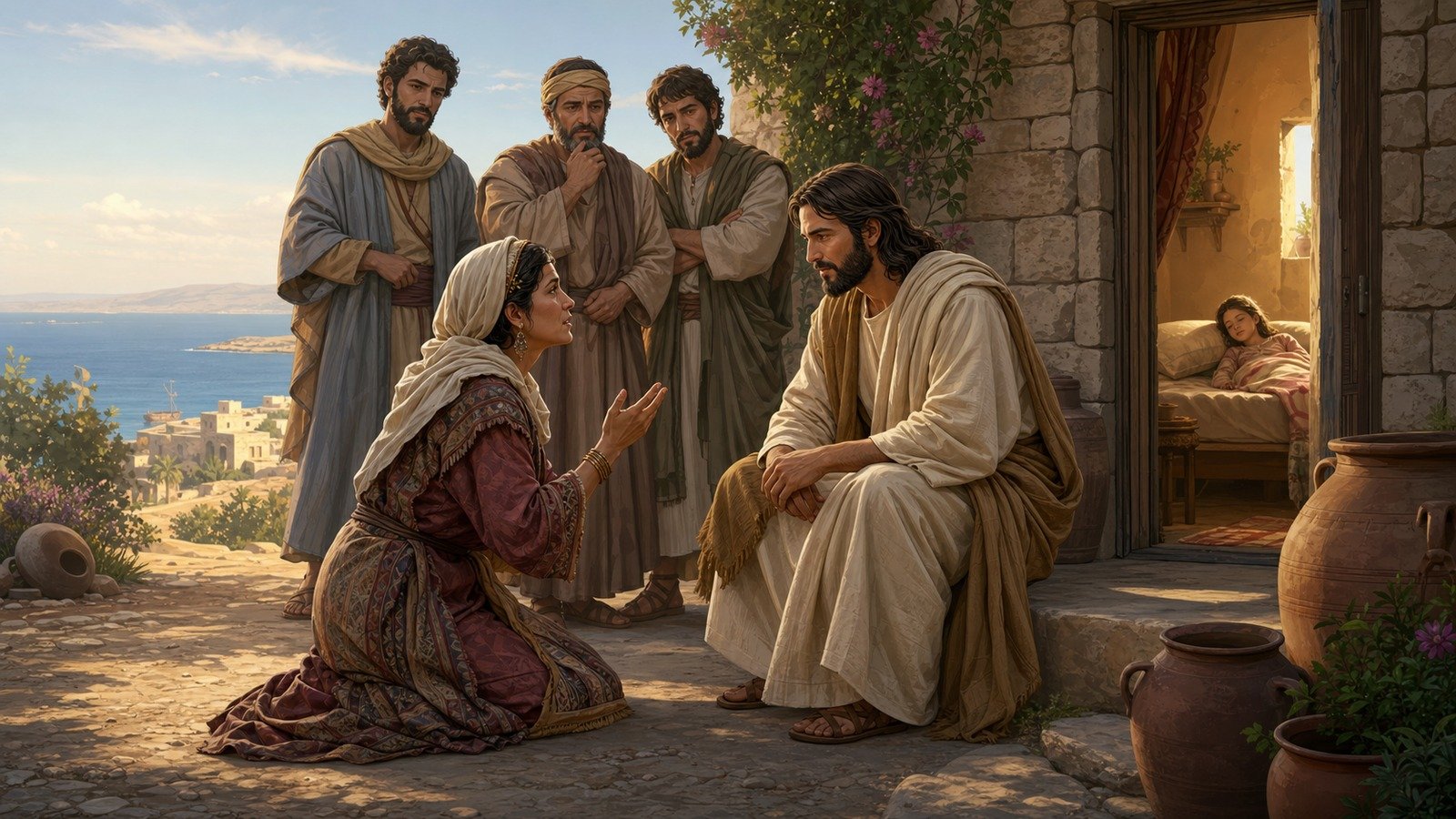
A Gentile woman from the region of Tyre and Sidon persistently pleads for her demon-possessed daughter's healing despite an initial, testing rebuff from Jesus; her persistence and faith are commended, and her daughter is healed from a distance.
Further context
2 min readJesus leaves Jewish territory altogether and goes north into the region of Tyre and Sidon, Phoenician port cities on the Mediterranean coast in what is now Lebanon. He enters a house and wants no one to know it, and cannot keep his presence secret.
A local woman finds him. Mark calls her a Greek, born in Syrian Phoenicia, meaning a Gentile by religion and a Phoenician by descent; Matthew uses the older word Canaanite, which reaches back to Israel's ancient enemies and carries all of that history.
Her daughter is possessed and she begs for help, addressing him as Lord, Son of David, which is a Jewish messianic title in the mouth of a pagan woman.
What follows is the most uncomfortable exchange in the Gospels. He answers her not a word. The disciples ask him to send her away because she keeps crying out after them. Then: I was sent only to the lost sheep of Israel. She kneels and says, Lord, help me. And then: it is not right to take the children's bread and toss it to the dogs.
Calling Gentiles dogs was standard abuse in Jewish speech of the period, and there is no way to make the sentence pleasant. The word used is the diminutive, the household animal rather than the scavenger in the street, which softens it slightly and does not remove the insult.
Her reply takes the picture he has offered and works inside it. Yes, Lord, but even the dogs under the table eat the children's crumbs. She does not dispute the priority of Israel; she points out that a household feeding its children does not thereby starve everything else in the room.
The response is unreserved. Woman, you have great faith. Your request is granted. Matthew records only one other person receiving that assessment, a Roman officer, and both are Gentiles.
She goes home and finds the child lying on the bed, and the demon gone. The healing happens at a distance, without a word spoken over the girl.
Why the exchange took this shape has been debated for as long as there has been Christian writing. The most common reading is that the refusals were pressure applied deliberately to draw out what she actually believed, in front of disciples who needed to see it. Whether that is right, the outcome stands: the argument is conceded to her, in her own terms.
Tyre was a Phoenician port built partly on an island, wealthy from purple dye and shipping, and it had a long and hostile history with Israel: Jezebel came from that coast, and the prophets denounced the city repeatedly. Galilee supplied it with grain, and the economic relationship was unequal enough to leave resentment on the Jewish side. Children's bread going to dogs would have sounded, in that region, like a complaint anyone might make.
This is also the furthest north he is recorded travelling, roughly fifty kilometres from Capernaum and well outside any Jewish jurisdiction, in a district where nobody was looking for him and where a man who wanted to be left alone for a while could be.