

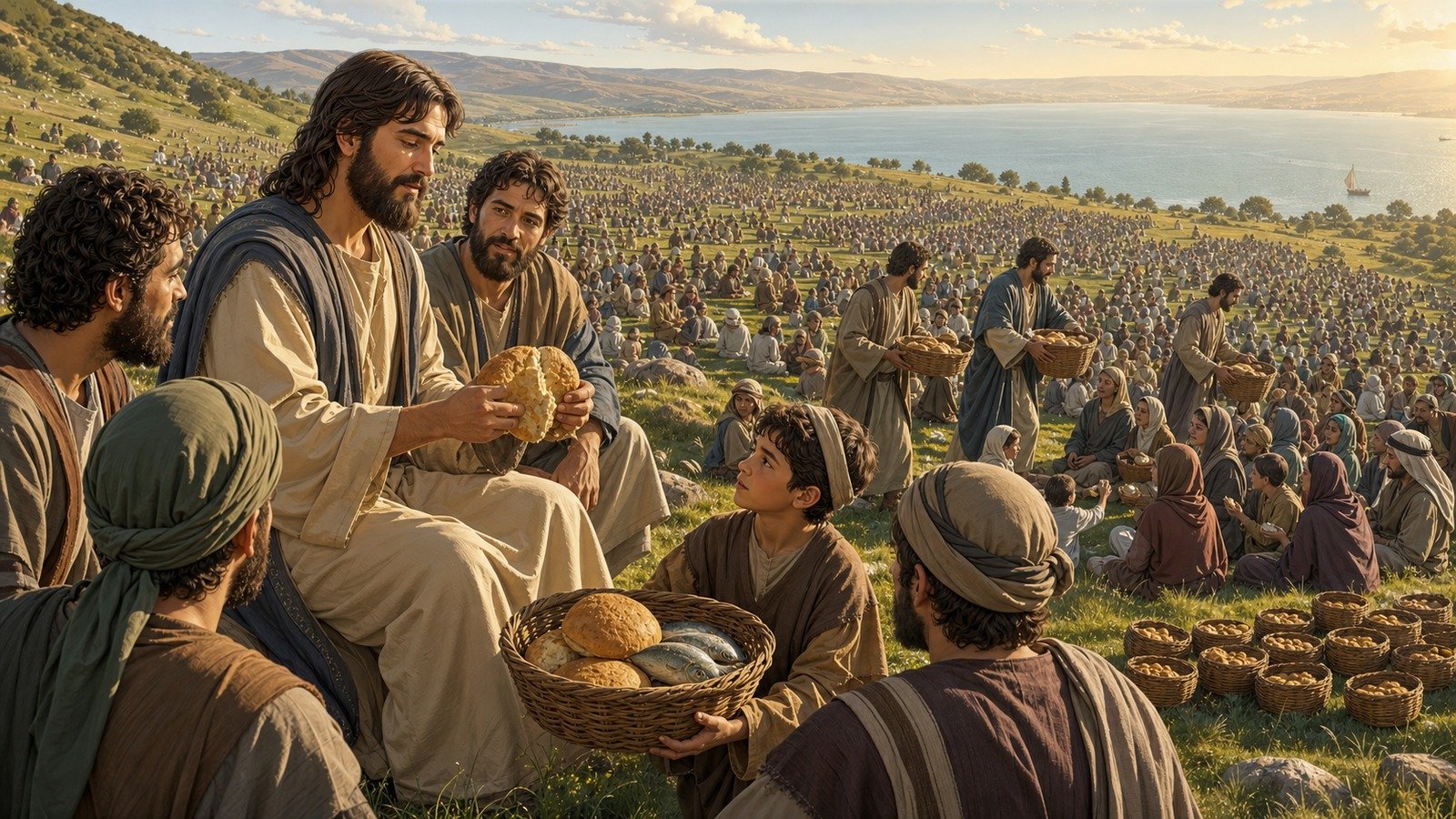
With a crowd of thousands following him into a remote area, Jesus multiplies five loaves and two fish to feed everyone, with twelve baskets left over, the only miracle recorded in all four Gospels.
Further context
3 min readThis is the only miracle in all four Gospels, and the setting explains why it nearly ends in a riot.
Jesus withdraws by boat to a solitary place after hearing about John's death, and the crowds follow on foot around the shore and get there first. He has compassion on them because they are like sheep without a shepherd, and teaches them, and by late afternoon there is a logistical problem.
The disciples propose sending everyone away to buy food. The reply, you give them something to eat, produces an itemised objection: it would take more than half a year's wages to buy enough bread for each one to have a bite. Philip has done the arithmetic and it does not work.
What is available is five small barley loaves and two fish, which John says came from a boy. Barley was the cheap grain, eaten by the poor, and the loaves would have been small flat rounds. Two fish means two small salted fish, the standard accompaniment.
The crowd is made to sit in groups of hundreds and fifties on the green grass, which is a detail marking spring and matching the note that Passover was near. Five thousand men are counted, besides women and children, so the actual number is larger.
He takes the loaves, looks up to heaven, gives thanks, breaks them and gives them to the disciples to distribute. Nothing is described happening. There is no gesture and no announcement; the bread simply keeps coming as it is handed out.
Everyone eats and is satisfied, and twelve basketfuls of broken pieces are collected. The instruction to gather the leftovers so that nothing is wasted is the detail nobody expects.
The reaction is political and immediate. The crowd concludes that this is the Prophet who is to come into the world, and intends to come and make him king by force. He withdraws again to a mountain by himself.
That reaction is not irrational. A leader in the wilderness who produces bread for a multitude is repeating what happened under Moses, and the expectation that a deliverer would do it again was current. What they want is a supply and a throne, and he leaves.
The setting is usually placed near Bethsaida on the north-eastern shore, where the ground rises from the lake in grassy slopes and could hold a crowd of that size within sight of the water.
Some readers have preferred to explain the event as a wave of sharing, with people producing food they had brought and concealed. That reading has been offered since the nineteenth century and it has one difficulty: the crowd's reaction. A group that has just discovered generosity in itself does not attempt to seize a man and make him king by force. Whatever they thought they had witnessed, they took it to be his doing rather than their own.
The twelve basketfuls are also a practical detail. Twelve disciples had objected to the arithmetic, and each of them ends the evening carrying more food than the whole crowd started with.
Passover being near dates the event to the spring, roughly a year before the final one, and the green grass fits that season in a country where the hills are brown for most of the year. It is one of the few places where two independent details in different accounts agree on the time of year without either of them making a point of it.