

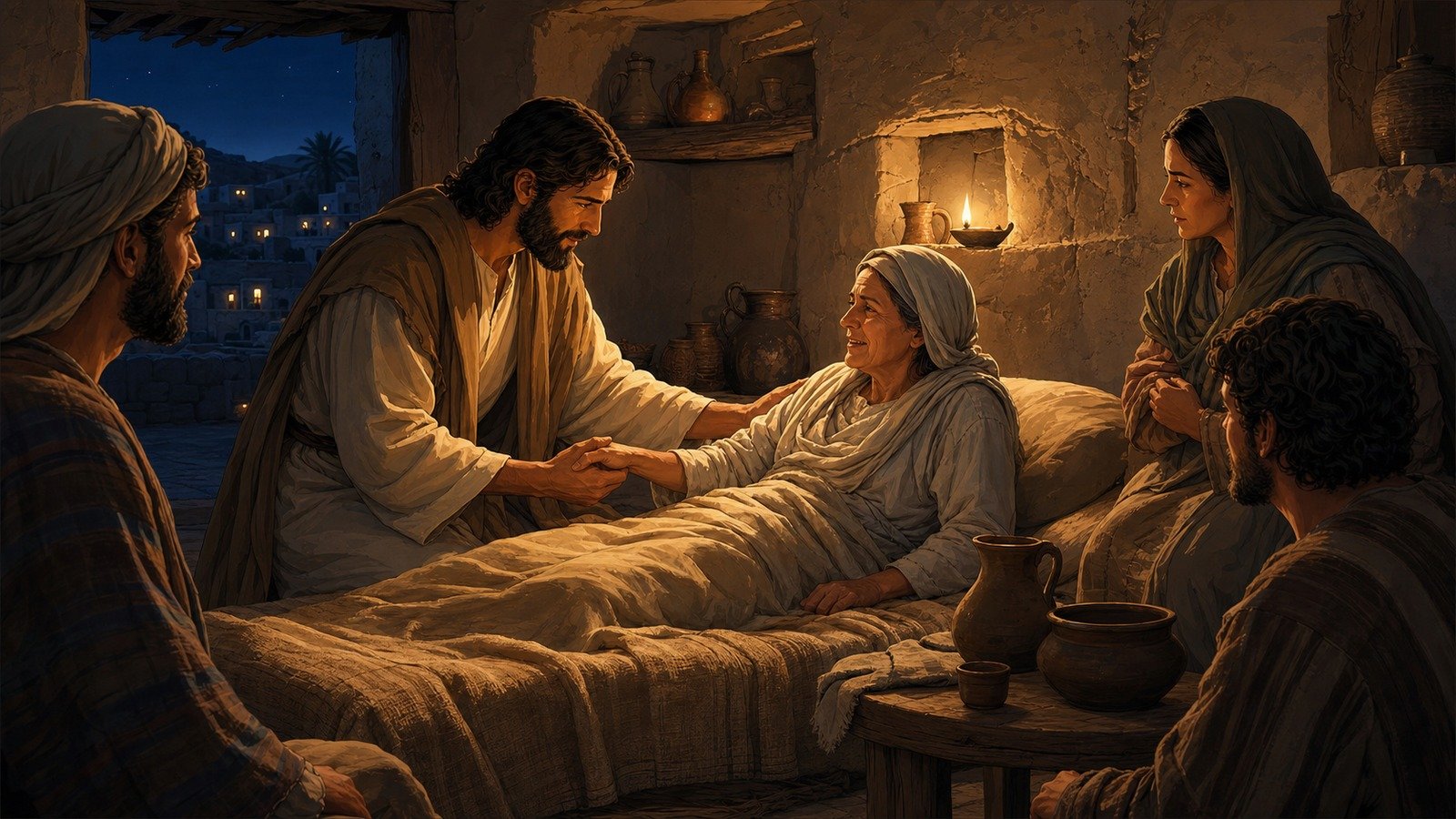
Jesus heals Peter's fevered mother-in-law at his own home; that evening, once the Sabbath ends, the whole town brings its sick and demon-possessed to the door, and Jesus heals many of them.
Further context
3 min readJesus leaves the synagogue and goes straight to the house of Simon and Andrew, with James and John, which is the ordinary pattern of a Sabbath: worship in the morning and then a meal.
Simon's mother-in-law is in bed with a fever, and they tell him about her at once. The mention of her existence establishes something people often overlook, which is that Peter was married; his wife travels with him decades later, according to a remark of Paul's.
Fever in that world was not a symptom but a diagnosis, and it was serious. Luke, whose vocabulary is more medical throughout, calls it a high fever, using a technical distinction found in ancient medical writers between high and low fevers.
The treatment takes one sentence and the details differ slightly between the accounts, which is the sort of variation you get from people describing the same small event. He goes to her, takes her hand and helps her up, and Luke has him bend over her and rebuke the fever, using the same verb used of the spirit in the synagogue.
The fever leaves her, and she begins to wait on them.
That last clause has been read in two ways, and both are probably right. It is evidence of the completeness of the recovery, since a fever normally leaves someone weak for days. And the verb is the one from which the word deacon comes, used in the Gospels of what angels did for Jesus in the wilderness and of what he says he came to do himself. The first person in Mark's Gospel described serving in that sense is a woman who has just got out of bed.
That evening, after sunset, when the Sabbath restrictions on carrying and travelling have ended, the whole town gathers at the door and they bring everyone who is ill or demon-possessed. He heals many with various diseases and drives out many demons, and does not let the demons speak because they know who he is.
Simon's house has a candidate. Beneath a Byzantine octagonal church at Capernaum, excavators found a first-century dwelling whose main room had been plastered and set apart from domestic use in the first century, with graffiti scratched on the walls in several languages including invocations of Jesus. Whether it was Peter's house cannot be proved, but a room in a fishing village singled out for veneration within a generation or two is unusual.
Very early the next morning, while it is still dark, he gets up, leaves the house and goes off to a solitary place to pray, and Simon and his companions go looking for him. When they find him they tell him everyone is looking for him, and his answer is not to go back: let us go somewhere else, to the nearby villages, so that I can preach there also. That is why I have come.
Peter having a mother-in-law establishes that he was married, which Paul confirms decades later when he asks whether he does not have the right to take a believing wife along with him, as the other apostles and Cephas do.
The house has been identified with reasonable confidence. Beneath an octagonal Byzantine church at Capernaum lies a first-century house of basalt whose central room was plastered and turned into a place of gathering in the first century, with graffiti on the walls invoking Jesus and mentioning Peter.
The healing is domestic in scale. He goes to her, takes her hand and helps her up, the fever leaves her, and she begins to wait on them.
Then, after sunset, when the Sabbath had ended and carrying was permitted again, the whole town gathers at the door and the sick are brought.
The next morning the disciples find him gone and their reaction is a complaint: everyone is looking for you!