
At Iconium, Paul and Barnabas see both a large number of converts and a hostile plot against them, forcing them to flee to the Lycaonian cities of Lystra and Derbe.
Further context
2 min readDriven out of Pisidian Antioch, Paul and Barnabas shake the dust off their feet and go on to Iconium, about a hundred and forty kilometres east along the road.
Iconium was an old Phrygian town on a well-watered plain surrounded by dry country, prosperous from agriculture, and it survives as Konya, one of the larger cities of modern Turkey. It had been given colonial status by the Romans and had a mixed population of Phrygians, Greeks, Jews and Roman settlers.
They go as usual into the Jewish synagogue and speak so effectively that a great number of Jews and Greeks believe.
Then the pattern that repeats in almost every city on this journey: the Jews who refused to believe stirred up the other Gentiles and poisoned their minds against the brothers.
The phrase used for what they did to their minds is an unusual one meaning to injure or embitter, and what it describes is a whispering campaign rather than a formal charge.
What follows is the interesting part. So Paul and Barnabas spent considerable time there, speaking boldly for the Lord, who confirmed the message of his grace by enabling them to perform signs and wonders.
They stay. Faced with organised hostility, they extend the visit rather than shortening it, and the result is a city split down the middle: the people of the city were divided; some sided with the Jews, others with the apostles.
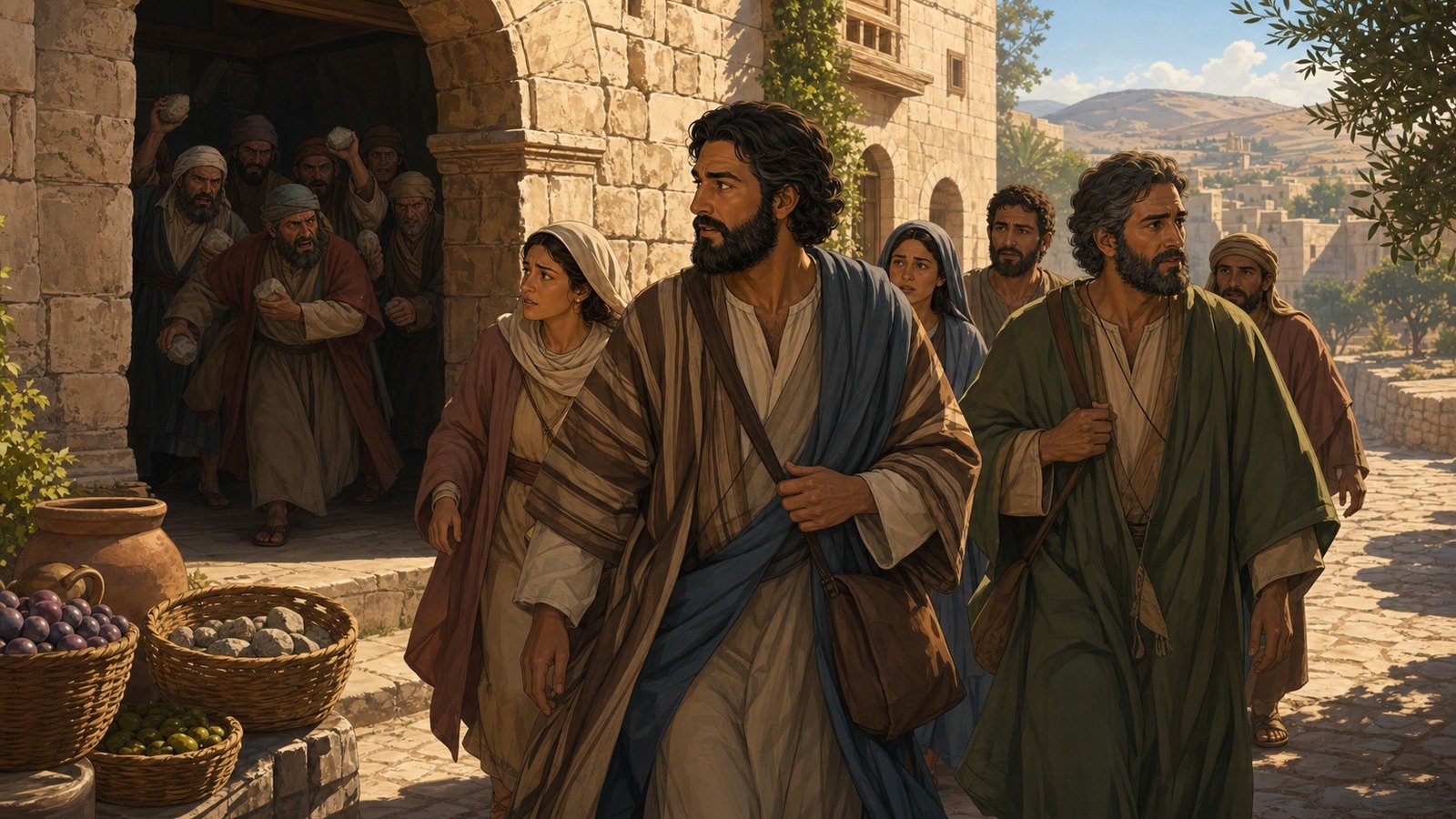
The break comes when a plot forms among both Gentiles and Jews, together with their leaders, to ill-treat them and stone them. Stoning is a Jewish penalty rather than a Roman one, which indicates who was driving it, and the involvement of city officials means the two men had lost whatever protection they had.
They find out about it and flee to the Lycaonian cities of Lystra and Derbe and to the surrounding country, where they continue to preach.
That geographical note is more precise than it looks. Iconium was Phrygian in culture and Lystra was Lycaonian, a different language area, and a first-century writer would have had to know the region to get the boundary right. It was long treated as an error until inscriptions confirmed the distinction, and it is one of the standard exhibits in arguments about the reliability of the account.
Iconium is also where the later apocryphal story of Paul and Thecla is set, a widely read second-century romance that is not history.
Speaking boldly is a repeated note through this whole section, and the Greek word behind it is the one from civic life meaning the right of a citizen to speak freely in the assembly.
Iconium is one of the four churches addressed in the letter to the Galatians, if the southern reading of that letter's destination is correct, which is the majority view. If so, the congregation formed in a divided city survived long enough to receive the most combative letter Paul ever wrote.
Signs and wonders are attributed to the two of them in the same sentence as their boldness, and the word for the confirmation describes a legal guarantee. The claim is that the message was underwritten by something the audience could see.