

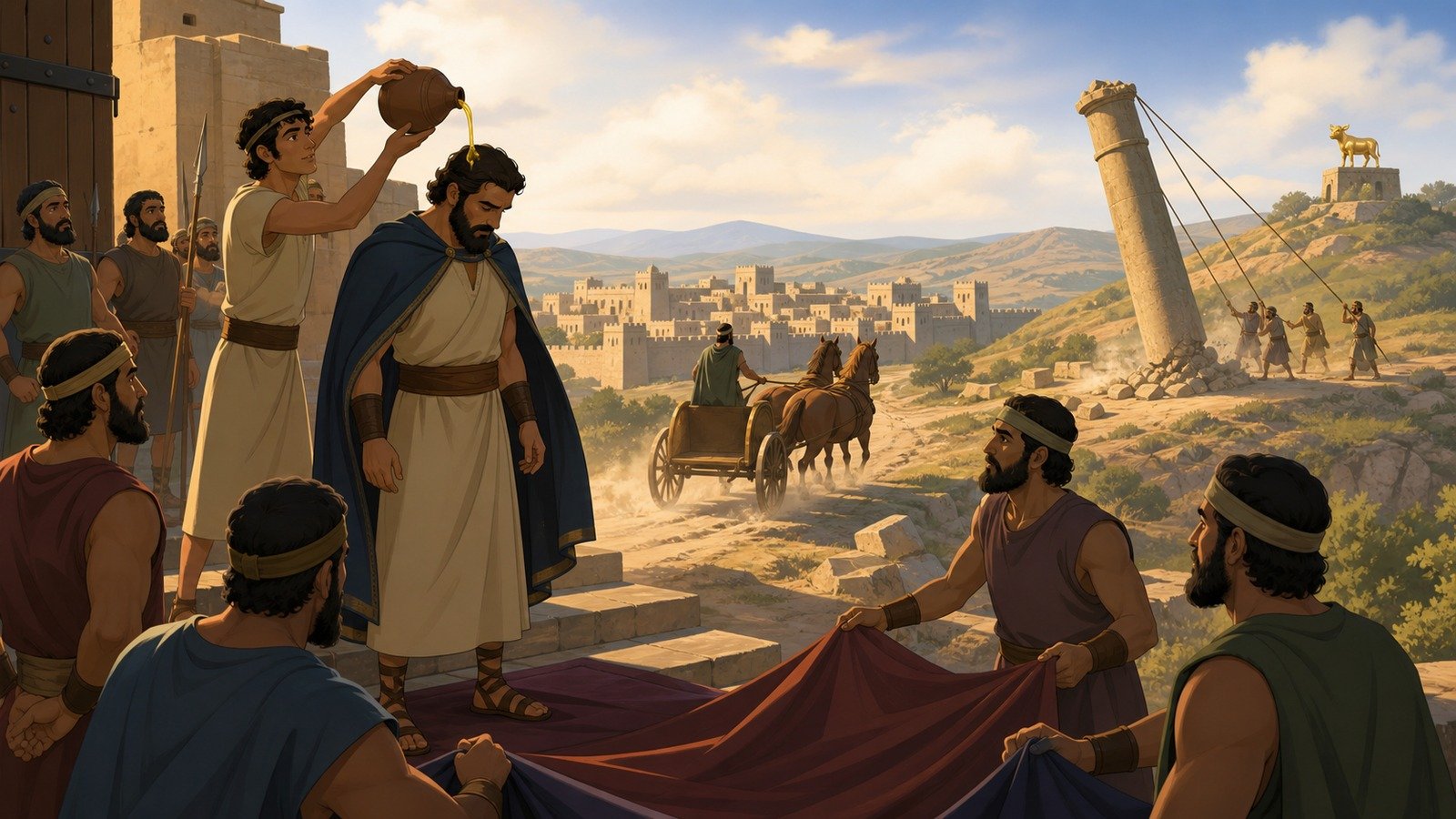
Anointed by a prophet sent by Elisha, Jehu kills Joram, Jezebel and the entire house of Ahab, along with Judah's visiting King Ahaziah, then destroys Baal worship in Israel, though he leaves Jeroboam's golden calves in place.
Further context
3 min readA young prophet is sent to Ramoth Gilead with a flask of oil and instructions to find Jehu son of Jehoshaphat, get him away from his fellow officers, anoint him king over Israel and then open the door and run.
He does exactly that, and adds a commission: you are to destroy the house of Ahab your master, and I will avenge the blood of my servants the prophets. When Jehu comes back out, the other officers ask what that madman wanted, and when he tells them they spread their cloaks under him on the bare steps, blow the trumpet and shout, Jehu is king.
What follows is executed at speed and with total ruthlessness. He orders the gates shut so no one can carry word, and drives to Jezreel. The watchman on the tower reports an approaching company, two riders are sent out and neither returns, and the watchman identifies the driving: he drives like a maniac.
He kills Joram of Israel with an arrow and has the body thrown into Naboth's field, quoting the judgement pronounced on Ahab over that vineyard. He kills Ahaziah of Judah. He arrives at the palace, and Jezebel paints her eyes, arranges her hair and looks out of an upper window, and greets him with a taunt comparing him to Zimri, the chariot commander who lasted seven days. He calls up to the window asking who is on his side, two or three eunuchs look down, and he tells them to throw her down, and they do.
He then writes to the guardians of Ahab's seventy sons in Samaria daring them to choose one and fight, and they capitulate, and the heads arrive in baskets and are piled in two heaps at the city gate. He kills the remaining relatives, the close friends and the priests, and then destroys the Baal cult by a deception: he announces a great festival for Baal, fills the temple with worshippers, checks that no servants of the LORD are among them, and posts eighty men outside with orders to let nobody escape.
The verdict on him is split down the middle. He is commended for destroying the house of Ahab and promised four generations on the throne. He is also condemned by a later prophet for the massacre at Jezreel, and assessed as not turning away from the sins of Jeroboam, since the golden calves at Bethel and Dan stayed.
In 841 BC he appears on the Black Obelisk of Shalmaneser III, bowing face down before the Assyrian king with tribute, labelled Jehu son of Omri. It is the only near-contemporary image of an Israelite ruler that survives, and it shows him prostrate.
Jehu is anointed by a young prophet sent by Elisha, who pours oil on his head in an inner room, delivers the message and runs.
What follows is the most violent sequence in the histories. Joram of Israel is shot in the back, Ahaziah of Judah is hunted down, Jezebel is thrown from a window and trampled by horses, seventy sons of Ahab are beheaded in Jezreel and their heads piled in two heaps at the city gate, forty-two relatives of Ahaziah are killed at a well, and the worshippers of Baal are gathered into their temple on the pretence of a great festival and massacred.
A century later the prophet Hosea names Jezreel as something God will punish the house of Jehu for, which sets one part of Scripture against another and has occupied readers ever since.
The Black Obelisk panel showing him prostrate before Shalmaneser is in the British Museum.