

Jesus returns to Galilee following John's arrest and reads from Isaiah in the Nazareth synagogue, declaring the prophecy fulfilled in himself; the initial admiration turns to fury when he suggests God's favour has historically extended beyond Israel, and the crowd attempts to throw him off a cliff.
Further context
3 min readNews about Jesus spreads through the whole countryside, and he teaches in the synagogues and everyone praises him. Then he comes to Nazareth, where he had been brought up, and goes into the synagogue on the Sabbath as was his custom, and stands up to read.
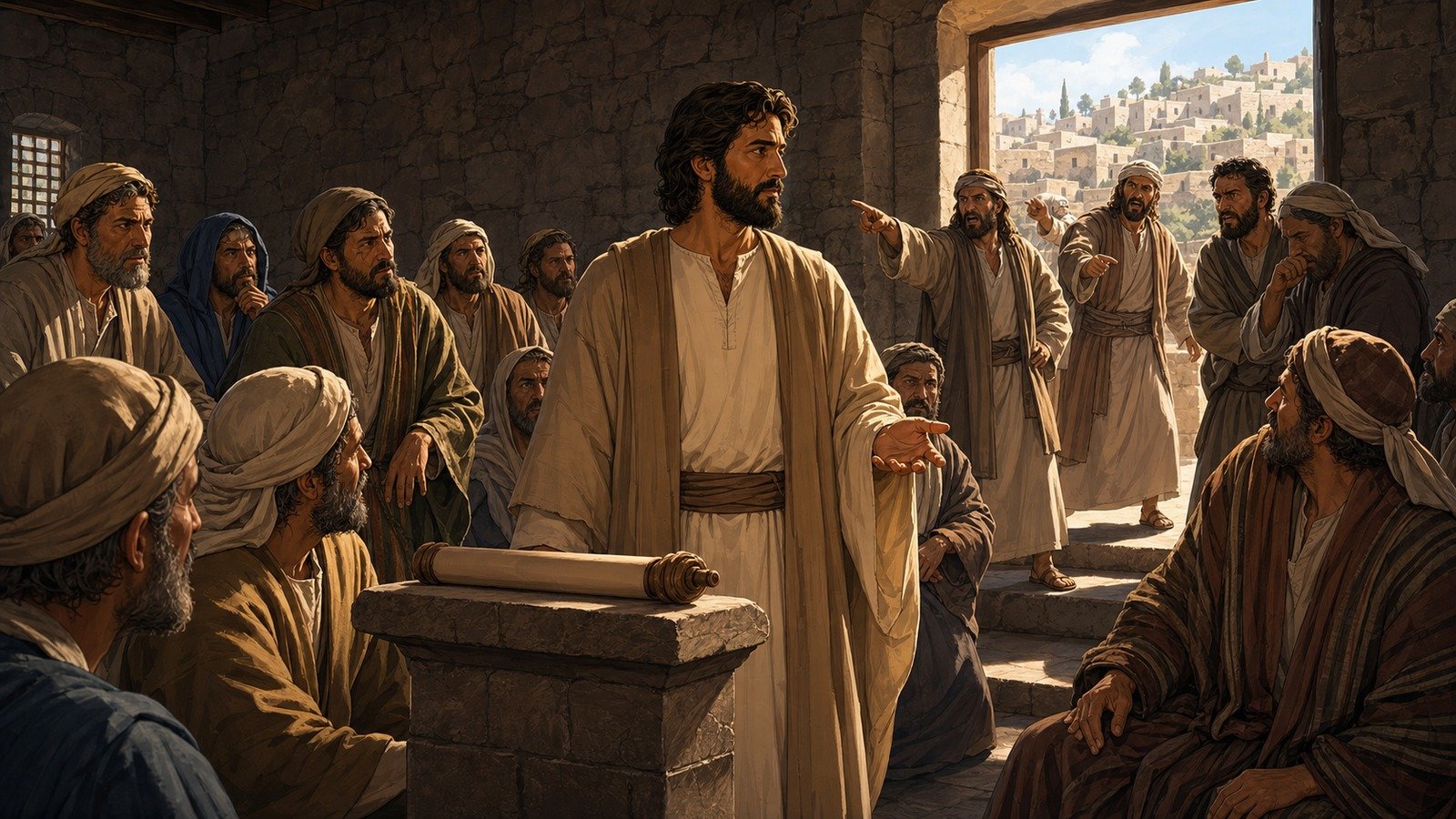
The order of service in a first-century synagogue involved a reading from the law, a reading from the prophets and then a comment, and any competent adult male could be invited to do it. He is handed the scroll of Isaiah, finds a place and reads: the Spirit of the Lord is on me, because he has anointed me to proclaim good news to the poor. He has sent me to proclaim freedom for the prisoners and recovery of sight for the blind, to set the oppressed free, to proclaim the year of the Lord's favour.
He stops mid-sentence. The original continues with the day of vengeance of our God, and he leaves it off, rolls up the scroll, hands it back and sits down, which is the posture a teacher took to speak. Every eye is fastened on him.
The sermon is one sentence: today this scripture is fulfilled in your hearing.
The initial reaction is favourable, and the question underneath it is the problem: is not this Joseph's son? A local boy is being admired, and admiration on those terms is what he refuses.
What he says next is calculated to provoke and it works. He quotes a proverb about a prophet not being accepted in his home town, and then produces two examples from their own scriptures, both of them about foreigners. There were many widows in Israel in Elijah's time, during a three-and-a-half-year famine, and he was sent to none of them but to a widow in Sidon. And there were many with leprosy in Elisha's time, and none of them was cleansed, only Naaman the Syrian.
Both examples are accurate and both are about God bypassing Israel to help a Gentile.
The congregation is furious. They drive him out of town and take him to the brow of the hill on which it was built, in order to throw him off the cliff, and he walks through the crowd and goes on his way.
Reading in a synagogue involved standing to read and sitting to teach, and the scroll was handed over by an attendant and handed back. What the congregation watched, in a room where everyone had known him since he was a child, was a local man take the scroll, find a place, read six lines, stop early, sit down and say that it had just happened.
The year of the Lord's favour he had just read about is the jubilee, when debts were cancelled, slaves freed and land returned. Announcing that, in a village of tenant farmers, was not an abstraction.
The scene in the Nazareth synagogue is the most detailed description of a first-century synagogue service anywhere. He stands up to read, the scroll of Isaiah is handed to him, he unrolls it and finds the place, reads, rolls it up, gives it back to the attendant and sits down, and the eyes of everyone are fastened on him.
Standing to read and sitting to teach is the recorded practice, and the attendant handling the scrolls is a known office.
The reading is about good news to the poor, freedom for prisoners, sight for the blind and release for the oppressed, and he stops mid-sentence, leaving out the line about the day of vengeance.
The turn comes when he raises two examples of prophets sent to foreigners rather than to Israel: Elijah to a Phoenician widow and Elisha to a Syrian general.
At that point the congregation drives him out of town to the brow of the hill to throw him off it.