

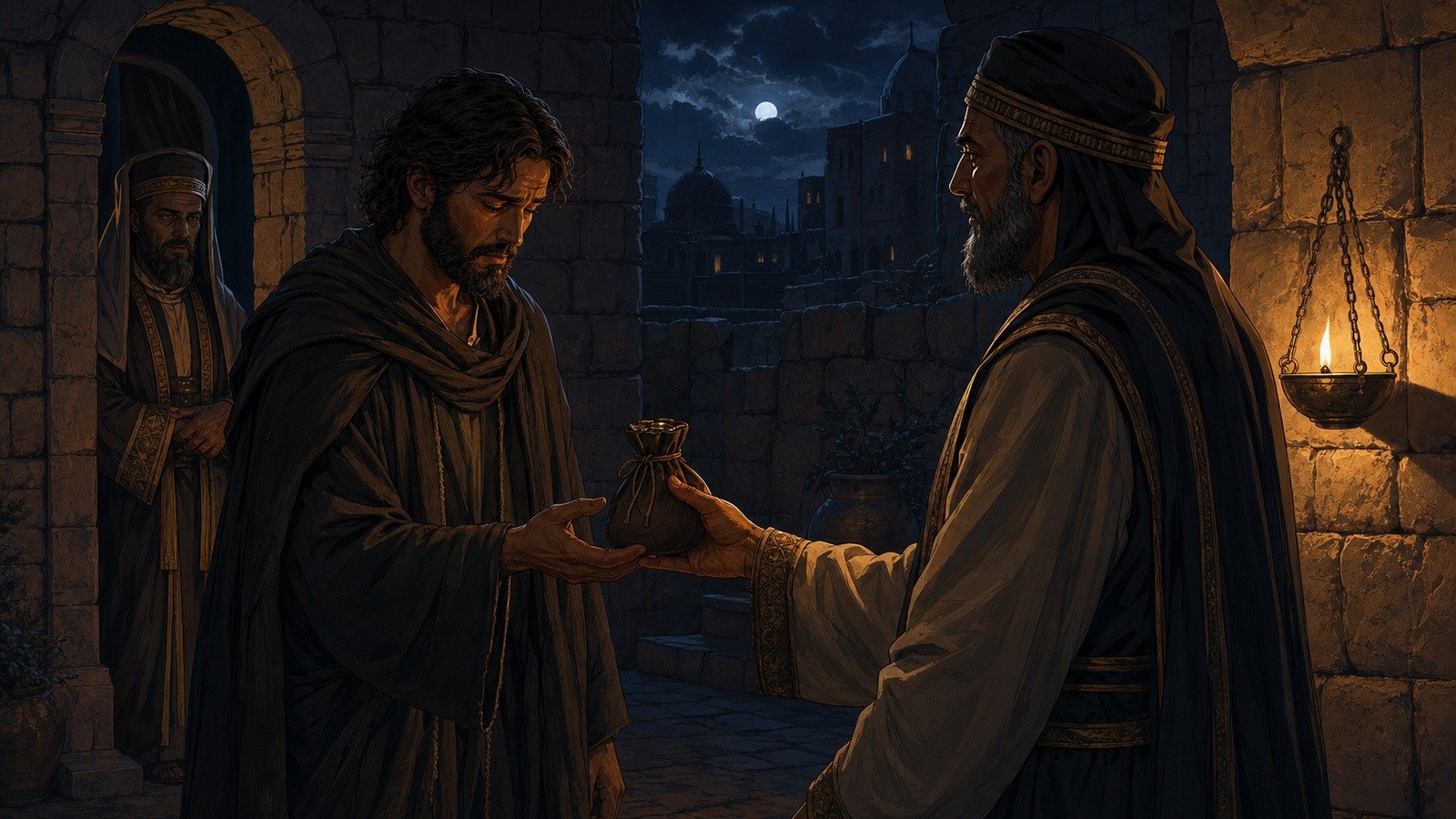
Judas Iscariot, one of the Twelve, approaches the chief priests separately and agrees to betray Jesus for thirty pieces of silver, then watches for an opportunity to hand him over away from the crowds.
Further context
2 min readJudas Iscariot is one of the Twelve, and the fact is stated every time he is named, as though it never stopped being remarkable.
His second name most probably means the man from Kerioth, a town in southern Judea, which would make him the only member of the group who was not a Galilean. An alternative derivation connects it to the sicarii, the dagger-men who assassinated collaborators in crowds, though that movement is not clearly attested by that name until later.
He goes to the chief priests on his own initiative and asks what they will give him if he hands Jesus over.
The amount agreed is thirty pieces of silver. That figure is not chosen at random: it is the compensation fixed in the law for a slave gored by an ox, and it appears again in Zechariah as the handsome price at which a shepherd is valued, thrown into the house of the Lord to the potter.
What thirty silver coins were worth depends on which coin is meant, and the likeliest candidate is the Tyrian shekel, the currency the temple required, which was struck at high purity and carried the head of the god Melqart. Thirty of those would be roughly four months' wages for a labourer. Enough to matter, and not a fortune.
Why he did it is the question nobody can answer, and the sources offer several partial explanations without settling on one. He is described as having charge of the money bag and helping himself to what was in it. He is described as objecting to expensive perfume being poured out. Satan is said to have entered him. And in one place Jesus had already said, long before, that one of the Twelve was a devil.
The theory that he was trying to force a confrontation, expecting a display of power rather than an arrest, has been popular for a century and a half and has no support in any first-century source. It survives because it makes the man comprehensible.
From then on he watched for an opportunity to hand him over.
What made him useful was not identification. Jesus had been teaching publicly in the temple courts all week and was recognisable to thousands. What Judas could supply was a location at night, away from the crowds, which is exactly what the priests had been looking for.
Iscariot is attached to his father's name as well as to his own, since Simon Iscariot is named too, which supports the place-name reading over the dagger-men one.
What became of the money is recorded and what became of him is recorded twice, differently. Both versions place him dead within a day of the condemnation, and both connect the money to a field outside the city that acquired a name people still used when the accounts were written.
He is listed last in every naming of the Twelve, always with the same clause attached, and there is no indication in any of them that the others suspected him. When the betrayal is announced at the supper, eleven men ask whether it is them.