

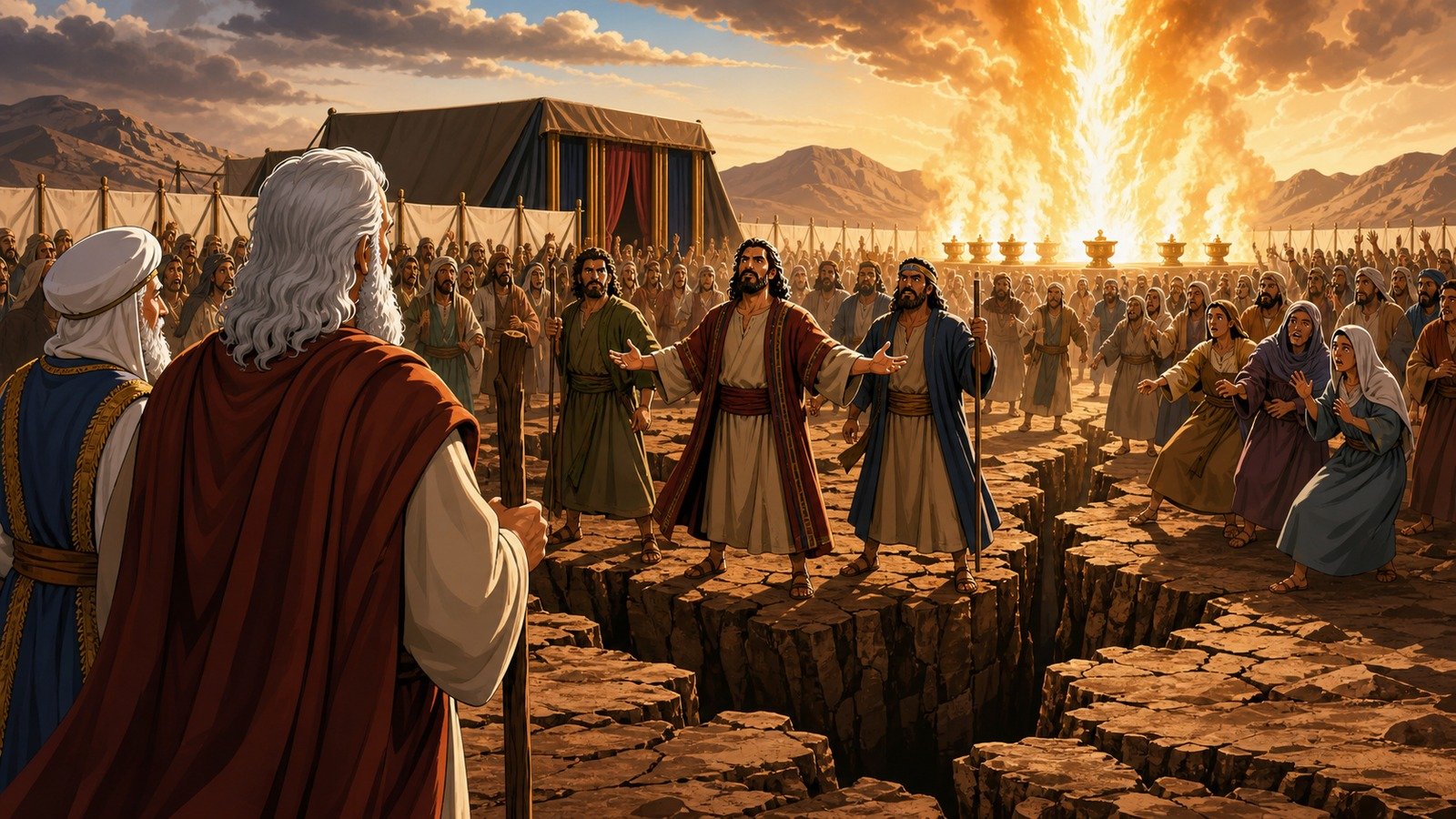
Korah, Dathan and Abiram lead a challenge against Moses' and Aaron's leadership; the ground swallows the ringleaders and fire consumes 250 supporters, a severe judgement on organised rebellion against appointed leadership.
Further context
2 min readTwo grievances converge into one revolt. Korah is a Levite of the Kohathite clan, which carries the most sacred objects of the sanctuary but is not permitted to serve as priests. Dathan and Abiram are Reubenites, descendants of Jacob's firstborn, whose tribe has no leadership role at all. Two hundred and fifty well-known community leaders join them.
The charge they bring is not obviously wrong, and that is what gives the episode its force. You have gone too far. The whole community is holy, every one of them, and the LORD is with them. Why then do you set yourselves above the LORD's assembly? Every clause of that can be quoted from what Israel has already been told, where the nation is called a kingdom of priests and a holy nation. The rebellion is framed in the vocabulary of the covenant.
Moses falls face down, then proposes a test with censers. Korah and his followers are to take censers, put fire and incense in them, and present them, and God will show whom he has chosen. He also puts a question to Korah that identifies what is really being asked for: is it not enough that you have been separated from the rest of the community and brought near to do the work at the sanctuary? Are you trying to get the priesthood too?
Dathan and Abiram refuse to come when summoned, and their answer contains one of the most striking inversions anywhere. Is it not enough that you have brought us up out of a land flowing with milk and honey to kill us in the wilderness? The phrase reserved throughout for the promised land is being applied to Egypt.
The outcome comes in two stages. The ground opens under the households of Dathan and Abiram and closes over them. Fire comes out and consumes the two hundred and fifty men holding censers. The censers themselves, having been presented before the LORD, are hammered into sheets to overlay the altar, so that a permanent reminder is built into the object the community worships at.
The following day the whole community grumbles against Moses and Aaron, saying they have killed the LORD's people, and a plague breaks out. Aaron takes a censer, runs into the middle of the assembly and stands between the living and the dead until it stops. The high priest whose office was being contested holds the line with the instrument the rebels were using, and the death toll is given as 14,700.
One detail recorded much later is easy to miss. The line of Korah did not die out. His descendants become temple musicians, and eleven psalms carry their name in the heading, including one that opens by saying how lovely is your dwelling place, and another that says a day in your courts is better than a thousand elsewhere. The family of the man who died contesting access to the sanctuary spent centuries singing in it.