

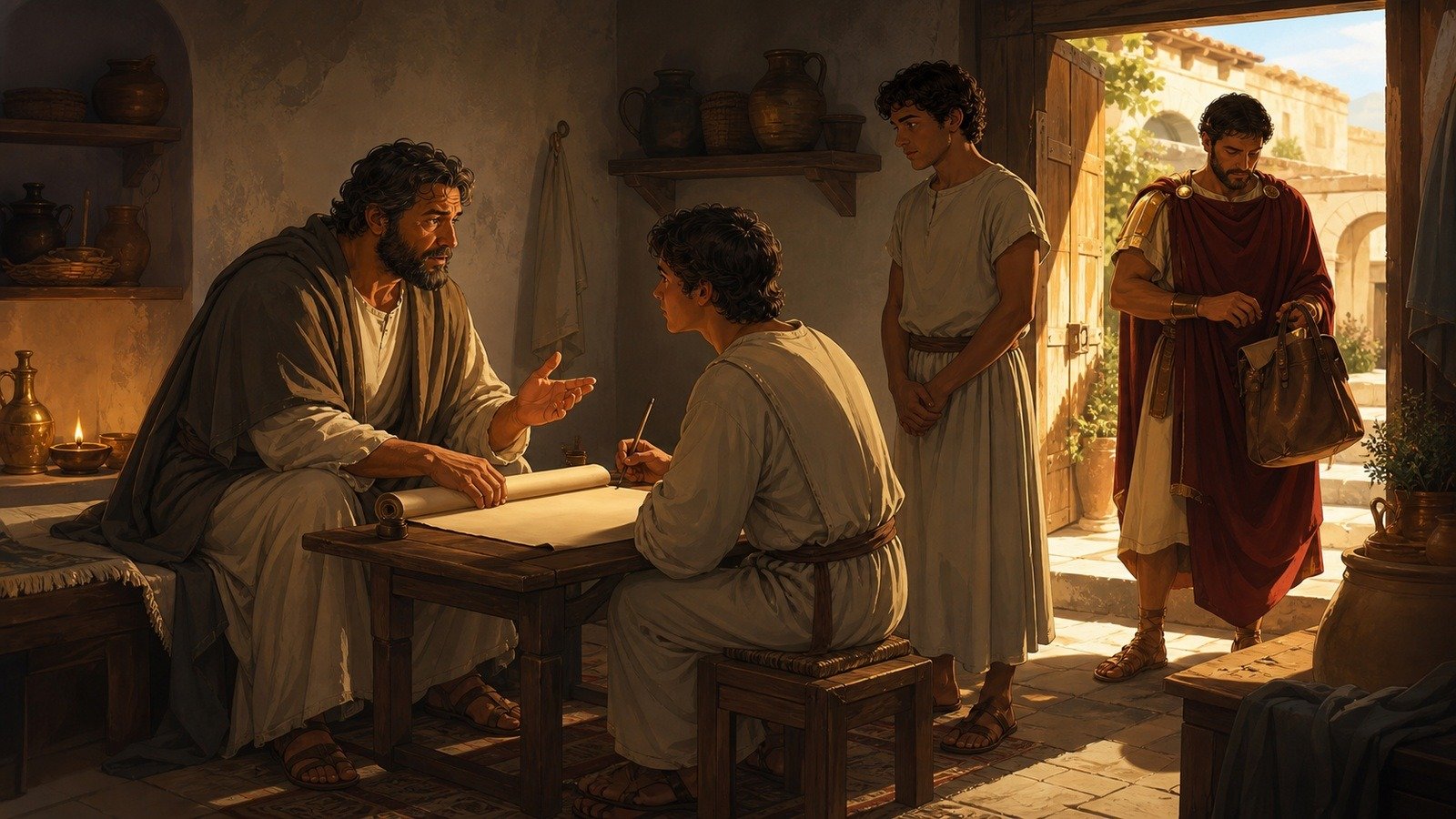
A brief, personal letter written alongside Colossians, appealing to a slave owner named Philemon to receive back his runaway slave Onesimus "no longer as a slave, but better than a slave, as a dear brother," without ever directly demanding manumission.
Further context
2 min readThe shortest of Paul's letters, twenty-five verses, written to one man about one slave, and it is the only private letter of his that survives.
Onesimus was a slave belonging to Philemon, a well-off Christian at Colossae in whose house the congregation met. He had run away, and had somehow reached Paul in prison, and had become a believer there.
The legal position was severe. A runaway slave could be branded, flogged, put in chains or executed, and anyone who harboured one was liable to the owner for damages. Roman law recognised one narrow exception: a slave who fled to a friend of his master in order to seek intercession was not technically a fugitive. Paul is very probably using that provision.
The letter is a masterpiece of pressure applied gently and it is worth watching how it works.
He begins by praising Philemon's love for all God's people and saying that he has derived great joy from it. He mentions that he could order him to do what he ought to do, and then says he prefers to appeal on the basis of love. He describes himself as an old man and now also a prisoner. He calls Onesimus my son, who became my son while I was in chains, and my very heart.
Then a pun that only works in Greek: the name Onesimus means useful, and Paul writes that formerly he was useless to you, but now he has become useful both to me and to you.
The request is stated carefully: I am sending him back to you, no longer as a slave, but better than a slave, as a dear brother. Welcome him as you would welcome me.
He offers to pay whatever the man owes, writes it in his own hand as a formal undertaking, and then remarks that Philemon owes him his very self.
And a closing line that has been called the most polite piece of arm-twisting in literature: confident of your obedience, I write to you, knowing that you will do even more than I ask.
What happened is unknown. About fifty years later a bishop of Ephesus named Onesimus is mentioned by Ignatius of Antioch, and whether it is the same man cannot be established.
The letter does not condemn slavery. It also makes it very difficult to keep a brother as property, and abolitionists and slave-owners both quoted it.
Onesimus is named again in the letter to Colossae as our faithful and dear brother, who is one of you, which means the congregation was told to expect him and to regard him that way before he arrived at his owner's door.
The letter survived at all only because somebody in that household kept it, which is itself a small piece of evidence about how the request was received.
Onesimus is the only slave in the New Testament whose name, owner, offence and destination are all recorded, and the whole file consists of one short letter written by a third party.