

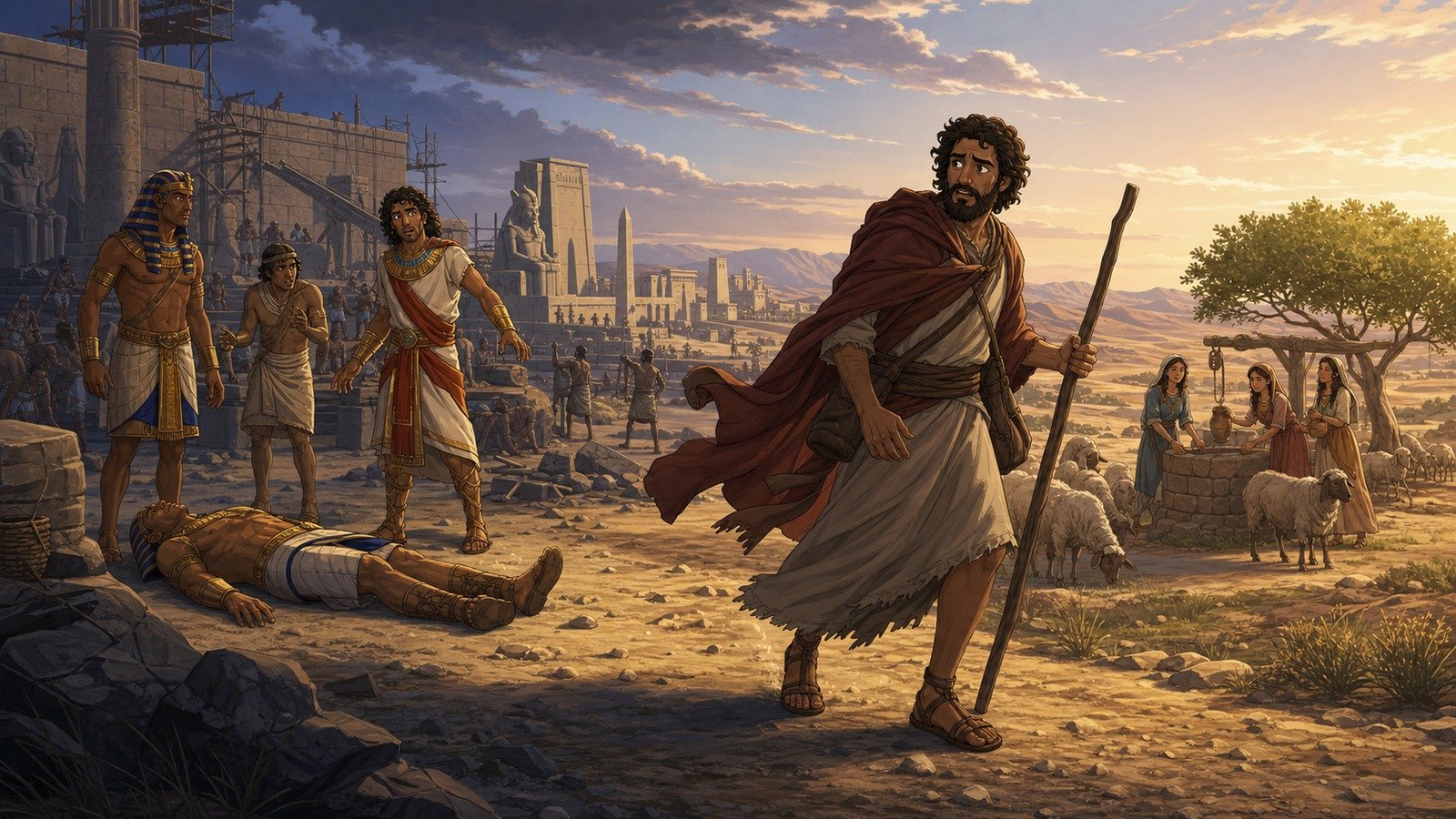
As an adult, Moses kills an Egyptian overseer he sees beating a Hebrew slave, then flees to Midian when the act becomes known, marries Zipporah, and settles as a shepherd for the next forty years.
Further context
3 min readMoses is forty when he goes out to where his own people are and watches them at their hard labour. That is the first indication that he knows who he is.
He sees an Egyptian beating a Hebrew, and one small detail settles the moral question of the scene: he looked this way and that and, seeing no one, he killed the Egyptian and hid him in the sand. A man acting from open conviction does not check for witnesses first.
The next day he intervenes between two Hebrews who are fighting, and asks the one in the wrong why he is hitting his fellow Hebrew. The reply drives him out of the country: who made you ruler and judge over us? Are you thinking of killing me as you killed the Egyptian? He is afraid and thinks, so this thing is known. Whatever standing he imagined he had among his own people, they have not granted it, and the same question about his authority gets thrown at him repeatedly forty years later in the desert.
Pharaoh hears and tries to kill him, and he flees to Midian, a territory usually located in north-western Arabia and the eastern Sinai, well beyond Egyptian administration.
He sits down by a well, which in this family's history is where marriages begin. Abraham's servant found Rebekah at a well and Jacob met Rachel at one, and this is the third time. Seven daughters of the priest of Midian come to draw water for their father's flock, and shepherds drive them away. Moses gets up, comes to their rescue and waters the flock himself.
Their report to their father contains a line worth pausing on: an Egyptian rescued us from the shepherds. In Egypt he was a Hebrew who had overstepped. In Midian he is taken for an Egyptian. He belongs to neither group, and that keeps being said.
The priest is called Reuel in one place and Jethro elsewhere, which is either two names for one man or a personal name alongside a title. Moses marries his daughter Zipporah, and their son is named Gershom, explained with a sentence rather than a celebration: I have become a foreigner in a foreign land. The Hebrew means a stranger there, and it is the only thing he is recorded as saying across forty years.
Forty years pass in that sentence about a wedding and a son, and nothing whatever is recorded from them. A man raised in a palace, educated at the centre of the most sophisticated state in the world, spends four decades keeping another man's sheep in territory nobody wanted. Whatever he had been trained for, none of it is used, and when he is finally addressed at a burning bush his first response is that he is the wrong person and cannot speak properly.
Midian's later place in the story is worth registering, because the connection lasts. His father-in-law comes back at Sinai with advice that reshapes Israel's judiciary. The Kenites, a group associated with Midian, are treated as allies in Judges and are spared by Saul when the Amalekites are not. Relations turn hostile at Peor and afterwards, and by the time of Gideon the Midianites are raiders occupying the Jezreel valley. The people Moses married into are neither consistently friend nor consistently enemy.