

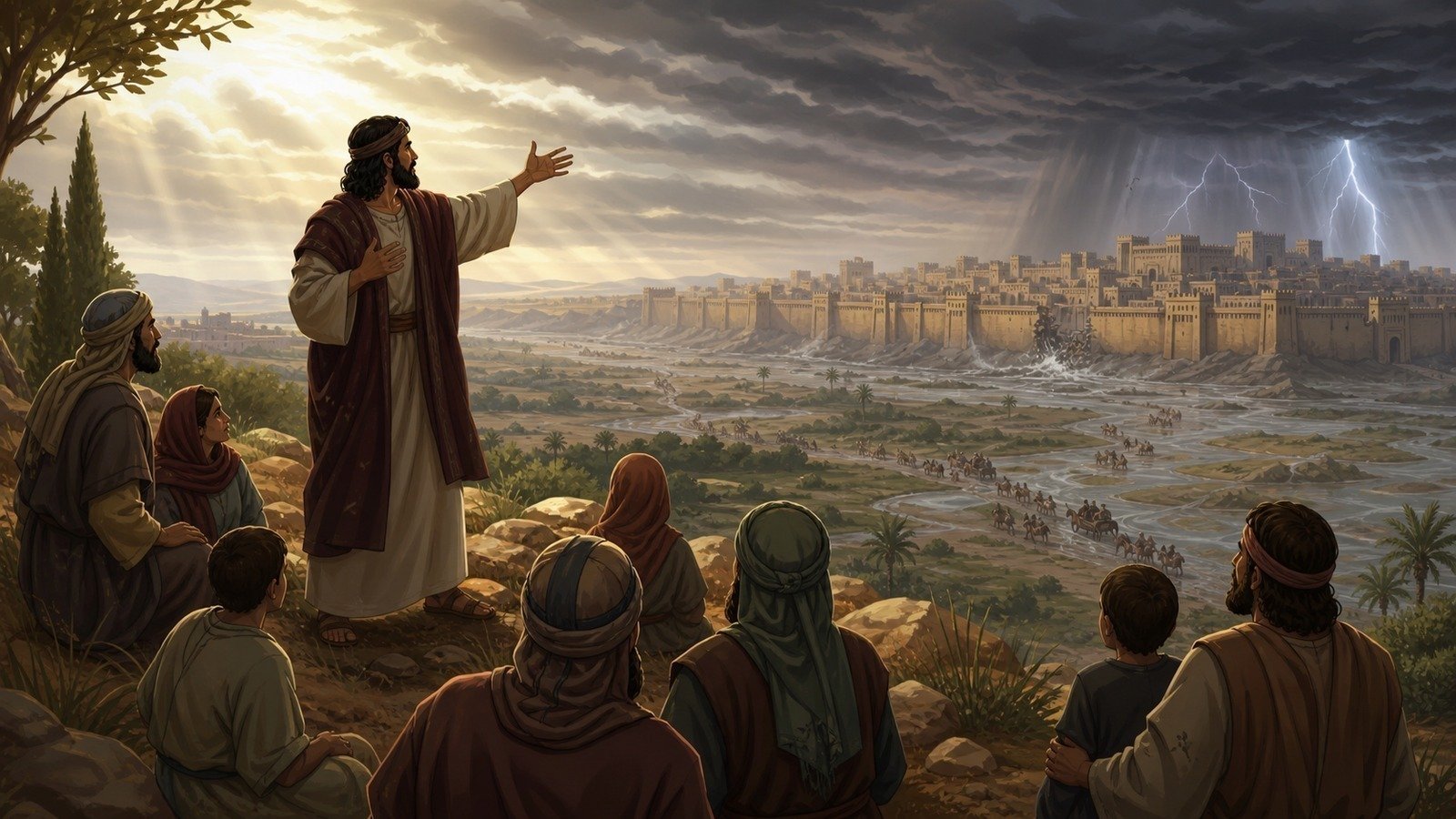
Nahum announces the coming destruction of Nineveh, the Assyrian capital, in vivid, celebratory terms, a message that would have offered comfort to a Judah still living under Assyrian shadow.
Further context
3 min readThe whole book is about the destruction of one city, and it can be dated within a fifty-year window by two events it mentions.
It refers to the fall of Thebes as something that has already happened, which fixes the earliest possible date at 663 BC, when Ashurbanipal sacked the Egyptian capital. And it predicts the fall of Nineveh, which happened in 612 BC when a coalition of Babylonians and Medes took the city. Somewhere between those two, a Judaean prophet wrote a poem celebrating the coming destruction of the empire that had held his country as a vassal for a century.
The Assyria he is writing about is not an abstraction. Its own royal inscriptions describe with satisfaction the flaying of captured rulers, the piling of severed heads, the impaling of prisoners outside city walls and the deportation of entire populations. Assyrian palace reliefs, now in the British Museum, depict these things in careful detail as propaganda. Nahum's language about a city of blood, full of lies, full of plunder, is not exaggeration for effect.
The poetry is violent and it is meant to be read aloud. He describes the attack in short bursts: the crack of whips, the clatter of wheels, galloping horses, jolting chariots, charging cavalry, flashing swords, glittering spears, many casualties, piles of dead, bodies without number, people stumbling over corpses.
The opening is more careful than the rest and it is what keeps the book from being simple hatred. The LORD is slow to anger but great in power, and the LORD will not leave the guilty unpunished. Slow to anger is a quotation from the description of God given at Sinai, and the same phrase Jonah had thrown back as a complaint when Nineveh was spared. A hundred years separate the two books, and they concern the same city: one about its reprieve and one about its end.
There is also a line in the middle that gets quoted on its own: the LORD is good, a refuge in times of trouble. He cares for those who trust in him.
The city fell in 612 BC after a siege, and the Babylonian Chronicle records it. Excavation has confirmed a violent destruction, with burning, collapsed walls and unburied bodies in the gateways. It was not resettled, and within two centuries a Greek army marched past the site without knowing what it had been.
What the poem is for is stated plainly at the end. It is addressed to Judah, and the instruction is to celebrate festivals and fulfil vows, because the wicked will not invade you again; they will be completely destroyed. It is written to a small nation living under an empire, telling it that the empire is not permanent.
Nineveh fell in 612 BC to a coalition of Babylonians and Medes, and the Babylonian Chronicle records the siege and the sack in a few flat lines. The site was never rebuilt, and by the time a Greek army marched past two centuries later nobody could tell them what the mounds had been.
Nahum's poetry is the most violent in the Hebrew Bible and it is also the most technically accomplished. The description of the assault is built out of short bursts: the crack of whips, the clatter of wheels, galloping horses, jolting chariots, charging cavalry, flashing swords, glittering spears, piles of dead, bodies without number.
He calls the city a lair of lions and asks where the lions' den is now, which is a direct hit at Assyrian royal imagery, since the kings had themselves carved hunting lions across their palace walls.
Nothing in the book asks anyone to feel sorry for Nineveh, which is the exact reverse of the position taken in the book of Jonah about the same city.