

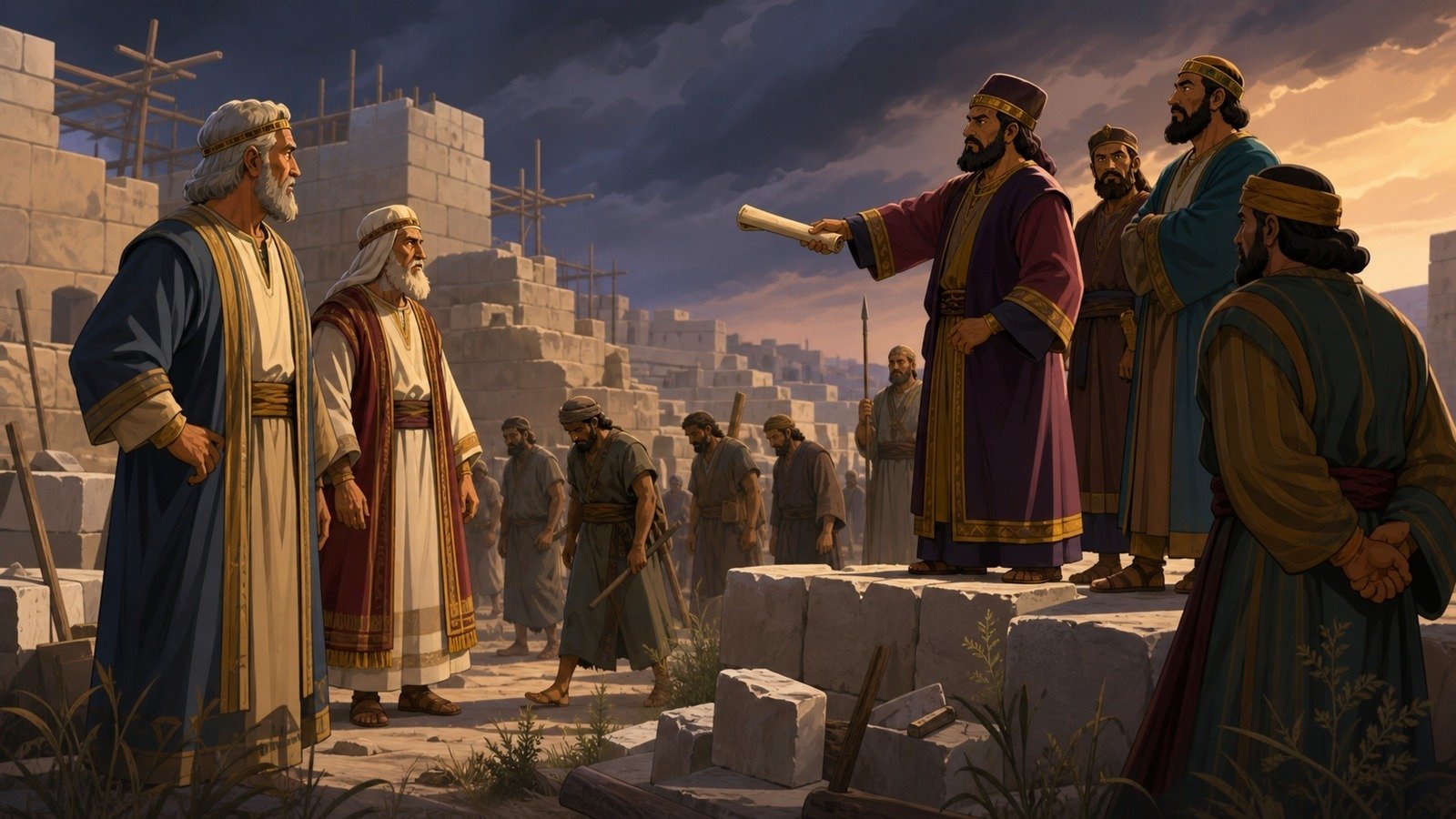
Local opposition, including formal complaints to the Persian court, halts construction on the Temple for roughly sixteen years, leaving the foundation unfinished until Darius I's reign.
Further context
3 min readThe opposition arrives first as an offer of help. The enemies of Judah and Benjamin come to Zerubbabel and the heads of families and say, let us help you build, because like you we seek your God and have been sacrificing to him since the time of Esarhaddon king of Assyria, who brought us here.
That is an accurate account of who they were. When Assyria destroyed the northern kingdom it deported the population and moved other peoples in, and those settlers had adopted the local religion alongside their own. The offer is genuine on its own terms and it is refused: you have no part with us in building a temple to our God. We alone will build it.
Whether that refusal was principled or arrogant has been argued ever since, and both things can be true. What it produced is not in doubt. The peoples around them set out to discourage them and make them afraid to go on building, and they hire counsellors to work against them and frustrate their plans during the entire reign of Cyrus and down to the reign of Darius.
The methods are administrative rather than violent, and they are recognisable to anyone who has dealt with a hostile bureaucracy. Letters are written to the imperial court. One of them, quoted in full and in Aramaic, argues that if this city is rebuilt and its walls restored, no more taxes, tribute or duty will be paid, and the royal revenues will suffer. It advises a search of the archives and asserts that Jerusalem has a long history of rebellion. The search is made, the claim is confirmed, and an order is issued to stop the work, which is then enforced by force of arms.
The correspondence quoted covers several different Persian reigns and is grouped by subject rather than by date, so some of it concerns the walls under Artaxerxes rather than the temple under Cyrus and Darius. Reading it as a strict sequence produces confusion; reading it as a dossier on obstruction does not.
The result is that work on the house of God in Jerusalem stops and remains at a standstill for about sixteen years.
The letter quoted also contains one of the few direct statements of how the community described itself to an imperial official: we are the servants of the God of heaven and earth, and we are rebuilding the temple that was built many years ago, one that a great king of Israel built and finished. But because our ancestors angered the God of heaven, he gave them into the hands of Nebuchadnezzar. That is a subject people explaining its own defeat to the government that now rules it.
What restarts it is not a change of policy but two prophets. Haggai and Zechariah begin preaching in the second year of Darius, the builders start again without waiting for permission, and a provincial governor's enquiry to the court then turns up the original decree of Cyrus in the archives at Ecbatana.
The opposition begins as an offer of help. The peoples around, who had been settled in the region by the Assyrians, come to Zerubbabel and say: let us help you build, because like you we seek your God and have been sacrificing to him since the time of Esarhaddon.
The refusal is flat: you have no part with us in building a temple to our God. We alone will build it.
Whether that was wise has been argued ever since, and it is the point at which the division that later produces the Samaritans hardens into permanent hostility.
What follows is administrative warfare rather than violence. Counsellors are hired to frustrate the plans, and a letter is sent to the Persian court arguing that Jerusalem has a history of rebellion and that a rebuilt city will stop paying tribute. The archives are searched, the claim is found to have a basis, and the work is stopped by force of arms until the second year of Darius.