

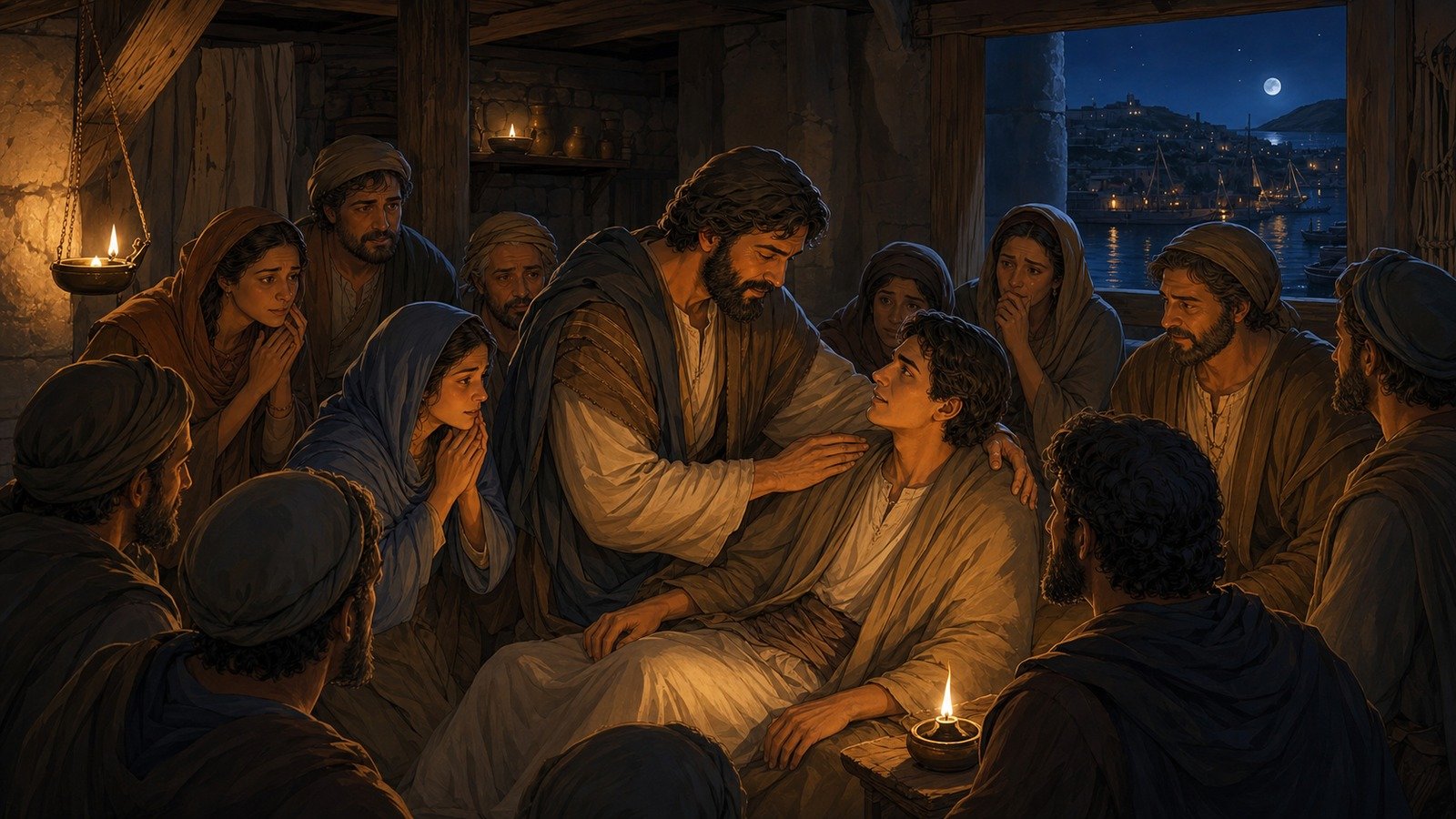
Paul travels through Macedonia and Greece encouraging the churches he had founded; at Troas, a young man named Eutychus falls asleep during a long night of Paul's teaching, drops from a third-storey window and is taken up dead, but Paul restores him to life.
Further context
2 min readAfter the uproar Paul leaves Ephesus and travels through Macedonia, speaking many words of encouragement to the believers, and then goes on to Greece, where he stays three months.
Those three months in Greece are almost certainly the winter he spent at Corinth, and they are when he wrote the letter to the Romans, which is the longest and most systematic thing he produced and the one that has had the largest effect on Christian thought.
He is about to sail for Syria when a plot is discovered, so he goes back through Macedonia instead, and a list of seven companions is given by name and city. That list is a snapshot of the collection he was carrying: delegates from the churches of Macedonia, Galatia and Asia, travelling with money for Jerusalem, which is exactly the arrangement he describes in his letters as a safeguard against any suggestion of mishandling.
At Troas they stay seven days. On the first day of the week they meet to break bread, and Paul, intending to leave the next day, talks until midnight.
There are many lamps in the upstairs room where they are meeting. Oil lamps burning in a crowded upper room consume the air and produce smoke, which is worth knowing before judging the young man.
Seated in a window is a young man named Eutychus, who is sinking into a deep sleep as Paul talks on and on. When he is sound asleep, he falls to the ground from the third storey and is picked up dead.
Paul goes down, throws himself on the young man and puts his arms around him. Do not be alarmed, he says, he is alive. The action is the same one Elijah and Elisha performed over dead boys, stretching themselves over the body.
Then he goes back upstairs, breaks bread and eats, talks until daylight, and leaves.
The people take the young man home alive and are greatly comforted.
Eutychus means fortunate, and whether the writer noticed is impossible to say.
The comedy in it is not smoothed away anywhere. A man is bored to sleep by the greatest preacher of the first century, falls out of a window, is raised from the dead, and the sermon resumes until dawn.
The first day of the week is mentioned as the day the believers met to break bread, which is one of the earliest indications of Sunday as the regular gathering.
Whether Eutychus was dead or only appeared so has been debated, largely because Paul says he is alive. The wording is blunt: he was picked up dead. Luke, whom the traditional identification makes a physician, uses the plain word and does not qualify it.
The seven named companions come from Berea, Thessalonica, Derbe, Asia and elsewhere, and their function was to accompany the money. Paul says he arranged it so that no one could criticise the way he administered the gift.
Three months in Greece is the vaguest time reference in the whole journey, and it covers the composition of the most consequential letter in Christian history.