

A Benjamite named Sheba leads a further, smaller revolt against David almost immediately after Absalom's rebellion ends; Joab suppresses it, and a wise woman's negotiation spares an entire city by having Sheba's head handed over instead.
Further context
2 min readThe dispute at the river turns into a secession within a day. A troublemaker named Sheba, a Benjamite from Saul's tribe, sounds the trumpet and shouts a slogan that will be used again a generation later when the kingdom actually splits: we have no share in David, no part in Jesse's son. Every man to his tent, Israel!
All the men of Israel deserted David to follow Sheba. Only Judah stays.
Before dealing with it, David deals with something at home. The ten concubines he had left to look after the palace, whom Absalom had taken publicly on the roof, are put in a house under guard and provided for, and he does not go in to them. They live as widows until the day of their death. Nothing is said about their position, and the arrangement is a life sentence for something done to them.
Amasa is given three days to muster Judah and takes longer, so David sends Abishai out with the household troops. Joab goes with them without being asked.
At the great rock in Gibeon they meet Amasa coming the other way. Joab is wearing a military tunic with a belted dagger, and it drops out as he steps forward. He takes Amasa by the beard with his right hand as though to kiss him, and Amasa does not notice the dagger in the other hand, and he is stabbed in the stomach and dies in the roadway. That is the second rival commander Joab has murdered by pretending an embrace at a meeting.
A man is left standing over the body calling the troops on, and they keep stopping to look, so the corpse is dragged into a field and covered with a garment.
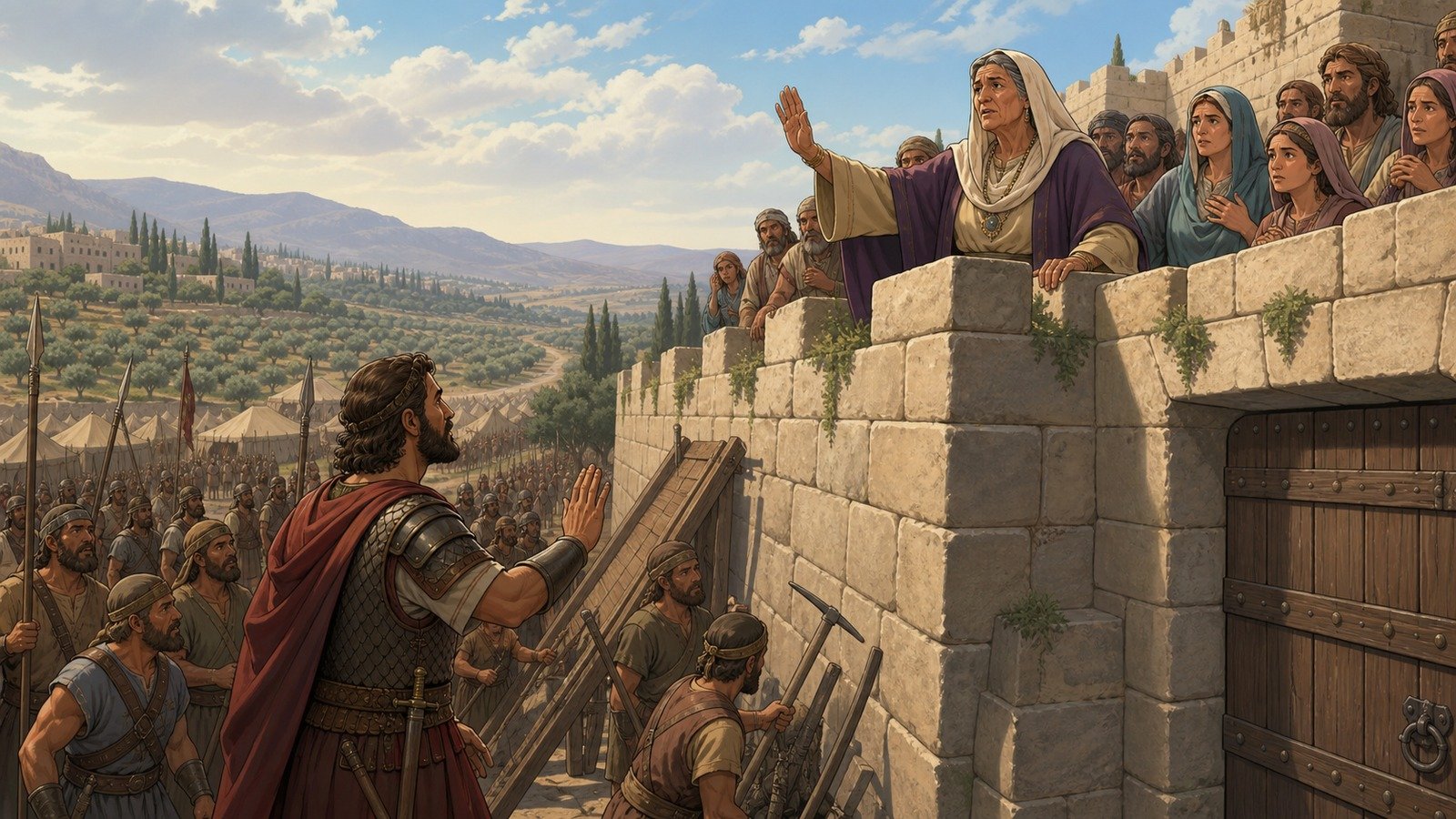
Sheba is pursued to Abel Beth Maakah in the far north and the town is besieged, and the siege ramp is going up when a woman calls from the wall and asks to speak to Joab. Her argument is a piece of civic negotiation. They used to say, get your answer at Abel, and that settled it. I am one of the peaceful and faithful in Israel. You are trying to destroy a city that is a mother in Israel. Why do you want to swallow up the LORD's inheritance?
Joab replies that he wants one man and nothing else. She takes it to the people of the town, they cut off Sheba's head and throw it over the wall, and the army goes home.
The slogan Sheba uses is not improvised. We have no share in David, no part in Jesse's son, every man to his tent, is repeated almost word for word by the northern tribes when they break away permanently a generation later. What is being suppressed here is not a personal grievance but the first appearance of a political position that eventually wins.
Two revolts have been ended by two women, one at Tekoa and one on a wall, and both of them by talking.