

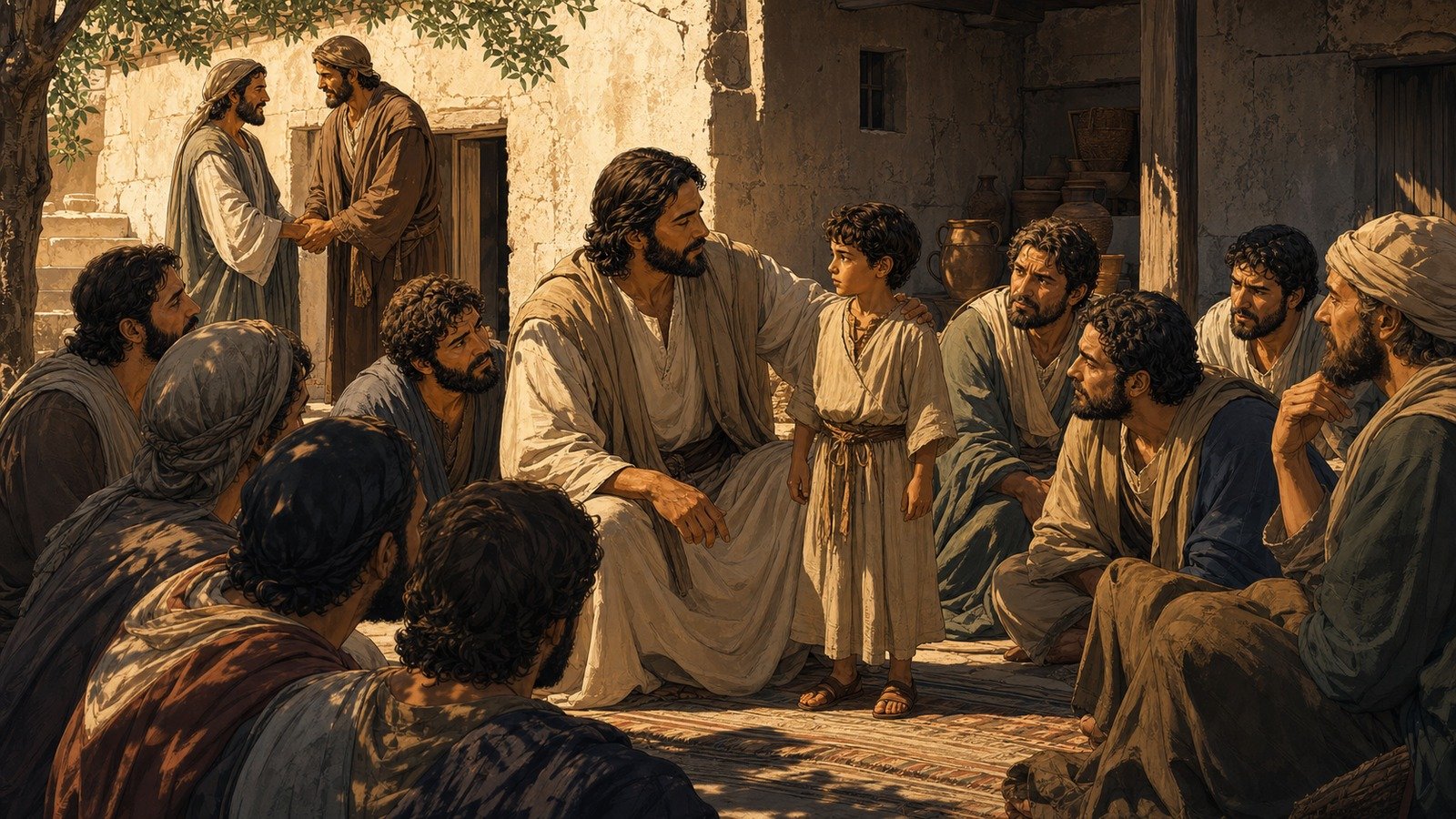
Finding the disciples arguing about who is greatest, Jesus sets a child before them as the model of kingdom greatness, followed by teaching on causing others to sin, restoring a sinning brother, and forgiving without limit.
Further context
2 min readIn the house at Capernaum Jesus asks the disciples what they had been arguing about on the road, and they say nothing, because they had been arguing about who was the greatest.
He sits down, which is what a teacher did before saying something formal, calls the Twelve, and states the rule: anyone who wants to be first must be the very last, and the servant of all.
Then he takes a child and has him stand among them, and takes him in his arms.
Modern readers hear that as sentiment, and it was not. Children in the Roman world had no legal standing, no property, no voice and very little protection, and a father could legally refuse to acknowledge a newborn. Affection for children certainly existed, but the child in that room was chosen precisely because he was the person present with the least status.
Whoever welcomes one of these little children in my name welcomes me, and whoever welcomes me does not welcome me but the one who sent me.
Then the tone changes sharply. If anyone causes one of these little ones who believe in me to stumble, it would be better for them to have a large millstone hung round their neck and to be drowned in the depths of the sea. The stone specified is the upper stone of a donkey-driven mill, a perforated disc of basalt weighing a great deal, not the small hand-mill of a household.
Drowning was a punishment Jews particularly abhorred, since it left no body to bury, and Romans used it for certain crimes.
What follows is the instruction about cutting off a hand or a foot and gouging out an eye rather than being thrown into hell, using the word Gehenna, from the Valley of Hinnom south of Jerusalem, where children had been burned in sacrifice under two of the worst kings and which had become an image of final destruction.
The section on restoring a brother sets out a graded procedure: go privately first, then take one or two others, then tell the assembly. The stages are designed to keep the number of people who know as small as possible for as long as possible.
Peter then asks how many times he must forgive, and offers seven, which was generous by the standards of contemporary discussion, where three was a common answer.
Seventy-seven times, he is told, and the Greek can also mean seventy times seven. Either way the number is meant to stop the counting. The phrase reaches back to a boast made by a descendant of Cain, who sang about avenging himself seventy-seven times, and turns it inside out.
The graded procedure for dealing with a wrong has been used as a disciplinary rule by churches ever since, and it is worth noting what it is designed to prevent. Every stage is an attempt to settle the matter at the lowest possible level, and the first move is a private conversation with the person concerned rather than a complaint to anyone else.
Peter's question about forgiveness follows immediately, which suggests he had understood the procedure as a mechanism for keeping score. The answer removes the ledger rather than raising the limit on it.