

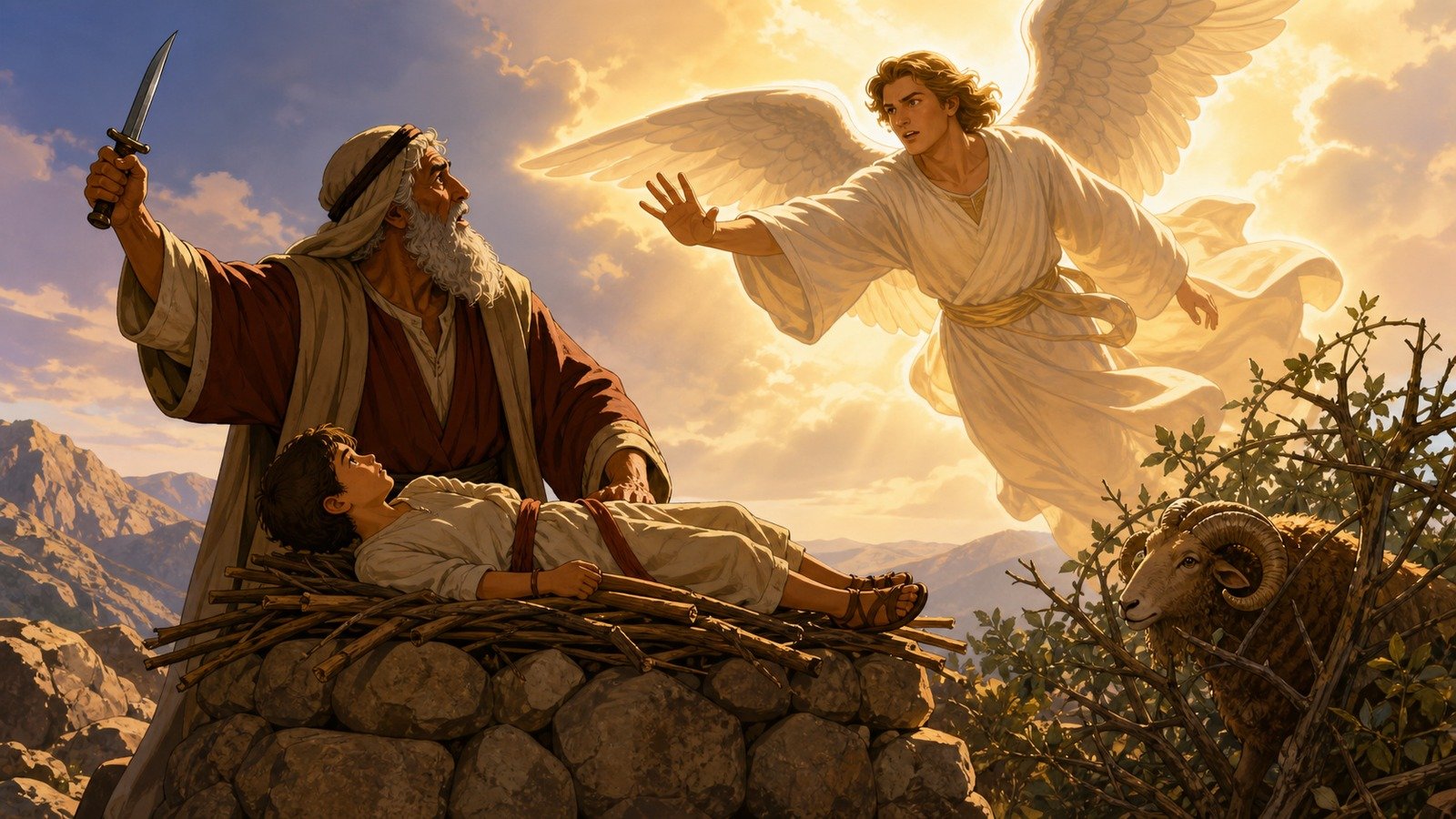
God tests Abraham by commanding him to sacrifice Isaac; Abraham obeys to the point of raising the knife before an angel stops him and a ram is provided instead. Christian tradition has long read this as an Old Testament foreshadowing of substitutionary sacrifice, though this is an interpretive reading rather than something the text states outright.
Further context
2 min readThe reader is told at the outset that what follows is a test. Abraham is not. Everything unbearable about the next three days is unbearable because he does not have the information the reader has been handed in the first sentence.
The command is worded to make it as hard as possible: take your son, your only son, whom you love, Isaac, and go to the region of Moriah and sacrifice him there as a burnt offering on a mountain I will show you. The name comes last, after three descriptions, and the phrasing echoes the first instruction he ever received, which also sent him to a place that would be shown to him.
He gets up early, splits the wood, saddles the donkey and sets out with two servants and the boy. The journey takes three days, and not one word spoken on that road is recorded. The silence is the most effective thing in the whole episode.
On the third day he sees the place, leaves the servants with the donkey, and says that the two of them will worship and come back. Isaac carries the wood and his father carries the fire and the knife. The one question the boy asks, where the lamb is, gets the answer that God himself will provide it. The Hebrew verb (yireh) means both to see and to provide, and it comes back at the end.
How old Isaac was is unknown. He is old enough to carry enough wood for a burnt offering and to ask an intelligent question, and he does not resist being bound, which in Jewish tradition has generally been taken to mean a young man rather than a child.
One word holds the episode together and is easy to miss in English. Abraham says hinneni, here I am, three times: to God at the start, to Isaac on the mountain when the boy calls him father, and to the angel who stops him. The same reply is given to the one issuing the command, to the son who is its object, and to the voice that revokes it.
The angel stops him as he takes the knife, and a ram is caught in a thicket by its horns. He names the place The LORD Will Provide, and a proverb evidently current when this was written down is added: on the mountain of the LORD it will be provided. Mount Moriah is later identified as the site where Solomon built the temple in Jerusalem, which is why this episode and that location are bound together.
The moral difficulty is real and should not be smoothed over. Child sacrifice is condemned in the strongest terms elsewhere in the Hebrew scriptures; Jeremiah says of the practice that God did not command it and that it never entered his mind. The episode is aware of this, which is why the sacrifice is stopped, why a substitute is supplied, and why the reader is told at the outset that it is a test. What it establishes has been argued over for a very long time, and the argument is ancient rather than modern; Kierkegaard's treatment in 1843 is only the best-known recent contribution.