

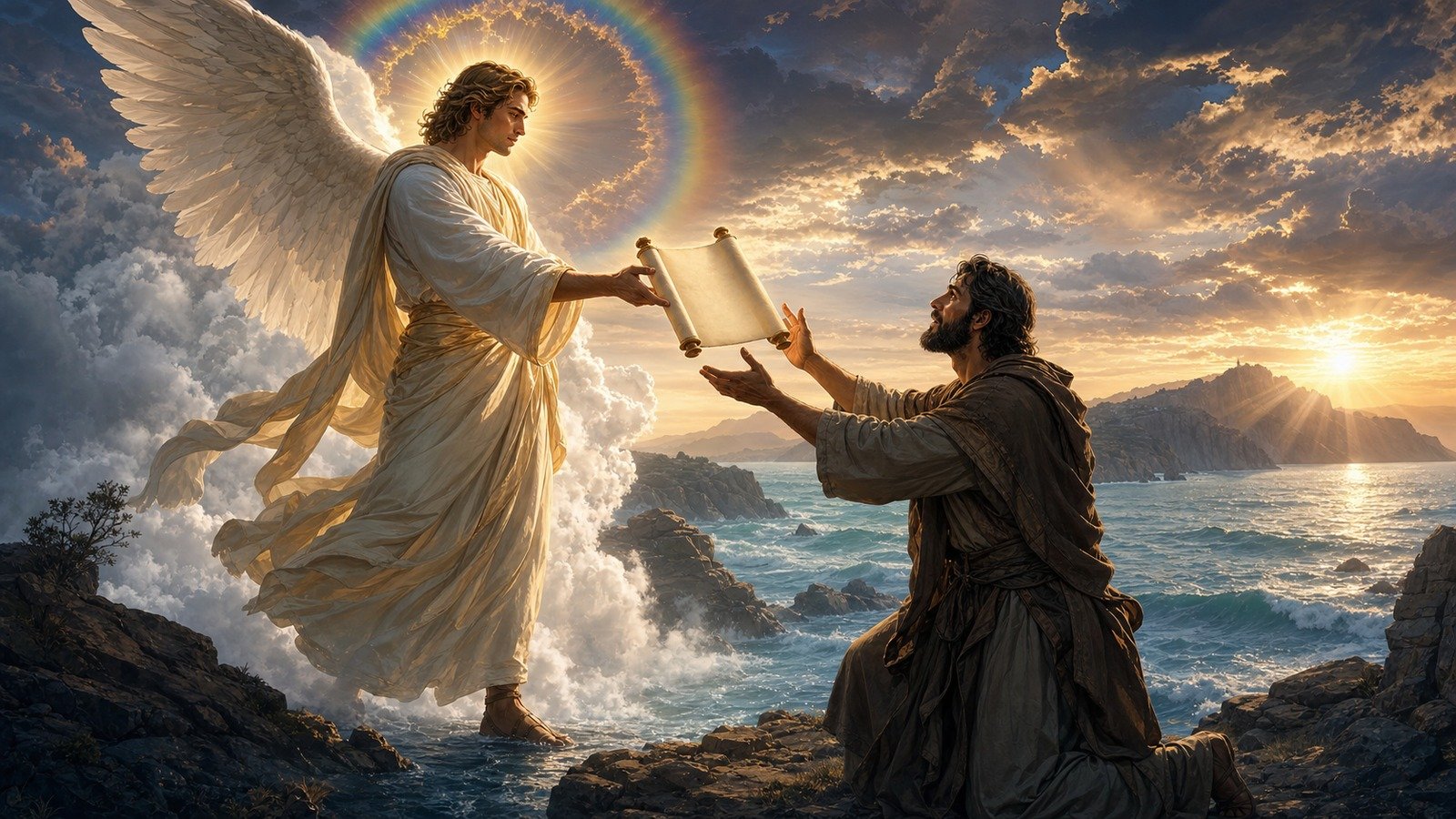
A mighty angel gives John a small scroll to eat, sweet in his mouth but bitter in his stomach, and tells him he must prophesy again about many peoples, nations, languages and kings.
Further context
2 min readBetween the sixth and seventh trumpets the sequence pauses again, as it did between the sixth and seventh seals.
A mighty angel comes down from heaven, robed in a cloud, with a rainbow above his head, a face like the sun and legs like fiery pillars. He plants his right foot on the sea and his left foot on the land, and gives a shout like the roar of a lion.
When he shouts, the voices of seven thunders speak. John is about to write what they said, and a voice from heaven stops him: seal up what the seven thunders have said and do not write it down.
That instruction is unique in the book. Everywhere else John is told to write, and near the end he is told specifically not to seal up the words of this prophecy. Here alone something is revealed and then withheld, and readers have proposed that the point is precisely that not everything is disclosed.
Then the angel swears by him who lives for ever and ever, who created the heavens, the earth and the sea, that there will be no more delay. That oath answers the question the martyrs had asked under the fifth seal.
In his hand is a little scroll, lying open, and John is told to take it and eat it: it will turn your stomach sour, but in your mouth it will be as sweet as honey.
He takes it and eats it, and both things happen exactly as described.
The image comes from Ezekiel, who is given a scroll covered with words of lament and mourning and woe and told to eat it, and finds it as sweet as honey in his mouth. Jeremiah says something similar about God's words being his joy, in a book largely composed of very bad news.
What the double taste means is not explained and does not need to be. A message can be good and be bitter to carry, and a man who has just watched a third of mankind killed and the survivors refusing to change is being told that he has to go on delivering it.
Then he is told: you must prophesy again about many peoples, nations, languages and kings.
The commission is renewed at the point where it would be most natural to stop.
Sealing the seven thunders is the one instruction in the book that withholds rather than discloses, and it sits in a document whose title means unveiling.
The angel standing with one foot on the sea and one on the land covers the two halves of creation, which is a way of saying that the oath applies everywhere.
The little scroll is a different object from the sealed scroll taken by the Lamb, and it is already open when John receives it. What is on it is never described.
Eating a scroll is one of the more physical images in prophetic writing, and it makes the same point every time it is used: the message has to be taken inside the person delivering it before it can be delivered at all.