

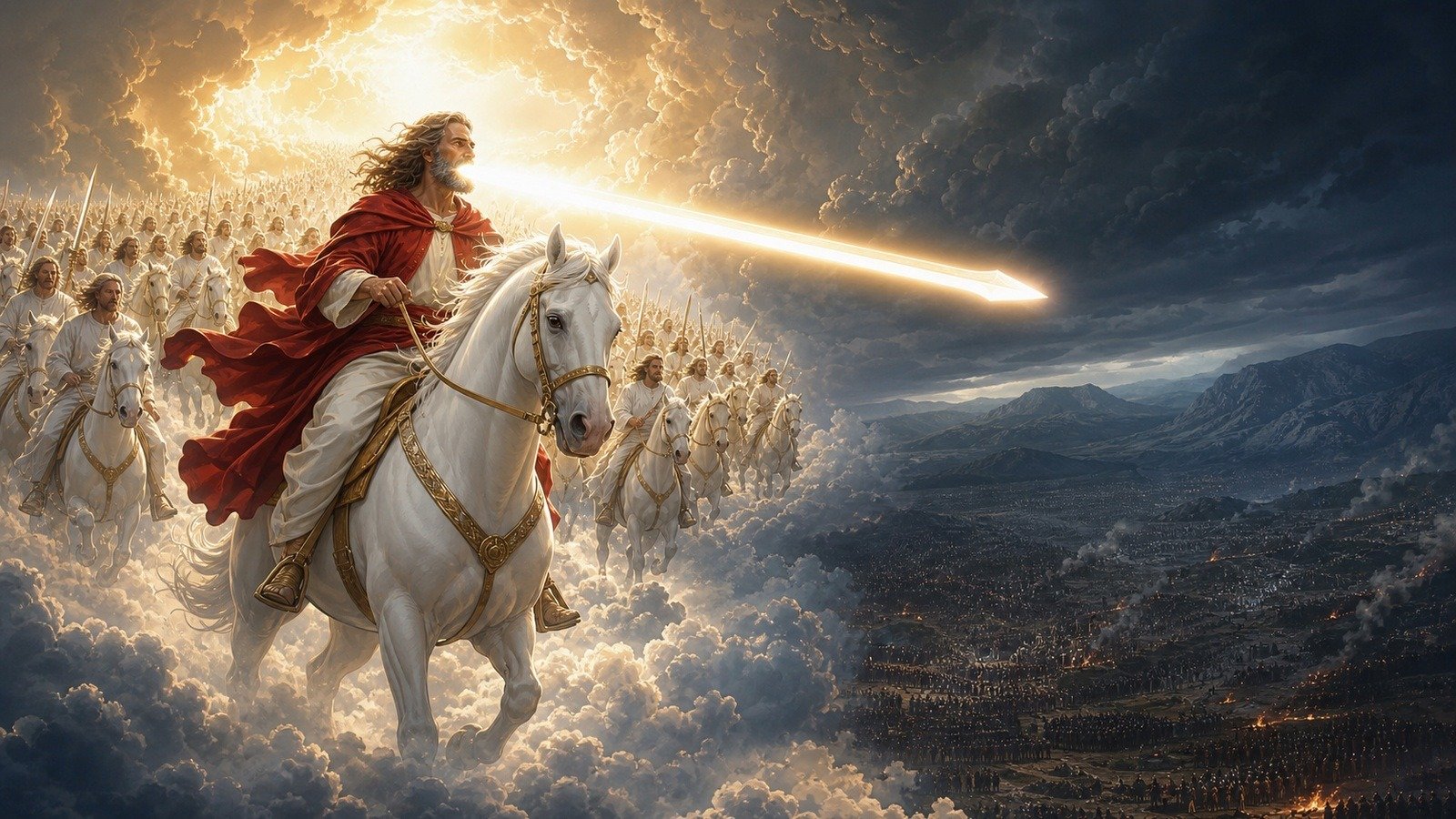
Heaven opens to reveal a rider called Faithful and True, his robe dipped in blood, leading the armies of heaven to judge and make war, with a sword from his mouth and a name written on him, "King of kings and Lord of lords."
Further context
2 min readHeaven stands open, and a white horse appears whose rider is called Faithful and True.
A rider on a white horse has appeared once before, under the first seal, and whether the two are the same figure is one of the standing questions about the book. The differences are substantial: that one carried a bow and was given a crown, and this one is named.
With justice he judges and wages war. His eyes are like blazing fire, and on his head are many crowns.
The word used for those crowns is the royal diadem rather than the victor's wreath, and many of them, on one head, is a claim about every authority the book has described so far.
He has a name written on him that no one knows but he himself, which sits oddly beside the three names he is given openly: Faithful and True, the Word of God, and King of kings and Lord of kings.
He is dressed in a robe dipped in blood, and the timing matters. The blood is on him before the battle begins, so it is not the blood of his enemies, and readers have taken it as his own, drawing on the winepress image from earlier and on Isaiah's figure with garments stained from treading.
Out of his mouth comes a sharp sword with which to strike down the nations.
That is the detail that governs the whole scene. He carries no weapon in his hands. The armies of heaven follow him riding white horses and dressed in fine linen, white and clean, which is wedding clothing rather than armour, and none of them is described doing anything at all.
King of kings and Lord of lords is written on his robe and on his thigh, which is where a name would be visible on a mounted rider, and the title was one the Persian and later the Parthian monarchs used of themselves.
An angel standing in the sun calls to the birds flying in midair to gather for the great supper of God, to eat the flesh of kings, generals, mighty men, horses and riders, and of all people, free and slave, great and small.
That invitation is placed immediately after the invitation to the wedding supper of the Lamb, and the two meals stand a few lines apart.
The armies of heaven follow on white horses in fine linen, white and clean, which is the same clothing given to the bride a few lines earlier. Whoever they are, they are dressed for a wedding and are riding into a battle.
Faithful and True is the title used of the speaker in the message to Laodicea, and the Word of God is the title used at the opening of the fourth Gospel, which is one of the closer points of contact between the two books.
Every weapon in the scene is speech. The sword comes from his mouth, the name is written on him, and the judging is done with justice, which is a legal word rather than a military one.