

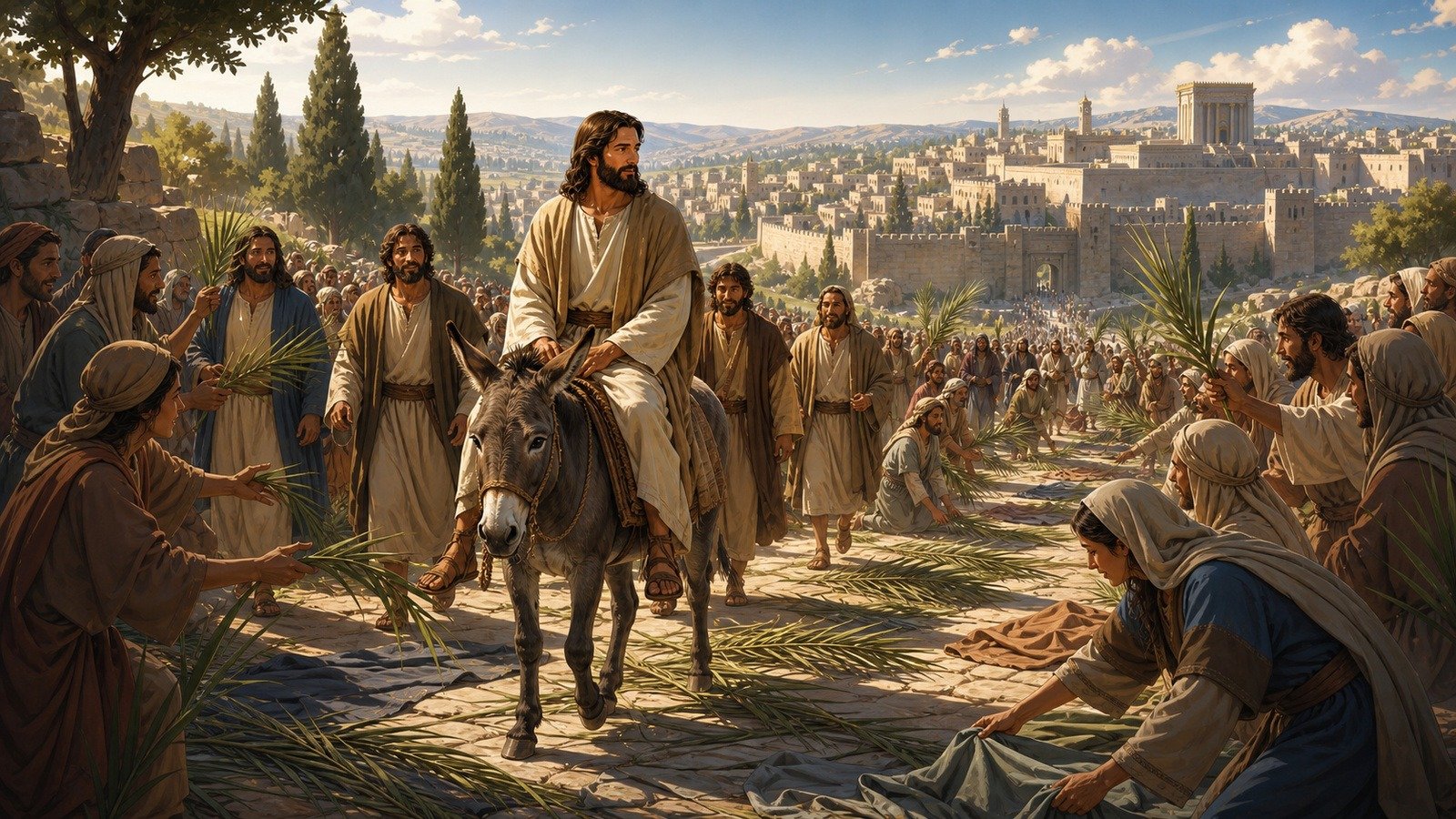
Jesus enters Jerusalem riding a donkey, deliberately fulfilling Zechariah's prophecy of a humble king, while crowds spread cloaks and branches and shout "Hosanna"; Luke alone records Jesus weeping over the city, foreseeing its coming destruction.
Further context
3 min readEverything about this arrival is arranged, and that is the first thing to understand about it. For two years Jesus has told people to say nothing and has withdrawn from crowds that wanted to crown him. Now he organises a procession.
Two disciples are sent ahead to a village with instructions to find a colt tied there, one that no one has ever ridden, and to untie it. If anyone asks, they are to say the Lord needs it. Whether this was prearranged with an owner or something else is unclear; the arrangement works.
An unridden animal matters, because things devoted to sacred use were required to be ones that had not been put to ordinary work.
The choice of animal is the message. A king arriving in a city he had conquered rode a horse, and Roman generals entered in a chariot. A donkey was what a man rode in peacetime, and Zechariah had written of a king coming to Jerusalem righteous and victorious, lowly and riding on a donkey. Anyone who knew that line, and many did, could not miss it.
The crowd spreads cloaks on the road, which is what was done for a king; the same thing had been done for Jehu when the army proclaimed him. Others cut branches from the trees, and palm branches had been a nationalist symbol since the Maccabean revolt and appeared on the coins struck by the rebels in both later wars against Rome.
They shout Hosanna, which is Hebrew for save now, a cry for help that had become an acclamation, along with the line about the one who comes in the name of the Lord. Both come from a psalm sung at the pilgrim festivals, so the words were familiar and the application was not.
The city that week was extraordinarily full. Josephus gives figures for Passover crowds that are certainly too high, but even conservative estimates put several times the normal population inside the walls, with pilgrims camped on the hillsides.
Coming round the shoulder of the Mount of Olives, where the city and the temple appear all at once across the Kidron valley, he stops and weeps over it. What he says is a prediction of a siege: your enemies will build an embankment against you and encircle you and hem you in on every side. They will not leave one stone on another, because you did not recognise the time of God's coming to you.
In AD 70 Titus encircled Jerusalem with exactly such a wall, and the city and temple were destroyed.
Some Pharisees tell him to rebuke his disciples. I tell you, he answers, if they keep quiet, the stones will cry out.
Whether the crowd that shouted on Sunday was the crowd that shouted on Friday is a question often raised and rarely examined. Jerusalem held an enormous transient population that week, and the people lining the road down from Bethany were largely pilgrims from Galilee who had walked the same route, while the crowd assembled in front of the prefect's residence early on a working morning was a Jerusalem crowd gathered at short notice by the chief priests. They need not have been the same people at all.
The entry is the first public act of the final week, and it is a claim made in a form the authorities could not prosecute. Nothing was said. A man rode a donkey.