

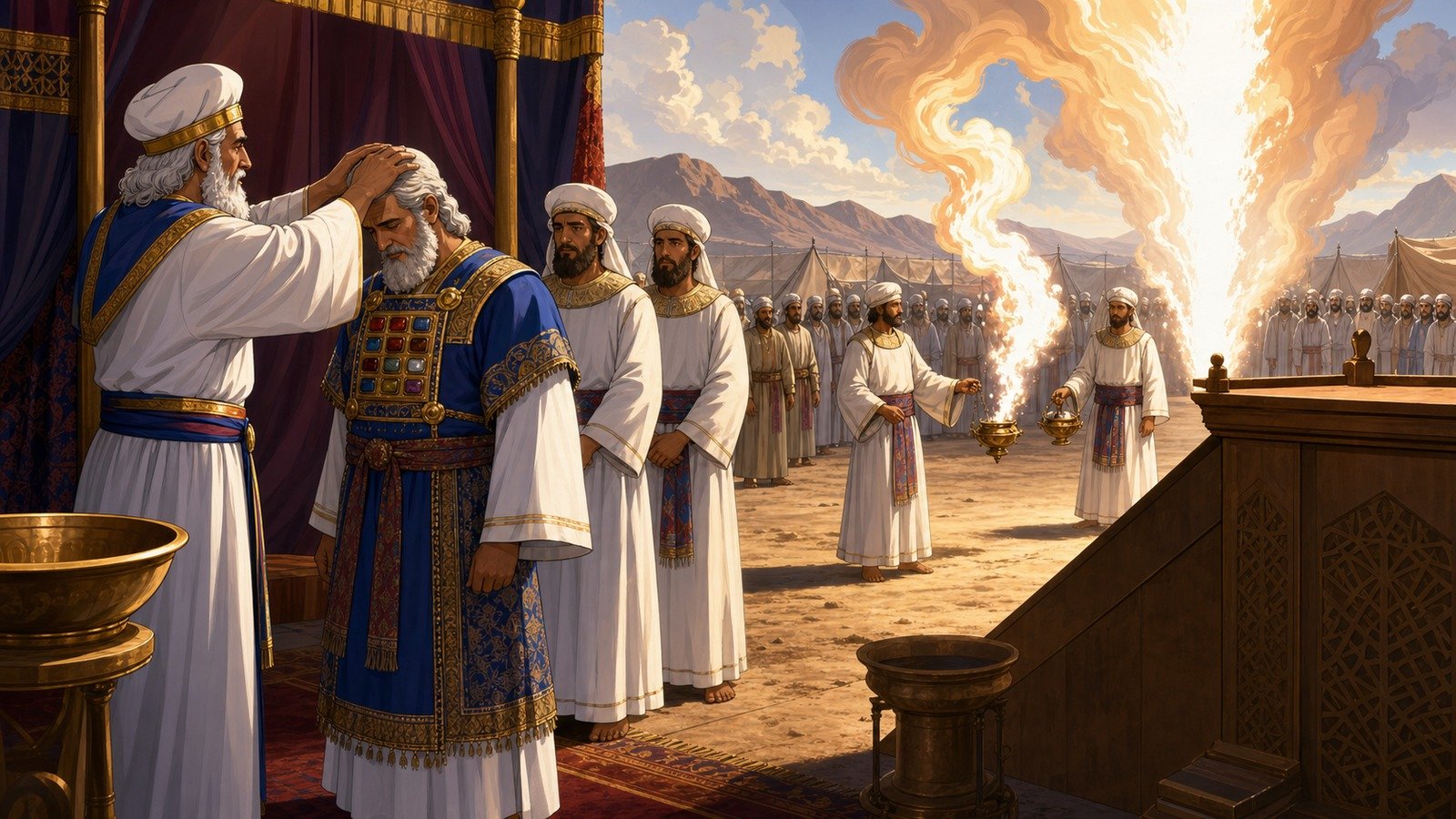
Aaron and his sons are formally ordained and begin offering sacrifices; two of his sons, Nadab and Abihu, die immediately after offering "unauthorised fire," a sober warning against careless worship.
Further context
2 min readThe ordination takes seven days. Aaron and his four sons are washed, dressed in the garments specified earlier, and anointed with oil, and three sacrifices are offered over the week. One detail in the ritual is unusual enough to remember: blood from the ram of ordination is put on the lobe of the right ear, the thumb of the right hand and the big toe of the right foot of each man. What they hear, what they handle and where they walk are marked in turn.
On the eighth day Aaron offers for the first time on his own account and for the people. He raises his hands and blesses them, he and Moses go into the tent and come out and bless them again, and fire comes out from the presence of the LORD and consumes the offering on the altar. The people shout and fall face down.
What happens next reverses everything within two sentences. Nadab and Abihu, Aaron's two eldest sons, take their censers, put fire in them, add incense and offer unauthorised fire before the LORD, contrary to his command. Fire comes out from the presence of the LORD and consumes them.
The Hebrew phrase means strange or foreign fire, and what was wrong with it is unknown. Proposals include fire taken from a source other than the altar, incense compounded outside the prescribed formula, entering the Most Holy Place without authorisation, and simply acting on their own initiative in a ritual whose every element had just been dictated in detail. Two words are all the explanation available: unauthorised, and contrary to his command.
The same fire that consumed the offering and confirmed the priesthood one day consumes the priests the next, and the two sentences sit close enough together that the parallel cannot be an accident.
Moses quotes a saying to his brother: among those who approach me I will be proved holy; in the sight of all the people I will be honoured.
Then four words: Aaron remained silent.
The bodies are carried out of the camp by their tunics, and Aaron and his two surviving sons are forbidden to let their hair go unkempt or tear their clothes, the ordinary signs of mourning, because the anointing oil is on them. The community may weep. The priests may not leave their posts, on the day their brothers die, at the altar where it happened.
The two men are named at every stage of the ordination and they are Aaron's eldest sons, which means the succession was expected to run through them. It runs instead through Eleazar, the third son, whose descendants hold the high priesthood for centuries. An arrangement that had just been set out in detail is altered on its eighth day by the deaths of the two men at the top of it.
What comes next has been read as a hint. God speaks directly to Aaron, for the only time in the whole book, and forbids priests to drink wine or other fermented drink when they enter the tent, so that they can distinguish between the holy and the common and teach the people. The placement invites the inference that drink was involved. That is a reasonable guess and nothing confirms it.