

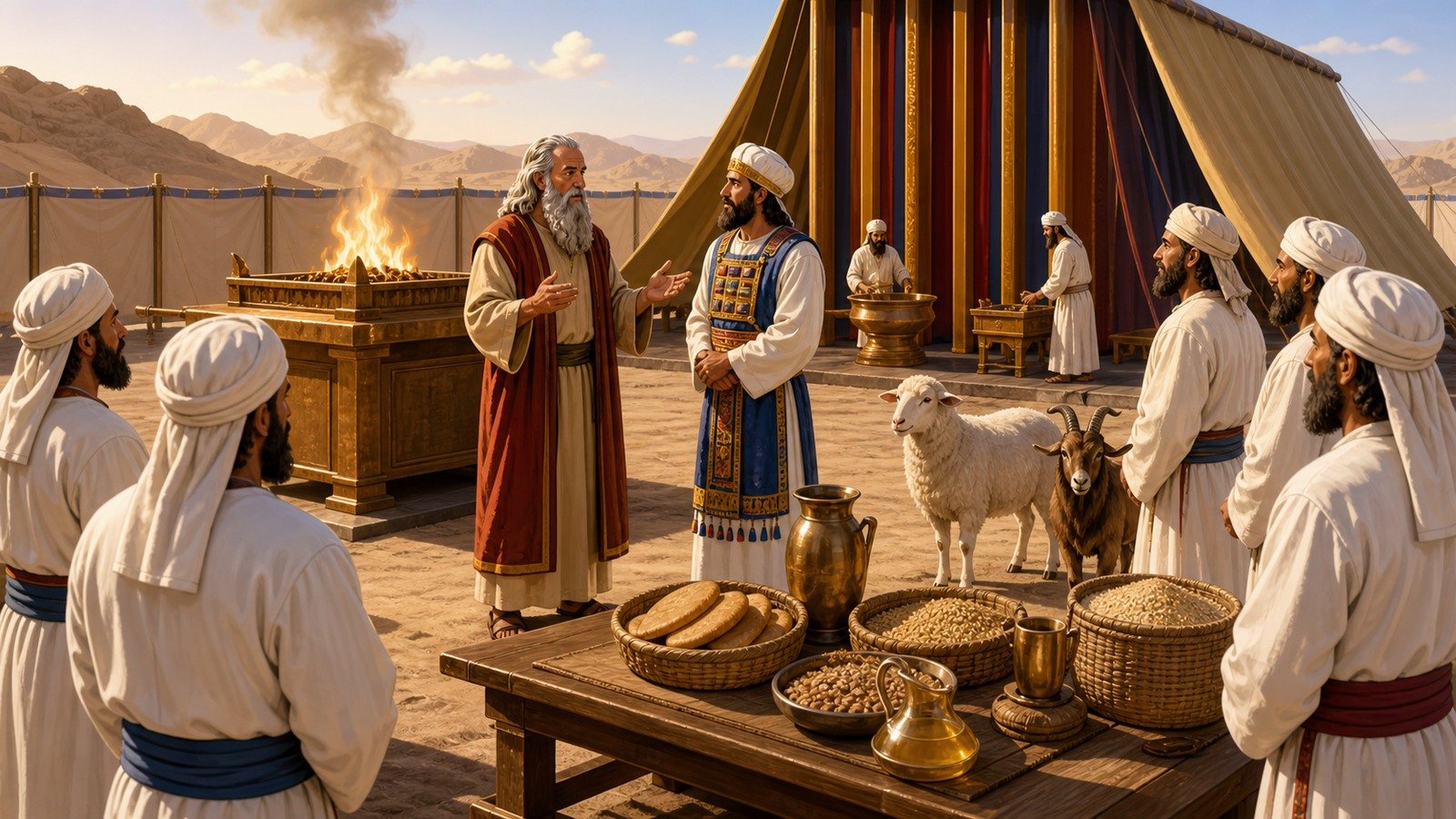
God sets out burnt, grain, fellowship, sin and guilt offerings in detail, establishing the mechanics of Israel's sacrificial worship at the newly completed tabernacle.
Further context
2 min readThe tent has just been finished and Moses cannot get into it. What follows answers exactly that problem: how a community lives with a holy presence camped in the middle of it.
Five kinds of offering are set out and each does something different.
The burnt offering is consumed entirely on the altar and nobody eats any of it; its Hebrew name means the one that goes up. The grain offering is flour with oil and incense, a portion burned and the rest given to the priests, and it is the only one with no animal in it. The fellowship offering is the one the worshipper eats, with specified parts burned and portions given to the priests, and it produces a shared meal. The purification offering, usually translated sin offering, deals with unintentional wrongdoing and with the contamination it causes to the sanctuary itself. The reparation offering covers cases where a loss can be calculated, and requires the value plus a fifth to be repaid to the injured party before the sacrifice is made at all.
Two features are easy to miss and both matter.
The first is that the offerings are graded by means rather than by status. A burnt offering may be a bull from the herd. If the worshipper cannot afford that, a sheep or a goat. If not that, two doves or two young pigeons. And if not even birds, then a tenth of an ephah of flour. The system is built so that poverty excludes nobody from it, and the wording is careful to state that the cheaper offering is accepted on the same terms as the expensive one.
The second is the gesture that opens the procedure. The worshipper lays a hand on the head of the animal, which is described as making it acceptable on his behalf. He brings it, presents it and kills it himself; the priest handles the blood and the altar. Sacrifice here is something a person does rather than something done for him at a distance by a professional.
The reason blood matters is stated once and plainly: the life of a creature is in the blood, and it has been given to make atonement. The logic is about life rather than about pain, which is why blood is handled with care, why fat is burned rather than eaten, and why neither is ever consumed.
The whole system rests on a distinction most modern readers have to be told about. Holiness in this world is not primarily a moral quality but a state of belonging to God, and things that are holy are dangerous to approach carelessly, in something like the way high voltage is dangerous. That is why two of Aaron's sons will shortly be killed at the altar, and why the elaborate procedures exist at all.
The priests receive fixed portions from most of the offerings, which is how they live, since the tribe of Levi is given no farmland anywhere. The letter to the Hebrews takes the whole arrangement as its starting point and argues that its endless repetition was itself significant: a sacrifice that had finally dealt with the matter would not have needed repeating every year.