

With David elderly, his son Adonijah tries to seize the throne with support from Joab and the priest Abiathar; Nathan and Bathsheba intervene, and David has Solomon publicly anointed and enthroned before his own death.
Further context
2 min readDavid is old and cannot keep warm, and the succession is unresolved. Adonijah, the eldest surviving son, decides to settle it himself.
He is described in terms that echo his dead brother exactly: very handsome, and born next after Absalom. One sentence explains the whole family: his father had never rebuked him by asking, why do you behave as you do? That is the third son in a row whose ruin is traced directly to a father who would not confront anybody.
He does what Absalom did, providing himself with chariots and horses and fifty men to run ahead of him, and he brings two heavyweight backers with him: Joab the army commander and Abiathar the priest, both of whom have been with David since the years in the caves. Zadok the priest, Benaiah who commands the bodyguard, Nathan the prophet and the elite warriors do not join him.
He holds a coronation feast at En Rogel, a spring just outside Jerusalem, and invites all his brothers except Solomon.
Nathan and Bathsheba move fast and in coordination. She goes to the king and reminds him of an oath he swore that Solomon would succeed him, and points out that the whole country is watching to see who he names, and that if nothing is done she and her son will be treated as criminals the moment he dies. Nathan comes in behind her and asks, innocently, whether the king has declared Adonijah his successor without telling his officials.
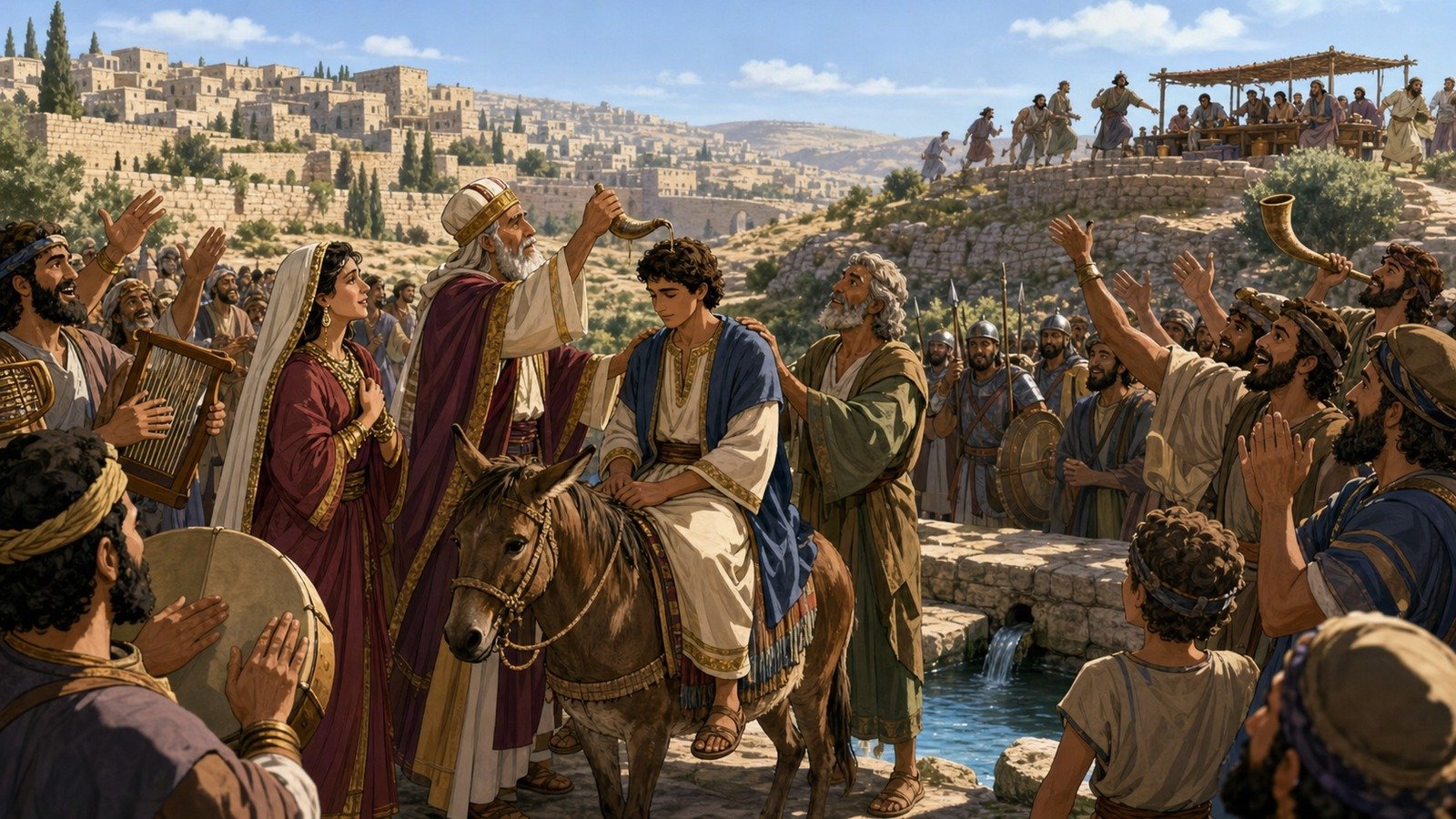
David acts immediately and stages a counter-coronation with three deliberate signals. Solomon rides the king's own mule, which is a public transfer of authority. He is anointed at the Gihon spring, which is inside the city and within earshot of En Rogel. And it is done by Zadok the priest and Nathan the prophet together, so the religious authority is unambiguous.
The trumpets sound and the crowd shouts long live King Solomon, and the noise reaches Adonijah's feast. Joab hears it and asks what the uproar in the city is about, and a messenger arrives and tells them everything.
One old man is being managed by everybody in the room. Bathsheba's speech and Nathan's arrival are coordinated in advance, down to the timing of the entrance, and both are reminding a king of an oath that no one else has heard him swear. Whether the oath was ever made cannot be established. What is clear is that Solomon was not the eldest, had no obvious claim, and became king because two people organised a morning better than his brother organised a feast.
The guests get up in alarm and disperse, and Adonijah runs to the sanctuary and takes hold of the horns of the altar, which is a claim to sanctuary. Solomon's response is conditional and cold: if he shows himself worthy, not a hair of his head will fall to the ground, but if evil is found in him, he will die. He is sent home.