

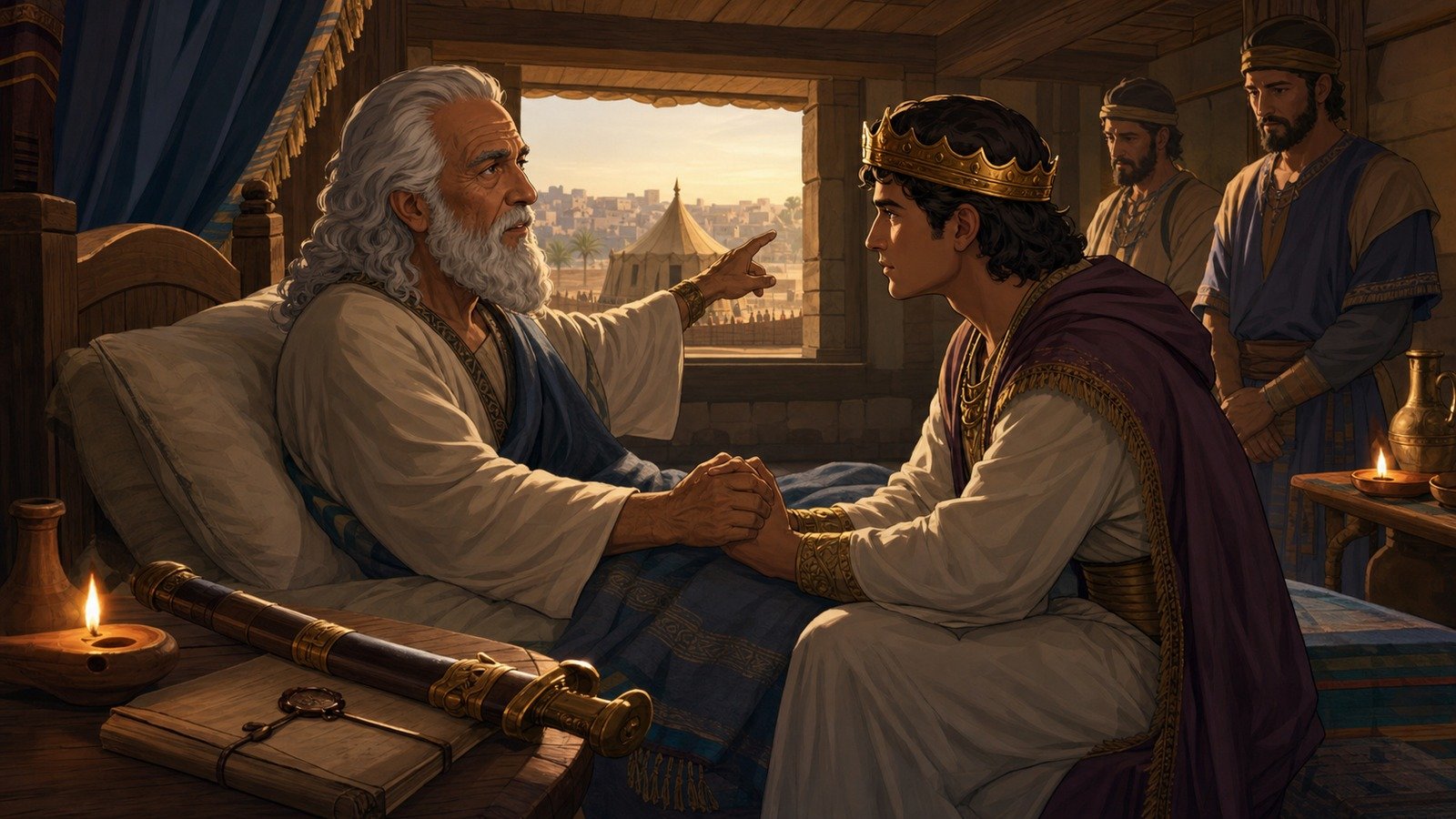
On his deathbed, David charges Solomon to walk faithfully with God and keep his commands, while also instructing him to settle several old scores, including Joab's earlier murders, left unresolved during David's own reign.
Further context
2 min readThe deathbed instruction comes in two halves and they do not sit comfortably together.
The first half is the one that gets quoted. I am about to go the way of all the earth. So be strong, act like a man, and observe what the LORD your God requires: walk in obedience to him, and keep his decrees and commands, his laws and regulations, so that you may prosper in all you do and wherever you go. Then a reminder of the promise made through Nathan, that his line will not fail to have a man on the throne of Israel, with a condition attached: if your descendants watch how they live, and if they walk faithfully before me with all their heart and soul.
The second half is a list of unfinished business, and it is delivered in the same breath.
Joab is first. David names the two murders: Abner son of Ner and Amasa son of Jether, both commanders of Israel, both killed in peacetime as though in war, with the blood of war on the belt around his waist and on the sandals on his feet. Deal with him according to your wisdom, but do not let his grey head go down to the grave in peace.
The sons of Barzillai are second, and they are to be treated well and given a place at the king's table, because their father stood by him when he fled from Absalom.
Shimei is third, the Benjamite who cursed him during the retreat. I swore to him by the LORD that I would not put him to the sword. But now, do not consider him innocent. You are a man of wisdom; you will know what to do to him. Bring his grey head down to the grave in blood.
That is a man arranging, on his last day, for a successor to break an oath he had sworn personally and kept for a decade. The oath was his to make and only his to keep, and by handing the matter to somebody who never swore it, he gets the outcome without the perjury.
Two readings of the charge are current. The first treats it as political realism: a new king of about twenty faces an army commander who has murdered two rivals and just backed a rival claimant, and a hostile clan leader with a following, and leaving either alive is a serious risk. The second treats it as exactly what it looks like, a settling of scores from a bed, using a son as the instrument. Both are defensible and the wording does not decide between them.
Solomon carries out every item within a few weeks, including having Joab killed while he is holding the horns of the altar, on the ground that the sanctuary offers no protection to a murderer.