

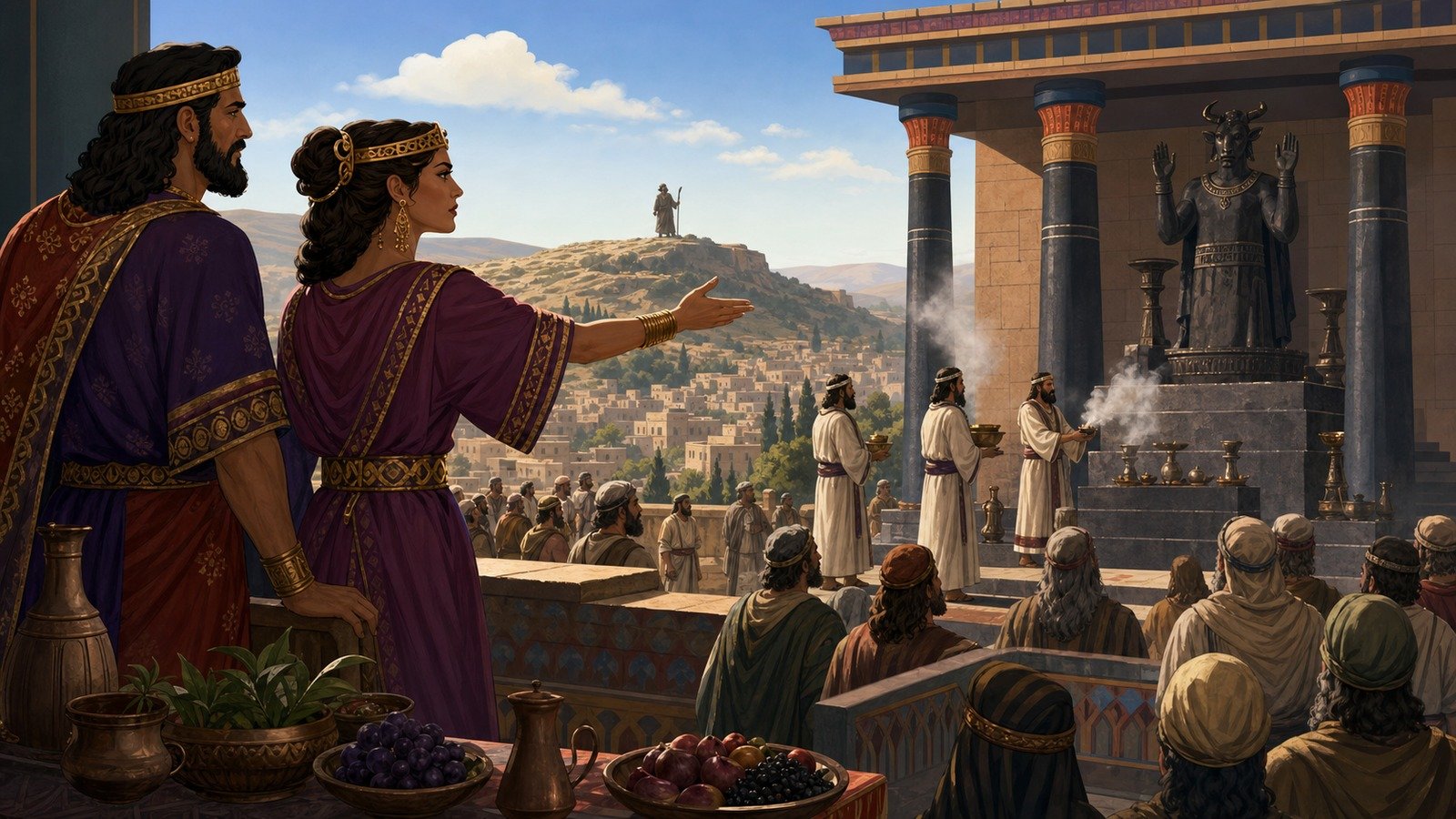
Ahab marries the Phoenician princess Jezebel and, at her instigation, builds a temple to Baal in Samaria, provoking the confrontation with Elijah that dominates the following chapters. A king commonly identified as Ahab is independently attested fighting at the battle of Qarqar in 853 BC.
Further context
3 min readTwenty-two years, and the summary is the harshest given to anyone so far: he did more evil in the eyes of the LORD than any of those before him, and he considered it trivial to commit the sins of Jeroboam, so he also married Jezebel and began to serve Baal.
The marriage is the substance of it. Jezebel is the daughter of Ethbaal king of the Sidonians, and a Phoenician alliance was the obvious move for a state whose economy ran on trade through the northern ports. Her father's name means Baal is alive, and a later Jewish historian records that he was a priest of Astarte who took the throne by assassination.
What she brings is not tolerance but establishment. A temple to Baal is built in Samaria with an altar in it, and an Asherah pole is set up. Four hundred and fifty prophets of Baal and four hundred of Asherah are maintained at royal expense and eat at her table. The prophets of the LORD are hunted, and a hundred of them are hidden in two caves by Obadiah, the man in charge of Ahab's palace, and supplied with food and water at considerable personal risk.
The Baal in question is a storm god, responsible for rain and therefore for whether anybody eats. Texts recovered from Ugarit in 1929 describe his cycle of death and return in detail, and the appeal of that religion in a country dependent on unpredictable winter rain is not mysterious.
One short note attached to the reign has an unexpected archaeological afterlife. Hiel of Bethel rebuilt Jericho, and laid its foundations at the cost of his firstborn son and set up its gates at the cost of his youngest, in accordance with a curse pronounced by Joshua centuries earlier. Foundation deposits involving child burials are attested at several sites in the region, which is what the sentence appears to be describing.
Ahab himself is more complicated than his verdict. He listens to prophets more than once, humbles himself when confronted over Naboth's vineyard and gets a stay of judgement for it, and fights two successful campaigns against Aram. He is also a substantial military power outside the Bible: an Assyrian inscription describing the battle of Qarqar in 853 BC lists Ahab the Israelite as contributing two thousand chariots and ten thousand infantry to the coalition that faced Shalmaneser III, which is the largest chariot force credited to any member of that alliance.
That battle is never mentioned in the Bible at all, and it is the single most useful synchronism in this whole period, because it fixes Ahab's reign against Assyrian records to within a year.
Twenty-two years, and the summary given of him is harsher than for anyone before: he did more evil in the eyes of the LORD than any of those before him.
The marriage to Jezebel, daughter of Ethbaal king of the Sidonians, was a trade alliance with the Phoenician coast and it brought her religion with it as state policy rather than private practice. A temple to Baal was built in Samaria, four hundred and fifty prophets of Baal were kept at royal expense, and the prophets of the LORD were hunted, with a hundred of them hidden in caves by a court official.
Excavations at Samaria produced the ivory inlays and the ostraca recording deliveries of wine and oil to the palace, which together give a picture of the wealth the reign generated.
Ahab appears in the Assyrian record commanding two thousand chariots at Qarqar, the largest contingent in the coalition.