

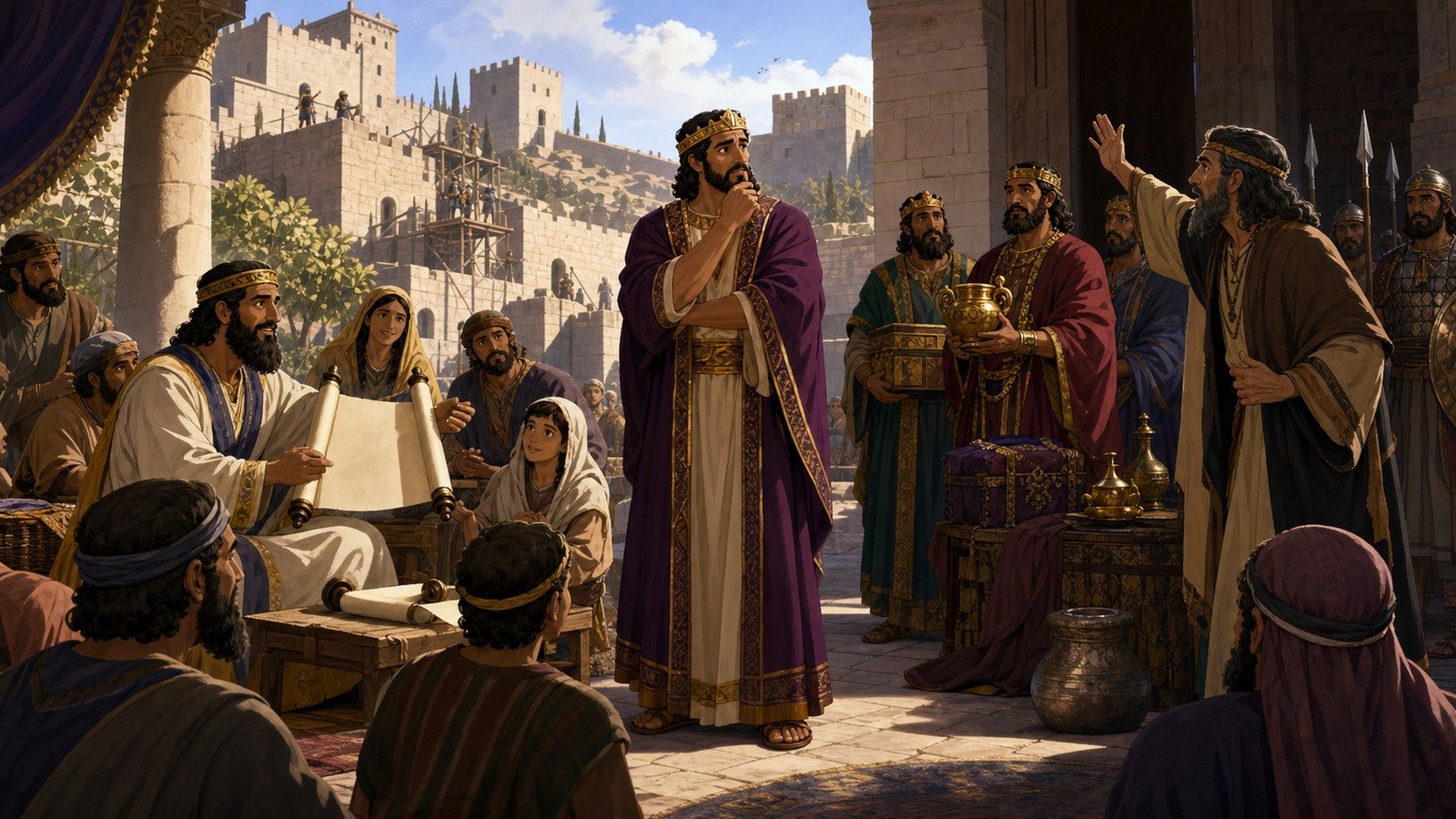
Jehoshaphat strengthens Judah, sends teachers to instruct the people in the Law, and largely follows his father Asa's faithfulness, though his military alliances by marriage with Ahab's house draw sharp prophetic criticism and later cause trouble for his descendants.
Further context
3 min readTwenty-five years in Jerusalem, and the assessment is favourable: he walked in the ways of his father Asa and did not stray from them, doing what was right in the eyes of the LORD. The standard qualification follows, that the high places were not removed and the people continued to offer sacrifices there.
Two things distinguish his reign and they pull in opposite directions.
The first is a serious attempt at making the law function. He sends officials, Levites and priests on a circuit through the towns of Judah with the book of the law to teach it, which is the first recorded programme of public legal education in the country. He then appoints judges in each of the fortified towns with an instruction that reads like a charter: consider carefully what you do, because you are not judging for mere mortals but for the LORD, who is with you whenever you give a verdict. Let the fear of the LORD be on you. Judge carefully, for with the LORD our God there is no injustice or partiality or bribery. A central court is set up in Jerusalem for difficult cases, staffed by Levites, priests and heads of families, and the division of responsibility between religious and civil matters is spelled out.
The second is a marriage alliance with the northern kingdom that nearly destroys his dynasty. His son Jehoram marries Athaliah, a daughter of the house of Ahab, and the consequences run for two generations: Baal worship imported into Jerusalem, the murder of his own grandsons, and a Phoenician-descended queen ruling Judah for six years.
The alliance also drags him into a war he had no business in. He agrees to join Ahab against Aram at Ramoth Gilead, and his one condition is that a prophet of the LORD be consulted first, which produces the confrontation with Micaiah son of Imlah. Four hundred court prophets promise victory. Micaiah, summoned reluctantly, first mocks them by repeating their answer and is then ordered to tell the truth, and describes Israel scattered on the hills like sheep without a shepherd. He is slapped in the face and put in prison on bread and water. Ahab goes into battle in disguise, and Jehoshaphat goes in his royal robes and is nearly killed by mistake, and Ahab is hit by an arrow shot at random.
One further episode of his reign is worth recording because of how it was fought. Facing an invasion from Moab, Ammon and Edom, he proclaims a national fast, prays in the temple courtyard with a sentence that has outlasted the crisis, we do not know what to do, but our eyes are on you, and then sends singers out ahead of the army. The invading coalition destroys itself before Judah arrives, and the men spend three days collecting equipment and valuables from the field.
He survives, and a prophet meets him on the way home with a question that stands over the whole policy: should you help the wicked and love those who hate the LORD?
Twenty-five years in Jerusalem and a favourable verdict, and what he is remembered for is a policy rather than a battle.
He set up a national judicial system, appointing judges in each of the fortified cities of Judah with an appeal court at Jerusalem, and he sent officials and Levites round the towns with the book of the law to teach it. That is the only such circuit recorded in either kingdom.
The alliance with the north was sealed by marrying his son to Ahab's daughter Athaliah, and the bill for it arrives within two generations, when she wipes out the royal family and takes the throne herself.
He also built a fleet at Ezion Geber for the gold trade, and the ships were wrecked in port before they sailed.