
Alexander defeats the Persian empire in a series of campaigns, taking Judea without recorded resistance, and spreads Greek language and culture across the entire eastern Mediterranean and Near East, the linguistic and cultural precondition for a Greek New Testament three centuries later.
No canonical Scripture reference (historical context outside the Protestant canon)
Further context
3 min readAlexander of Macedon crosses into Asia in 334 BC at twenty-two with about forty thousand men, and in eleven years he takes everything from the Aegean to the Punjab.
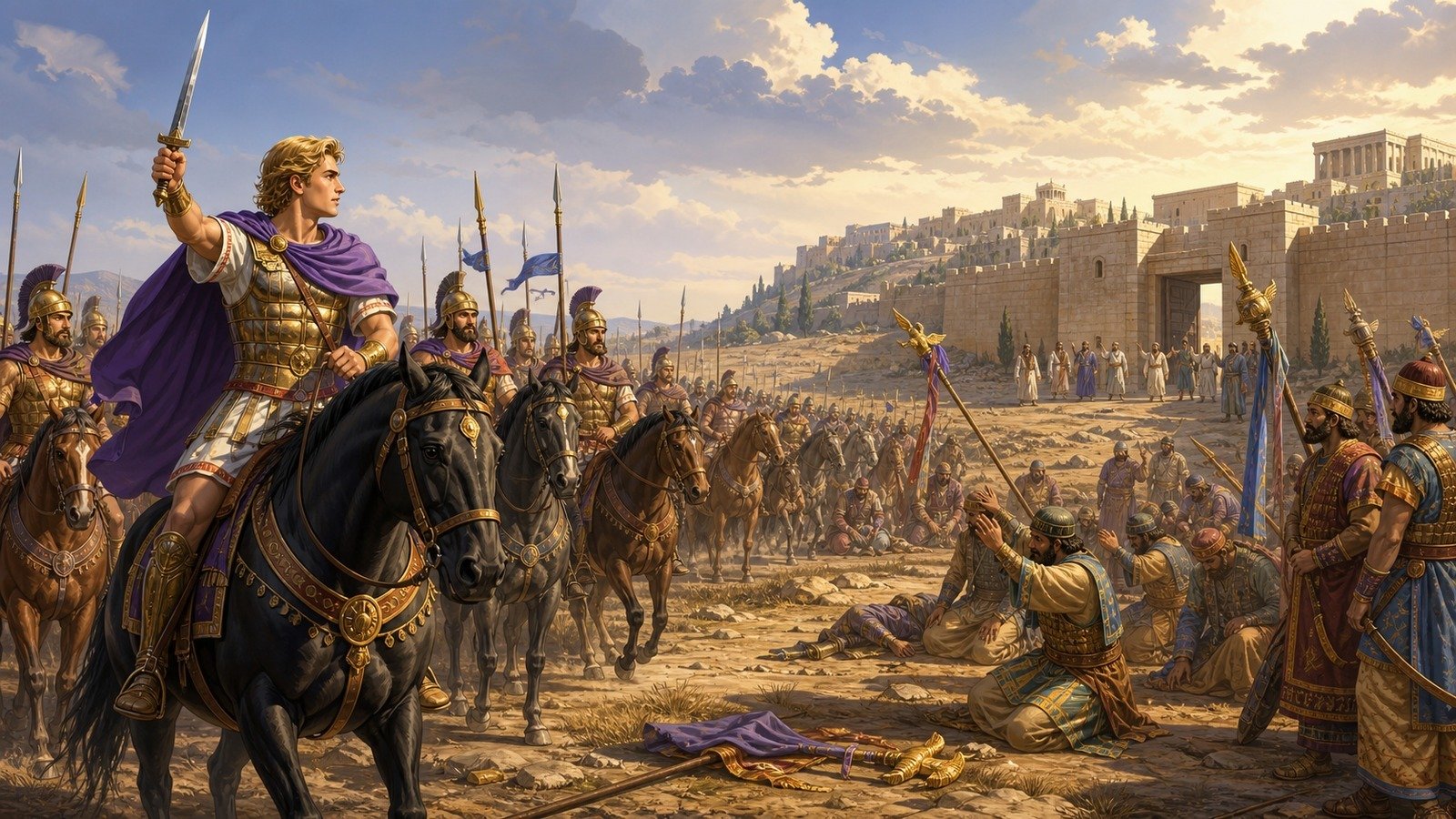
The campaign runs through three set-piece battles. At the Granicus he takes the coast of Asia Minor. At Issus in 333 he defeats Darius III himself and captures the Persian royal family. At Gaugamela in 331 he destroys the main Persian army and the empire collapses; Darius flees and is murdered by his own satraps the following year.
Between Issus and Gaugamela he spends most of a year reducing the Phoenician coast, and the siege of Tyre is the part of the campaign that touches this region directly. The city sat on an island half a kilometre offshore and had never been taken. He built a causeway out to it from the rubble of the mainland town, took seven months over it, and stormed the walls. The causeway silted up and Tyre has been a peninsula ever since. Ezekiel had described the city's stones, timber and soil being thrown into the sea two and a half centuries earlier.
Judea submits without a fight and is not mentioned in the surviving campaign accounts. A story preserved much later has Alexander meeting the high priest outside Jerusalem and being shown a prophecy about himself, and no contemporary source supports it.
One detail of the campaign has a long echo. Ezekiel had described Tyre's stones, timber and rubble being thrown into the sea and the city becoming a bare rock where fishermen spread their nets. Alexander built his causeway out of the ruins of the mainland town, quite literally scraping the site clean to do it. Whether that counts as fulfilment or as coincidence is the sort of question these correspondences always raise, and the causeway is still there.
What he leaves behind matters far more than the conquest. Greek becomes the common language of the eastern Mediterranean, in a simplified form that everybody could use for trade and administration, and it stays that way for a thousand years. Greek cities are founded across the region with their gymnasiums, theatres and civic institutions, and the pressure to adopt Greek dress, education and manners becomes the central cultural question for Jewish communities for the next two centuries.
Two consequences bear directly on the New Testament.
The Hebrew scriptures are translated into Greek in Alexandria during the third century BC, producing the version known as the Septuagint. That translation is what most Jews outside Judea actually read, and it is the version the New Testament writers usually quote.
And the New Testament is written in that same common Greek, by Jews, about a Galilean who spoke Aramaic, and is readable from Spain to Mesopotamia the moment it is finished.
The campaign figures are worth stating because the scale is hard to credit. Alexander crossed the Hellespont in 334 BC at the age of twenty-two, won at the Granicus that spring, at Issus the following year, took Tyre after a seven-month siege by building a causeway to the island, took Egypt without a fight, won at Gaugamela in 331, burned Persepolis, and reached the Punjab by 326. His army mutinied at the Beas and refused to go further.
Josephus preserves a story that he came to Jerusalem, was met by the high priest in his vestments, and bowed to him. Nothing outside that account supports it, and most historians treat it as legend.
What Judea actually got was a change of landlord. The tribute went to a different capital and the local arrangements continued.
The change that mattered was linguistic, and it arrived slowly and permanently.