

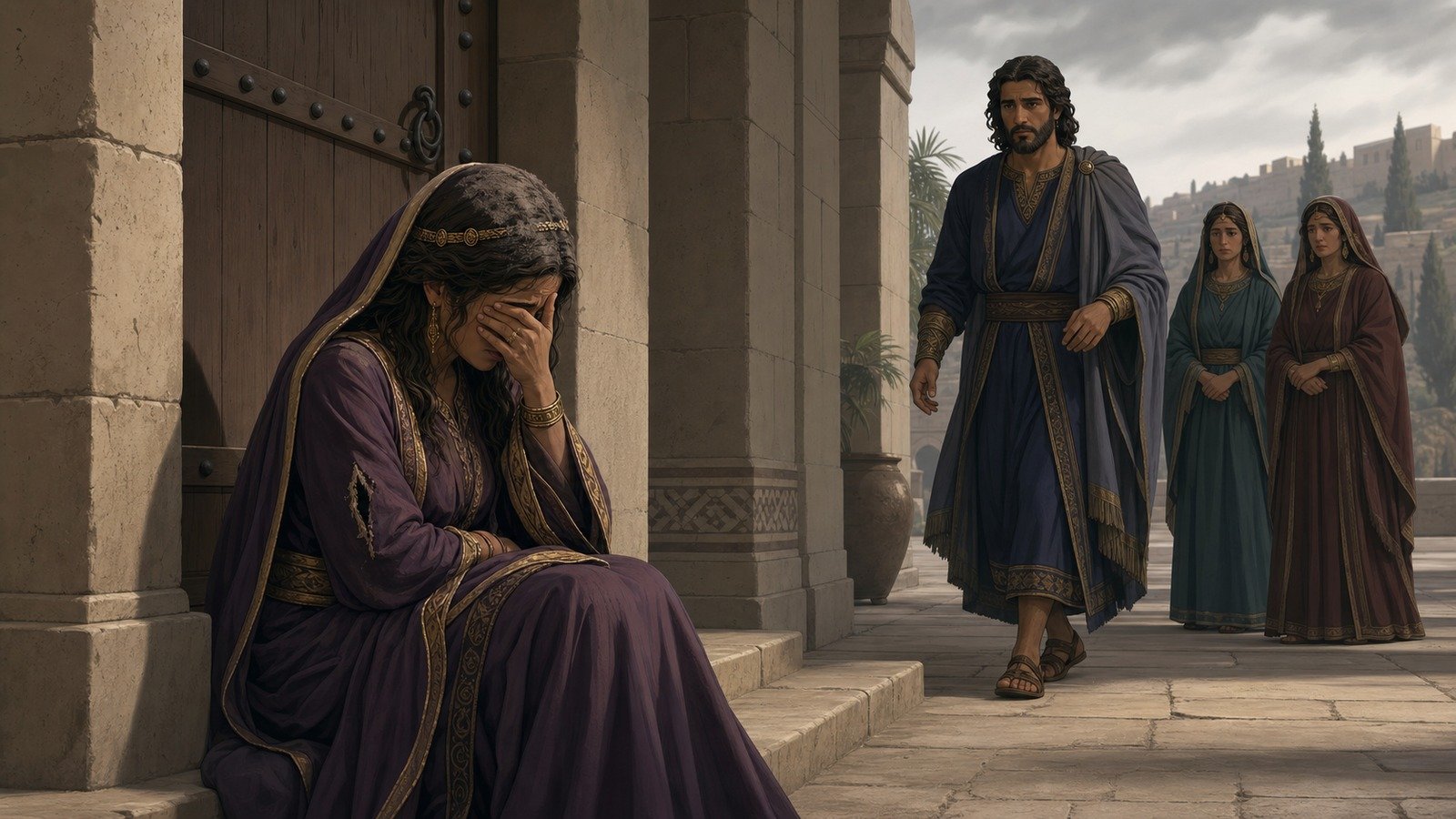
David's son Amnon feigns illness to lure his half-sister Tamar into his room and rapes her; David is angry but takes no disciplinary action, a failure that sets up Absalom's later revenge.
Further context
2 min readThe sword that was promised to the king's household arrives first among his own children, and it starts with his eldest son.
Amnon is David's firstborn and the heir. Tamar is his half-sister, the full sister of Absalom, and she is described as beautiful. He becomes obsessed with her to the point of illness, and the reason given is that it seemed impossible for him to do anything to her, since she was a virgin, which means she was closely supervised.
His cousin Jonadab, described as a very shrewd man, supplies the plan: pretend to be ill, ask the king to send Tamar to make food in your sight and feed you.
It works exactly as designed. David sends her himself. She goes to her brother's house, takes dough, kneads it, makes bread in his sight and bakes it, and he refuses to eat and sends everyone out of the room.
Her attempt to stop him is a speech of four arguments delivered fast. Do not, my brother. Do not force me. Such a thing should not be done in Israel. Do not do this wicked thing. What about me? Where could I get rid of my disgrace? And what about you? You would be like one of the wicked fools in Israel. Please speak to the king; he will not keep me from being married to you. She is arguing law, her future, his reputation, and finally offering him a legal route to the same end, which suggests she was reaching for anything that might work.
He refuses to listen and overpowers her.
Then comes the line that turns the episode: he hated her with intense hatred, so that he hated her more than he had loved her. He tells her to get out, and when she says that sending her away is a greater wrong than what he has already done, he calls a servant and has her put out and the door bolted behind her.
She puts ashes on her head, tears the ornate robe she is wearing as an unmarried daughter of the king, and goes away weeping aloud. Absalom's response is to tell her to be quiet for now and not take this thing to heart, and she lives in his house, a desolate woman.
One consequence for Tamar is stated in a single clause and it is easy to pass over. She lives in her brother's house, a desolate woman, and that is the last anyone hears of her. The word covers isolation and ruin together, and in a society where a woman's future ran through marriage, an unmarried daughter of the king who had been assaulted had no route back to a normal life. Absalom later names his own daughter after her.
David hears about all of it and is furious and does nothing whatever. The Greek version adds an explanation the Hebrew lacks, that he would not punish Amnon because he loved him and he was his firstborn. Either way, a king who had just passed a death sentence on a hypothetical sheep thief takes no action against a rapist in his own family, and two years later that failure kills his eldest son.