

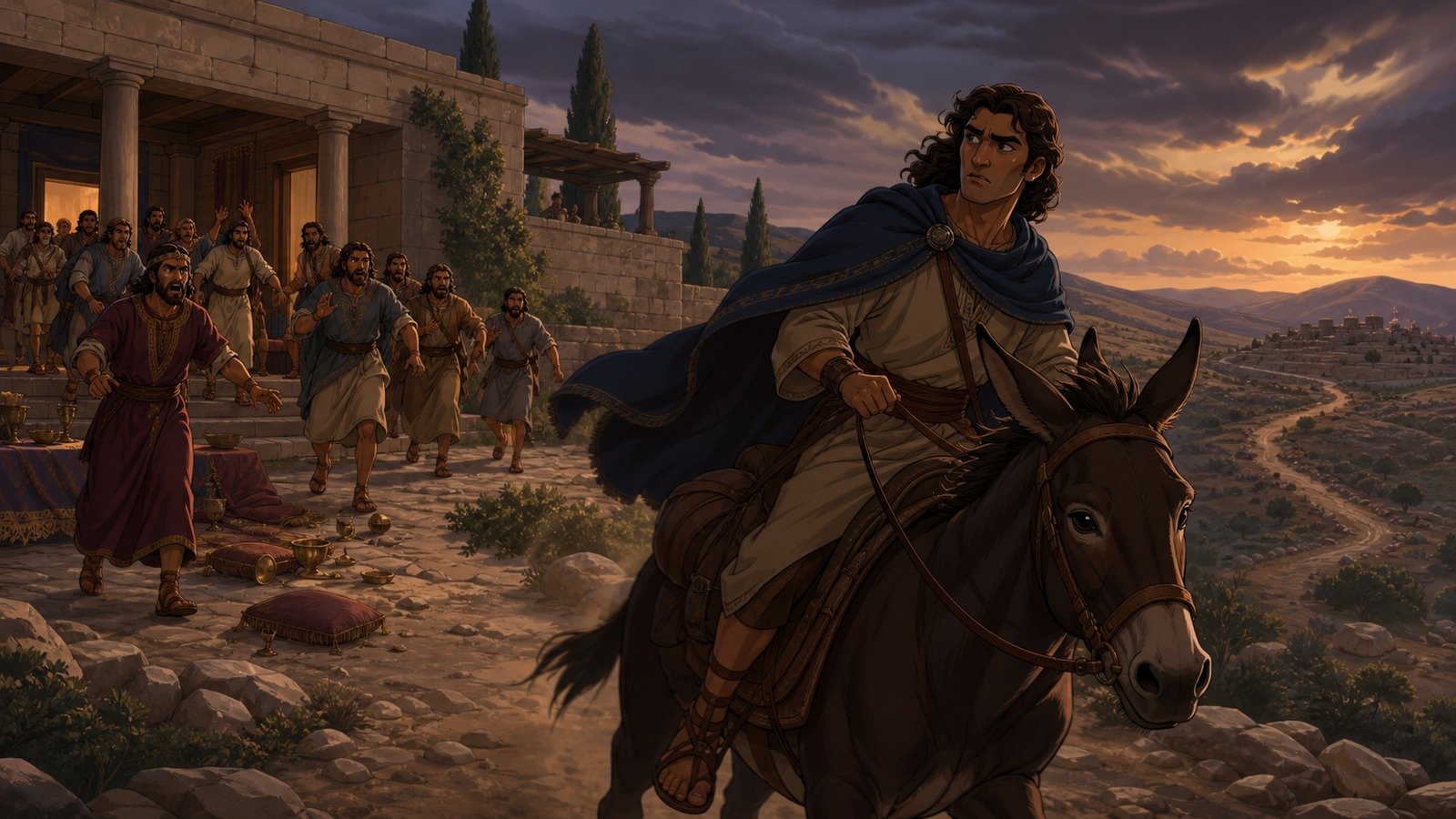
Two years after the rape, Absalom has Amnon killed at a feast and flees to his grandfather's kingdom of Geshur, beginning a rupture with David that will eventually erupt into open rebellion.
Further context
2 min readTwo years pass in one sentence, and in that time Absalom says nothing to Amnon, either good or bad. That silence is the most frightening thing about him.
The occasion he chooses is a sheep-shearing at Baal Hazor, which is a festival with feasting and drinking, and the same setting as the Nabal episode a generation earlier. He invites the king first, knowing the invitation will be declined as too great a burden, and then asks that Amnon come instead. David's question, why should he go with you, gets no answer beyond insistence, and he agrees and sends all the king's sons.
The instruction to the servants is cold and deliberate: watch until Amnon is in high spirits from drinking wine, and when I say strike Amnon down, then kill him. Do not be afraid. Have not I given you this order? Be strong and brave. He takes the responsibility onto himself in advance, in the language a commander uses before a battle.
They do it, and the remaining king's sons get up, mount their mules and flee.
The news that reaches Jerusalem first is that every one of the king's sons is dead, and David tears his clothes and lies on the ground. Jonadab, the cousin who supplied the plan for the rape two years earlier, is the one who corrects the report and tells the king that only Amnon is dead, adding that this has been Absalom's intention ever since the day his sister was raped. He knew, and had said nothing to anybody for two years.
Absalom flees to Geshur, a small Aramean kingdom north-east of the Sea of Galilee, and stays there three years. That is not a random destination. His mother Maakah was the daughter of the king of Geshur, so he is going to his grandfather, and the marriage alliance David made decades earlier now provides sanctuary for the man who has just murdered the heir.
Geshur is also a reminder of how the family was built. David married Maakah as a political alliance while ruling one tribe from Hebron, and he had at least seven wives by then and more afterwards, with sons by different mothers competing for the same throne. Amnon, Absalom and Adonijah are half-brothers, each raised in a separate household inside the same palace, and every one of the three succession crises comes out of that arrangement.
The closing sentence is the one that sets up everything after it: the spirit of the king longed to go to Absalom, for he was consoled concerning Amnon's death.
What has happened in five years inside one household is a rape, a two-year silence, a murder at a party and an exile, and at no point does the head of that household do anything at all. He is furious about Tamar and takes no action. He mourns Amnon and takes no action. He longs for Absalom and does not send for him. The prophet had said calamity would come out of his own house, and what is actually driving it is a father who cannot bring himself to confront any of his children.