

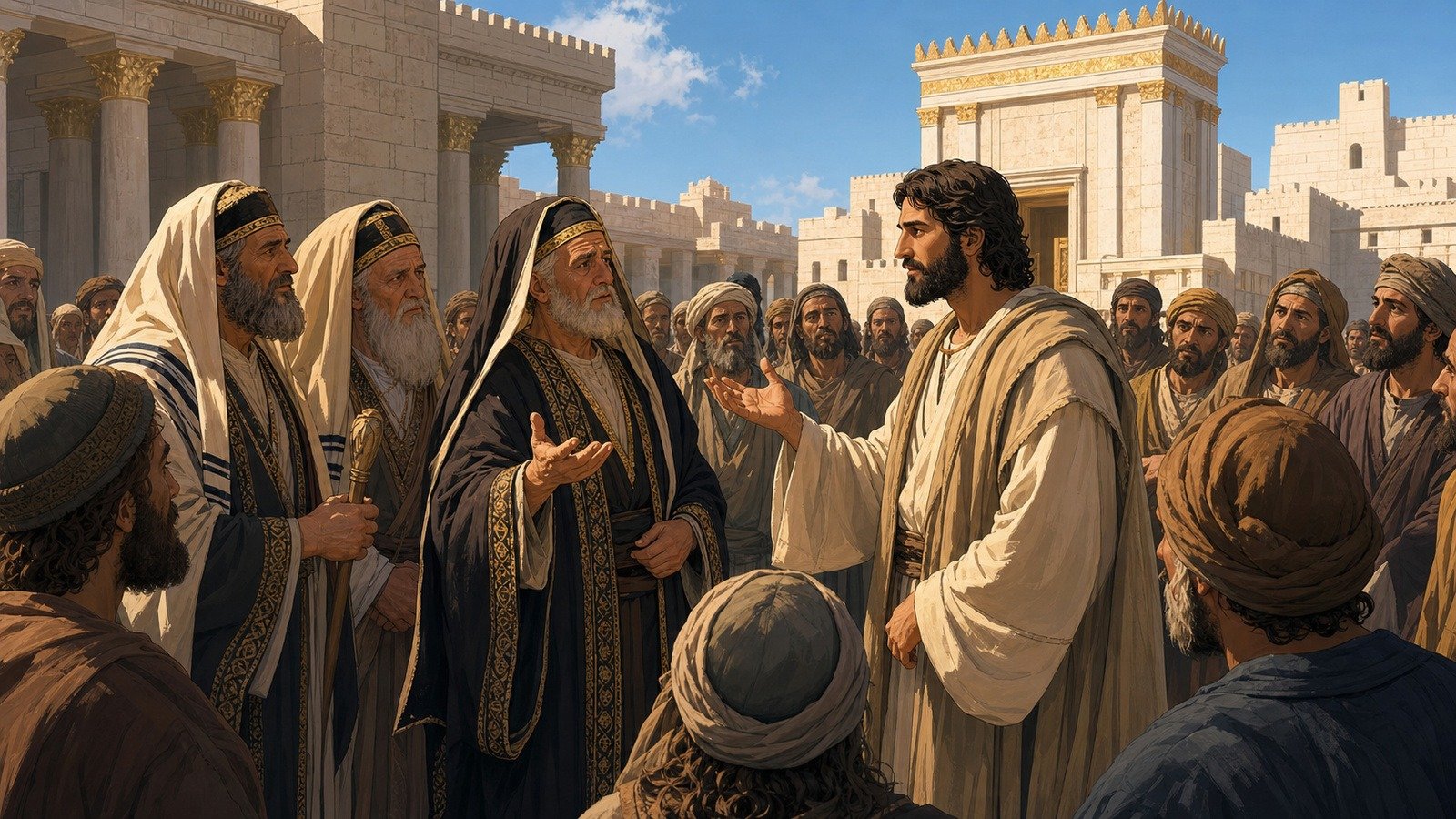
Religious leaders directly challenge Jesus' authority to teach and act as he does; he answers with a counter-question about John the Baptist's authority that leaves them unable to respond without political risk either way.
Further context
2 min readThe delegation that comes to Jesus in the temple courts the following day is the full weight of the establishment: chief priests, teachers of the law and elders, which is the composition of the Sanhedrin itself.
Their question is procedural and entirely reasonable given what he had done to the tables. By what authority are you doing these things? And who gave you authority to do this?
Behind it lies a system. A teacher's standing came from his training, and rabbis cited the men they had studied under. Priests held office by descent and appointment. Anyone acting in the temple precincts without a recognised warrant was acting illegally, and a man who had disrupted the licensed trade there was answerable for it.
The reply is a counter-question, which was a normal move in rabbinic argument rather than an evasion. I will ask you one question. Answer me, and I will tell you by what authority I am doing these things. John's baptism, was it from heaven, or of human origin?
That is not a debating trick. It puts the same question to them about a man they had already declined to endorse, and it makes their answer about him a test case for their answer about anyone.
Their deliberation is reported, which is unusual and rather damaging. If we say from heaven, he will ask why we did not believe him. But if we say of human origin, we are afraid of the people, for they all hold that John really was a prophet.
Nothing in that calculation concerns whether the thing was true. Both options are weighed for consequences, and the answer given is the one that costs least: we do not know.
Then I will not tell you by what authority I am doing these things.
What is on display is a body whose authority was real, whose right to ask was genuine, and which will not commit itself in public on a question it has certainly discussed in private. John had been dead perhaps two years, executed by a ruler they had no love for, and his popular standing was still high enough to make an honest answer dangerous.
The exchange sets up everything that follows through that Tuesday. Three parables are told immediately afterwards, each about people entrusted with something who fail to deliver it, and the audience is the delegation standing in front of him.
Rabbinic debate frequently proceeded by counter-question, and answering a question with a question was not rudeness but method, a way of establishing what the questioner already accepted before proceeding. What is unusual here is the answer he gets back, which concedes nothing and establishes nothing.
Their we do not know is also a false statement rather than an admission of ignorance. They had certainly reached a view about John, since he had been preaching a few kilometres away to enormous crowds and they had sent a delegation to interview him.
Nothing in the exchange concerns the trade he had disrupted, the money changers or the licences. The delegation asks about credentials, and the answer refuses to supply them on the terms requested.