

God repeatedly turns Balaam's intended curses into blessings over Israel across four oracles, including a prophecy of a coming "star out of Jacob," despite Balak's mounting frustration.
Further context
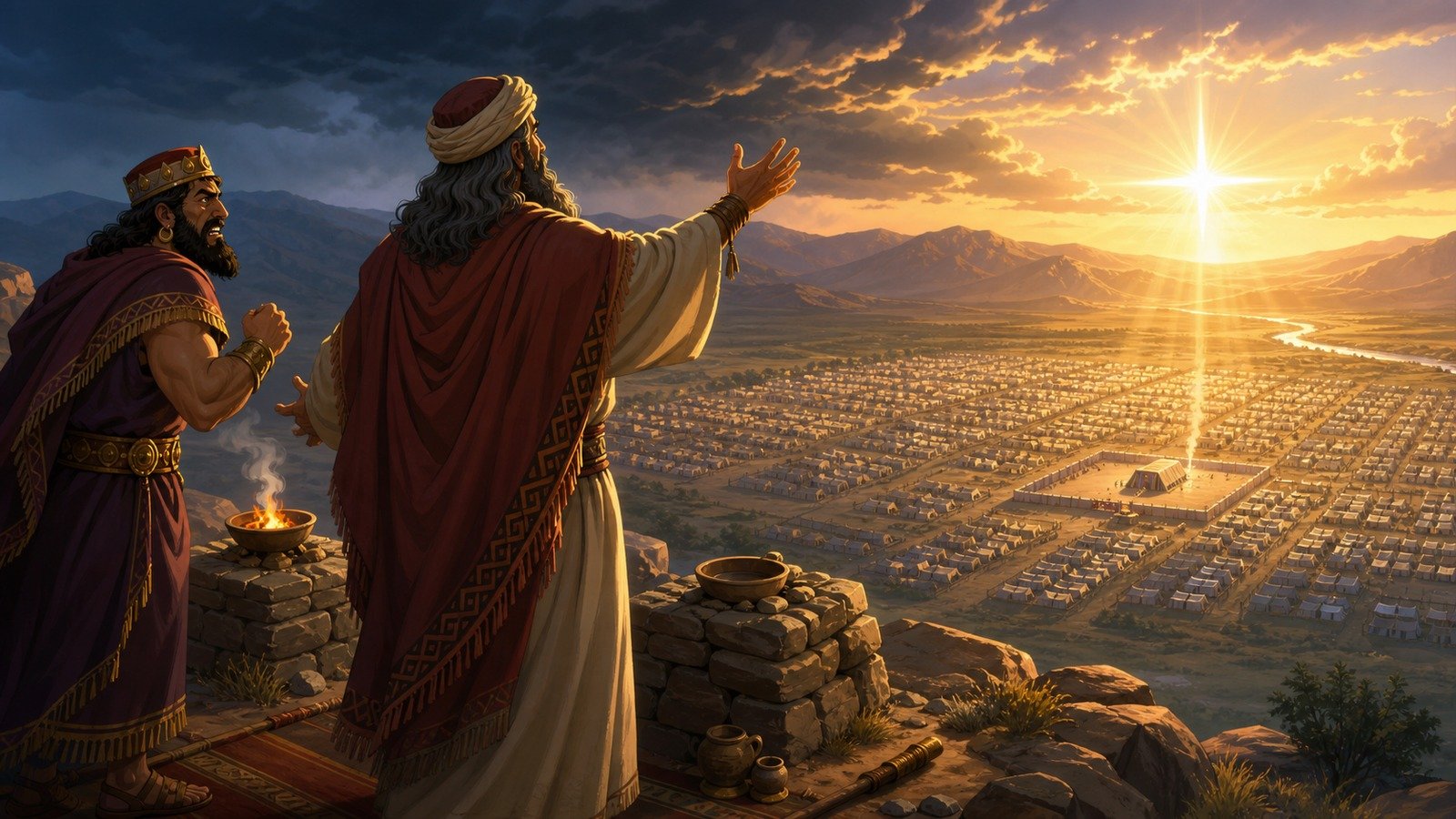
2 min readThe same procedure is repeated three times and then broken. Balak takes Balaam to a high place overlooking part of the Israelite camp, seven altars are built, a bull and a ram are offered on each, and Balaam withdraws to see what he will be given to say. Each time he comes back and blesses.
The first oracle asks the question the whole episode turns on: how can I curse those whom God has not cursed? How can I denounce those whom the LORD has not denounced? Balak's reaction is exasperation, and he moves him to a different vantage point on the theory that seeing a smaller part of the camp might help.
The second is more pointed. God is not human, that he should lie, not a human being, that he should change his mind. Does he speak and then not act? Does he promise and not fulfil? I have received a command to bless; he has blessed, and I cannot change it.
Before the third, something shifts. He stops resorting to divination and turns towards the wilderness, and the Spirit of God comes on him. What follows opens with a line that entered Jewish daily liturgy and is still recited on entering a synagogue: how beautiful are your tents, Jacob, your dwelling places, Israel.
Balak's anger boils over and he tells him to go home without payment. Balaam gives a fourth oracle anyway, unpaid and unrequested, and it looks further forward than the others. A star will come out of Jacob; a sceptre will rise out of Israel. That line was read as a promise of a coming ruler in later Jewish and Christian interpretation, and it had a political afterlife: when Simon bar Kosiba led a revolt against Rome in AD 132 he was given the name son of the star in reference to it.
The story should not stop there, because the later verdict on this man is uniformly negative and the reason lies a few chapters on. The Midianite women who drew Israel into disaster at Peor are said to have done so on Balaam's advice. Unable to curse, he appears to have advised his employers on how to make Israel forfeit its protection from the inside.
The oracles also contain some of the sharpest political language in the whole period. Israel is described as a people who live apart and do not consider themselves one of the nations, which is an observation an outsider would make and a description the nation later applied to itself. Balak has paid for a curse, been given four blessings, and is left with a professional telling him that the people he wanted removed will crush the foreheads of Moab.
Three separate New Testament writers use him as a byword. One refers to the teaching of Balaam, who taught Balak to entice the Israelites into sin. Another speaks of rushing for profit into Balaam's error. A third describes a man who loved the wages of wickedness. A prophet who delivered four true oracles about Israel, one of which is still sung in synagogues, is remembered as the type of a man who sold a gift.