

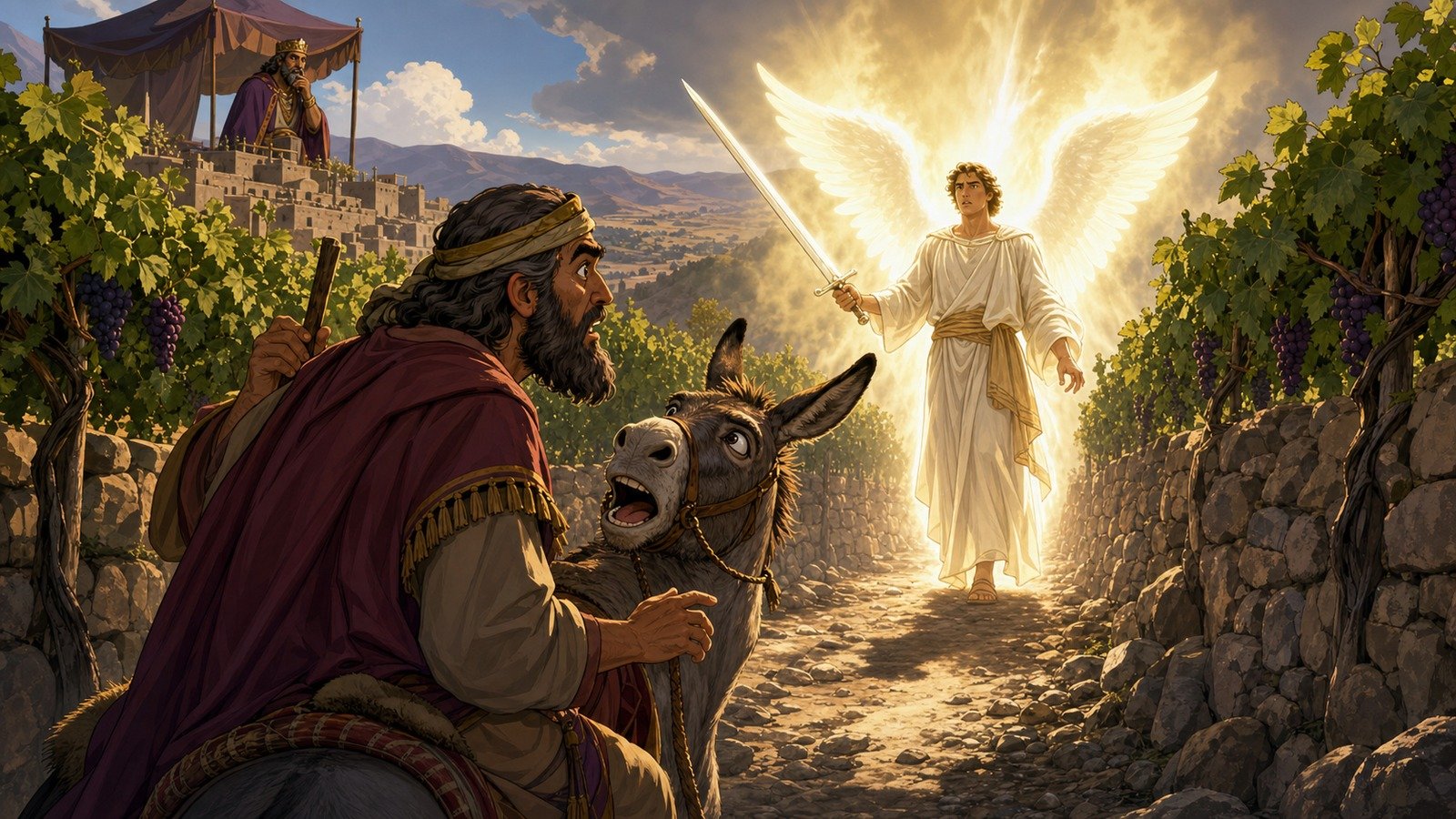
Moabite king Balak hires the pagan seer Balaam to curse Israel; on the way, Balaam's own donkey sees a blocking angel he cannot and speaks to rebuke him, a strange and famous episode confirming that Balaam ultimately answers to God, not Balak.
Further context
2 min readMoab watches Israel defeat two Amorite kings and camp on its border, and Balak son of Zippor is terrified because they are so numerous. His response is not military. He sends for a professional.
Balaam son of Beor lives at Pethor near the Euphrates, several hundred kilometres away, which indicates a reputation of some size. The delegation of Moabite and Midianite elders arrives with the fee for divination and a commission: come and put a curse on these people, because I know that whoever you bless is blessed and whoever you curse is cursed.
A remarkable piece of external evidence bears on this man. In 1967 excavators at Deir Alla in the Jordan valley found plaster fragments from a wall inscription, dated to around 800 BC, beginning with an account of Balaam son of Beor, a seer of the gods, who received a vision at night. It is written in a West Semitic dialect and has nothing whatever to do with Israel. It establishes that a figure of that name was known as a visionary in that region independently of the Bible, which is unusual for a minor character in these books.
The theology is handled carefully. Balaam consults God, is told not to go, and refuses the first delegation. A second and more distinguished embassy arrives with a higher offer, and this time he is told to go but to do only what he is told. Then, in a sentence that has puzzled readers for centuries, God is very angry that he goes.
Three explanations are usually offered: that the permission was a concession to a man who kept asking, that the anger is directed at his motive rather than his journey, and that two traditions have been preserved side by side. What is not in doubt is that he is presented as a man who says the right things and is going anyway.
The angel of the LORD stands in the road with a drawn sword and the donkey sees him three times. First she turns off into a field. Then, in a narrow path between two vineyard walls, she presses against the wall and crushes her rider's foot. Then she lies down under him. He beats her each time.
Then her mouth is opened, and her question is domestic rather than prophetic: what have I done to you to make you beat me these three times? When he says she has made a fool of him, she answers, am I not your own donkey, which you have always ridden to this day? Have I been in the habit of doing this to you? He has to say no.
His eyes are then opened and he sees what the animal has been seeing all along. The angel's words are blunt: your donkey saw me and turned away from me these three times. If it had not turned away, I would certainly have killed you by now, but I would have spared it.
A New Testament letter summarises the episode acidly: a prophet rebuked for his wrongdoing by a donkey, an animal without speech, which restrained his madness.