

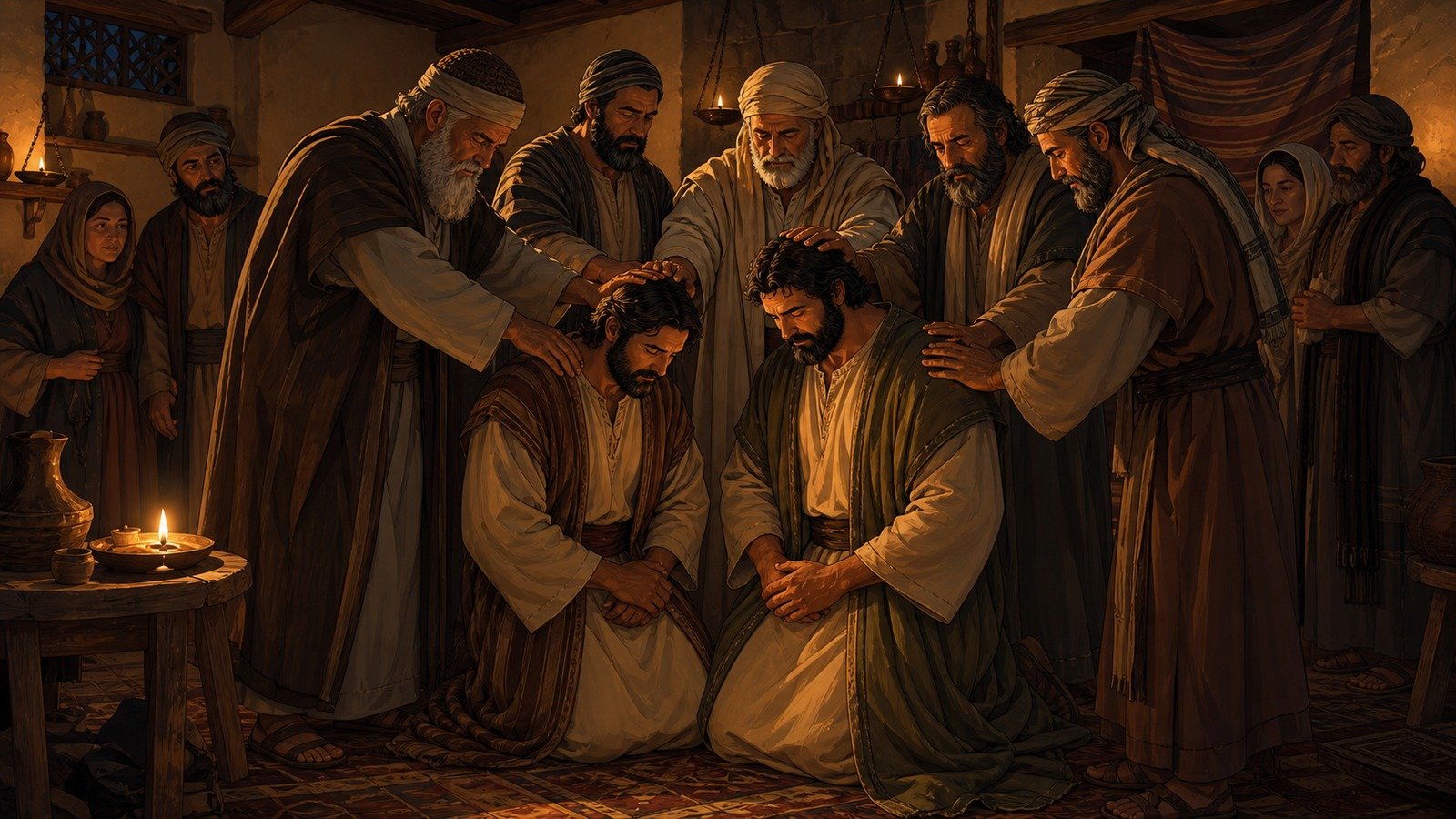
During worship and fasting, the Antioch church is told by the Holy Spirit to set apart Barnabas and Saul for a specific work; the church commissions them with the laying on of hands, beginning what is traditionally called Paul's first missionary journey.
Further context
2 min readAt Antioch there were prophets and teachers, and five of them are named, which is one of the more informative lists in the New Testament.
Barnabas, the Cypriot Levite. Simeon called Niger, whose nickname means the black one and most probably indicates an African. Lucius of Cyrene, from what is now Libya. Manaen, who had been brought up with Herod the tetrarch, meaning Antipas, so a man raised in a royal household. And Saul.
Between them they cover Cyprus, Africa, the Herodian court and Tarsus, in a Syrian city, leading a congregation of Jews and Greeks. That is what the leadership of the first Gentile church looked like.
While they were worshipping the Lord and fasting, the Holy Spirit said, set apart for me Barnabas and Saul for the work to which I have called them.
How that instruction was delivered is unstated, and the setting suggests it came through one of the prophets present.
So after they had fasted and prayed, they placed their hands on them and sent them off.
Two things about that sending are worth noticing, because they set the pattern for everything afterwards.
The initiative comes from a local congregation rather than from Jerusalem. Antioch commissions its own two best men and lets them go, which for a church a few years old is a substantial thing to give away.
And nobody is going anywhere new in the first instance. They sail for Cyprus, which is where Barnabas is from, and they take John Mark with them as their helper. The pattern of the whole enterprise is people travelling to places where they have connections, along existing routes, using the synagogue network as a starting point in each city.
They go down to Seleucia, the port of Antioch, and sail from there.
The journey that follows lasts perhaps two years and covers Cyprus and the southern part of Asia Minor. It is the first of three, and by the end of the third the man now called Saul has planted congregations across the northern Mediterranean and written several of the letters that make up a third of the New Testament.
Manaen's description, brought up with Herod the tetrarch, uses a term for a boy raised alongside a royal child as a companion, an established position in Hellenistic courts. That means one of the leaders of the Antioch church had grown up with the man who executed John the Baptist and mocked Jesus.
Fasting is mentioned twice in three sentences, which is the only time the practice is described in connection with a decision of this kind.
Sending two of five named leaders away indefinitely was a substantial cost for a church of that age, and nothing suggests it was reluctant. The instruction is reported as the Spirit's and the congregation acts on it within a paragraph.
Antioch's leadership list is the only one of its kind in the New Testament, and its range is the point. Nothing comparable existed anywhere else, and the congregation that produced it is the one that sent the mission to the Gentile world.