

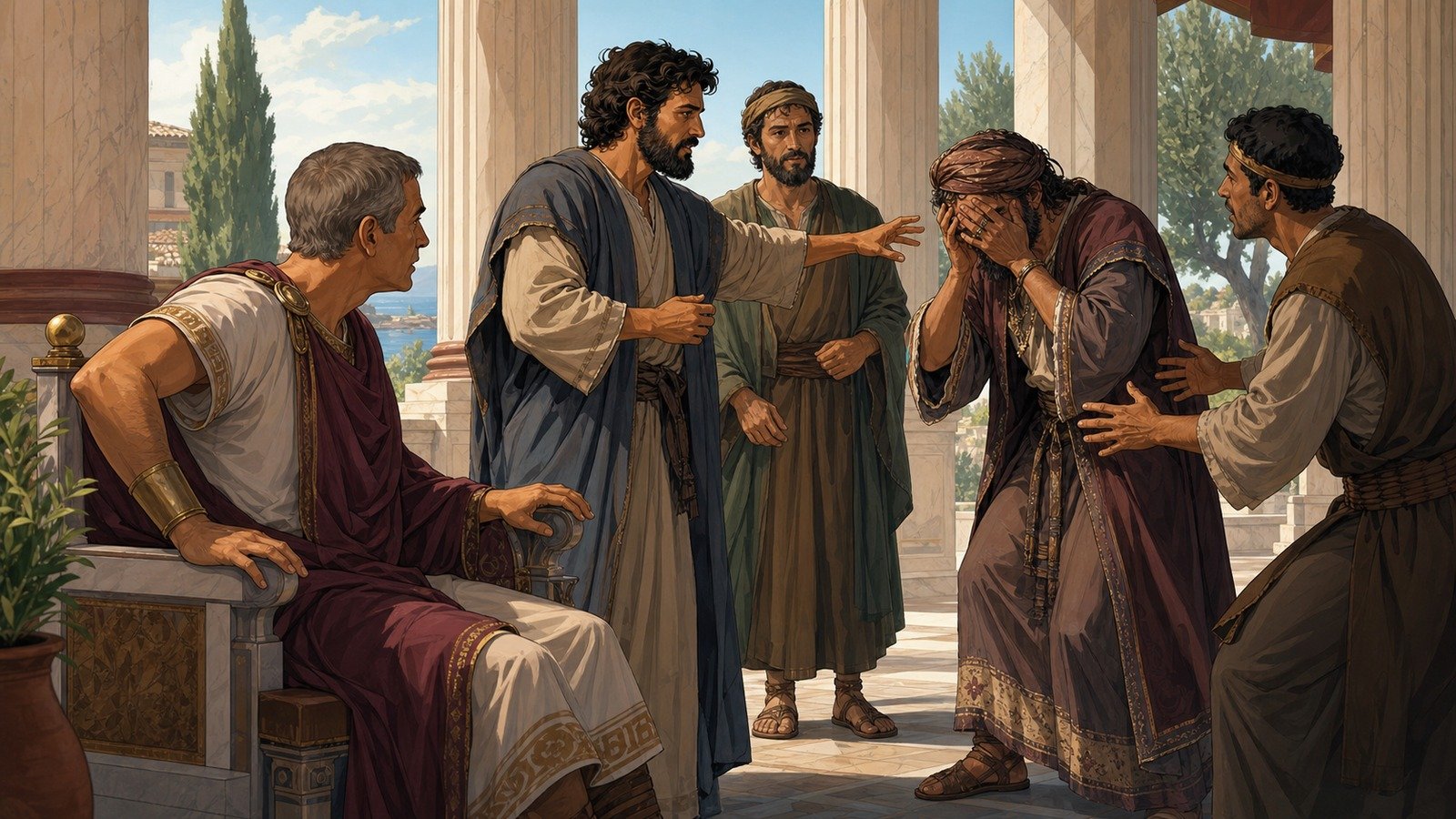
On Cyprus, Saul, now called Paul in the text for the first time, confronts a sorcerer named Elymas who opposes his preaching to the Roman proconsul; Paul strikes him blind, and the proconsul, astonished, believes.
Further context
2 min readBarnabas and Saul land at Salamis on the eastern end of Cyprus and work westward across the island to Paphos, proclaiming the word in the Jewish synagogues.
Cyprus was a senatorial province, governed by a proconsul, and its copper mines had been famous since the Bronze Age; the metal takes its English name from the island. Paphos, at the western end, was the administrative capital and the site of a celebrated sanctuary of Aphrodite, who was held to have come ashore there.
At Paphos they meet a Jewish sorcerer and false prophet named Bar-Jesus, who is an attendant of the proconsul, Sergius Paulus.
That a Roman governor kept a resident astrologer is entirely in character for the period. Educated Romans consulted specialists in divination as a matter of course, and Jewish practitioners had a particular reputation for it, since eastern wisdom sold well.
Sergius Paulus is described as an intelligent man, and he sends for Barnabas and Saul because he wants to hear the word of God. Inscriptions naming a Sergius Paulus have been found both at Rome and in Asia Minor, and whether any of them refers to this man is argued over without resolution.
The sorcerer, called Elymas, opposes them and tries to turn the proconsul from the faith.
Then Saul, who was also called Paul, filled with the Holy Spirit, looked straight at him and said: you are a child of the devil and an enemy of everything that is right! You are full of all kinds of deceit and trickery. Will you never stop perverting the right ways of the Lord? Now the hand of the Lord is against you. You are going to be blind for a time, not even able to see the light of the sun.
Immediately mist and darkness came over him, and he groped about, seeking someone to lead him by the hand.
A man temporarily blinded and needing to be led by the hand is exactly what had happened to Paul himself outside Damascus, and it is difficult to believe the parallel escaped him.
When the proconsul saw what had happened, he believed, for he was amazed at the teaching about the Lord.
Two things change permanently at this point. Saul is called Paul from here onwards, which is most probably his Roman name used in Roman company rather than a new one. And the order of the pair reverses: it has been Barnabas and Saul, and from now on it is Paul and his companions.
Sergius Paulus is the first Roman official recorded believing, and he is a proconsul, which is the rank a senatorial province carried. That detail was once treated as an error, since Cyprus had at times been imperial rather than senatorial and would then have had a legate; the correction is that it had been transferred to the senate in 22 BC, and coins from the island confirm the title.
What the proconsul made of it afterwards is unknown, and there is no record of a church on Cyprus in Paul's letters.