

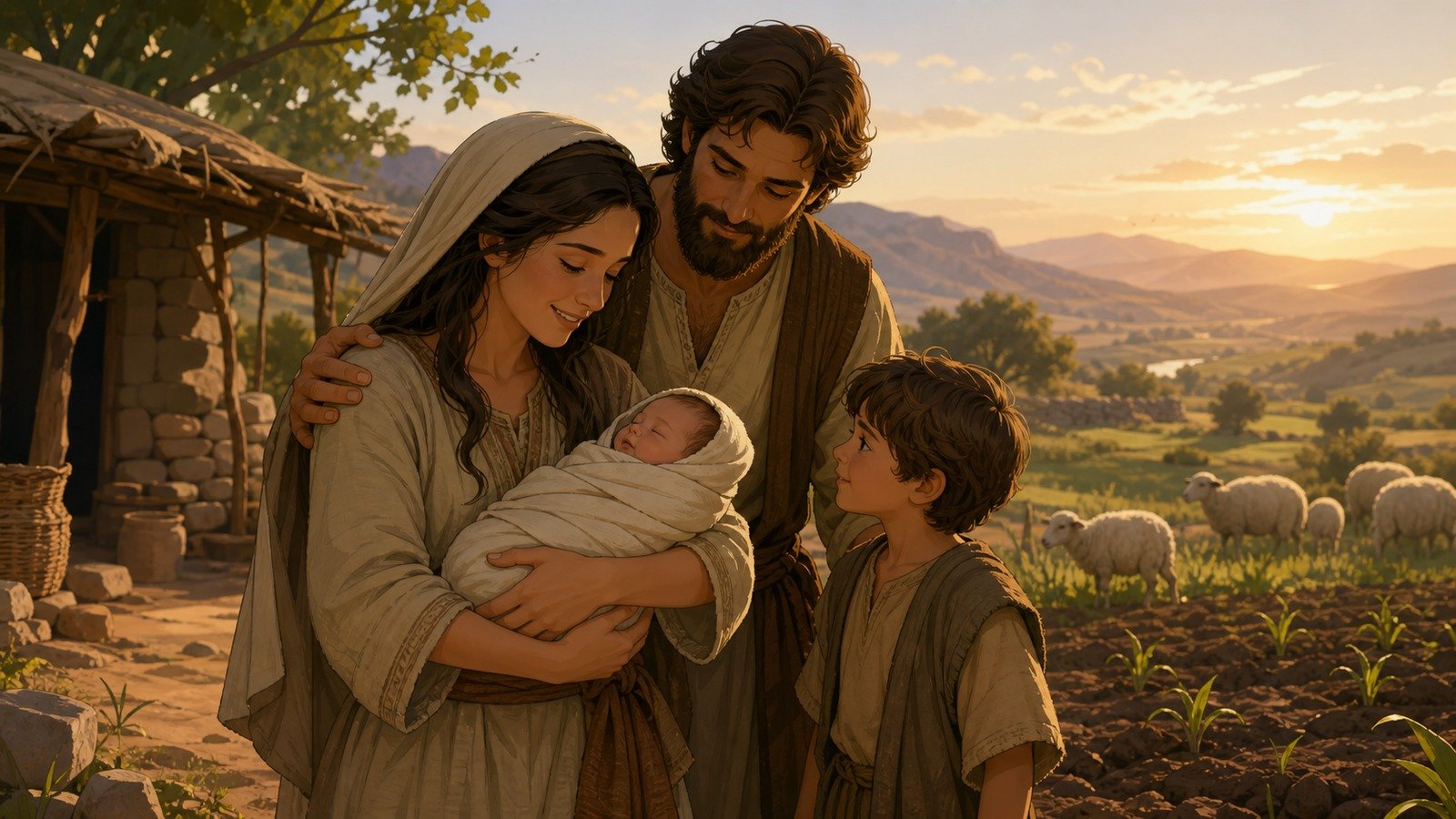
Adam and Eve's first two sons are born after their expulsion from Eden, Cain a farmer and Abel a shepherd, setting up the sibling rivalry the rest of the chapter turns on.
Further context
2 min readThe first human birth in the Bible happens outside the garden, immediately after the expulsion, and that placement is the point of it.
Eve's words at the birth are the only indication of how she understood what had happened: "With the help of the LORD I have brought forth a man." The verb she uses means to acquire or to produce (qanah), and it sounds like the name Cain (Qayin). Attaching a name to a similar-sounding word is a standard technique in Hebrew storytelling and recurs constantly through Genesis. Her sentence credits the birth to God rather than to herself, which is striking coming so soon after a scene about grasping at something withheld.
Abel's name comes with no explanation at all. The word behind it means breath or vapour (hevel), something insubstantial that disperses as soon as it appears. The same word opens Ecclesiastes, repeated five times in a single line and usually translated "meaningless" or "futile". Whether the name was meant to anticipate a short life is impossible to establish, but the word is identical.
Their occupations are given in one line and they matter for what follows. Abel kept flocks; Cain worked the soil. Both are ordinary and necessary, and neither is ranked above the other. Cain's work continues the task the man was given in the garden, on ground that has just been cursed and now resists cultivation.
Two things commonly assumed here are worth correcting. Cain and Abel are not described as the first children born, only as sons born to Adam and Eve. And they are not described as the only ones. Other sons and daughters are mentioned later without any indication of when they arrived. The question that surfaces further on, when Cain is said to have a wife, has no answer anywhere. Readers have proposed that he married a sister, that the story is not attempting a complete population history, or that it assumes a wider human world it never describes. None of these can be established, and any confident answer supplies material the author did not.
The two trades divide the world these brothers lived in. A shepherd moved with the seasons, owned little that could not be carried, and measured wealth in animals that could die overnight. A farmer stayed put, cleared and worked one patch of ground, and depended on rain arriving at the right week. The two ways of life competed for the same land and the same water across the whole ancient Near East, and disputes between herdsmen and cultivators run through the rest of Genesis, from Abraham and Lot dividing the country between them to Joseph's brothers being settled apart from the Egyptians because shepherds were despised there.
What the birth carries is expectation. The judgement on the serpent had spoken of the woman's offspring, and these are the first offspring to arrive. Anyone reading forward with that promise in mind is about to watch one of these two brothers kill the other, and that is the immediate answer given to any hope that the matter would resolve itself quickly.