

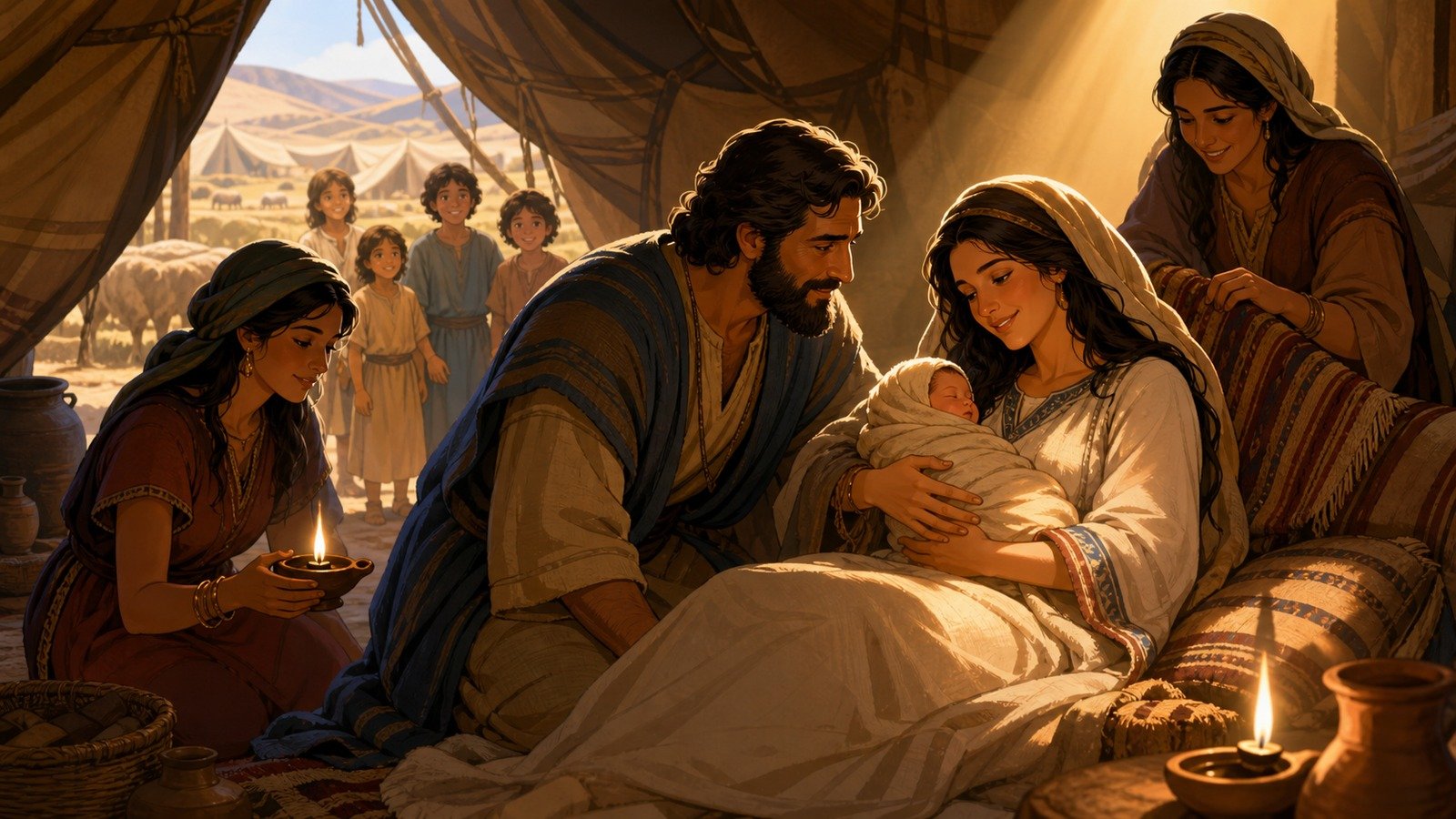
God finally "remembers" Rachel, and she bears Joseph, the eleventh son and Jacob's clear favourite, whose story will dominate the rest of Genesis.
Further context
3 min readThen God remembered Rachel. The verb does not describe recollection; it is used throughout the Hebrew scriptures for acting on something already undertaken, and it is the same word used at the turning point of the Flood. He listened to her and enabled her to conceive.
The naming is unusual because two explanations are supplied at once and both are hers. God has taken away my disgrace, she says, using a verb meaning to remove or gather up (asaph). Then: may the LORD add to me another son, using a different verb meaning to add (yasaph). The name Joseph can be heard as either, and neither is chosen over the other. The first looks backwards at years of humiliation in a household where her sister had six sons. The second asks for more, immediately.
The request is granted and it costs her life. Her second son is born on a road near Bethlehem and she dies in the birth.
The immediate consequence of Joseph's arrival is a decision. Jacob goes to Laban and asks to be sent on his way, and the two events are connected directly. With Rachel's son born the household is complete enough to move, and the six years of flock-tending and the departure follow from this point.
Joseph occupies a larger share of the family's story than anyone else in it. His account runs to fourteen chapters, more than Abraham receives and roughly a quarter of the whole book. Nothing in these three sentences anticipates that.
One legal consequence deserves stating, because it explains a puzzle in the later histories. Reuben, the firstborn, loses his standing through an incident recorded later. The rights of the firstborn then pass to the sons of Joseph while the leadership goes to Judah, which is stated explicitly in a genealogy written centuries afterwards. That is why Joseph's two sons, Ephraim and Manasseh, each become a tribe with its own territory, giving their father the double portion belonging to a firstborn, while the royal line runs through a different brother. Birthright and leadership are split between two men, neither of whom is the eldest.
Rachel's position alongside all this is worth noticing. She is the wife Jacob chose, worked fourteen years for and loved. She is also the last of the four women to bear a child, the mother of only two of the twelve sons, and the one who does not live to reach the family's home. Leah, whom he did not want, is buried beside him in the cave at Hebron.
Rachel's two sons stand oddly in the family that follows. Joseph gets two tribes through his own sons and the double portion of a firstborn; Benjamin's tribe is the smallest and is nearly destroyed in a civil war. Neither of them produces the royal line, which runs through Leah's fourth son, or the priesthood, which runs through her third. The wife Jacob worked fourteen years for supplies neither the kings nor the priests of the nation descended from him.
The naming also closes a sequence. Eleven sons and one daughter have been born in about seven years to four women, and every one of them has been named with a sentence about rivalry, vindication, wages or hope of affection. This is the last of them. No child is named again until Benjamin, and his name is contested at his mother's deathbed.