

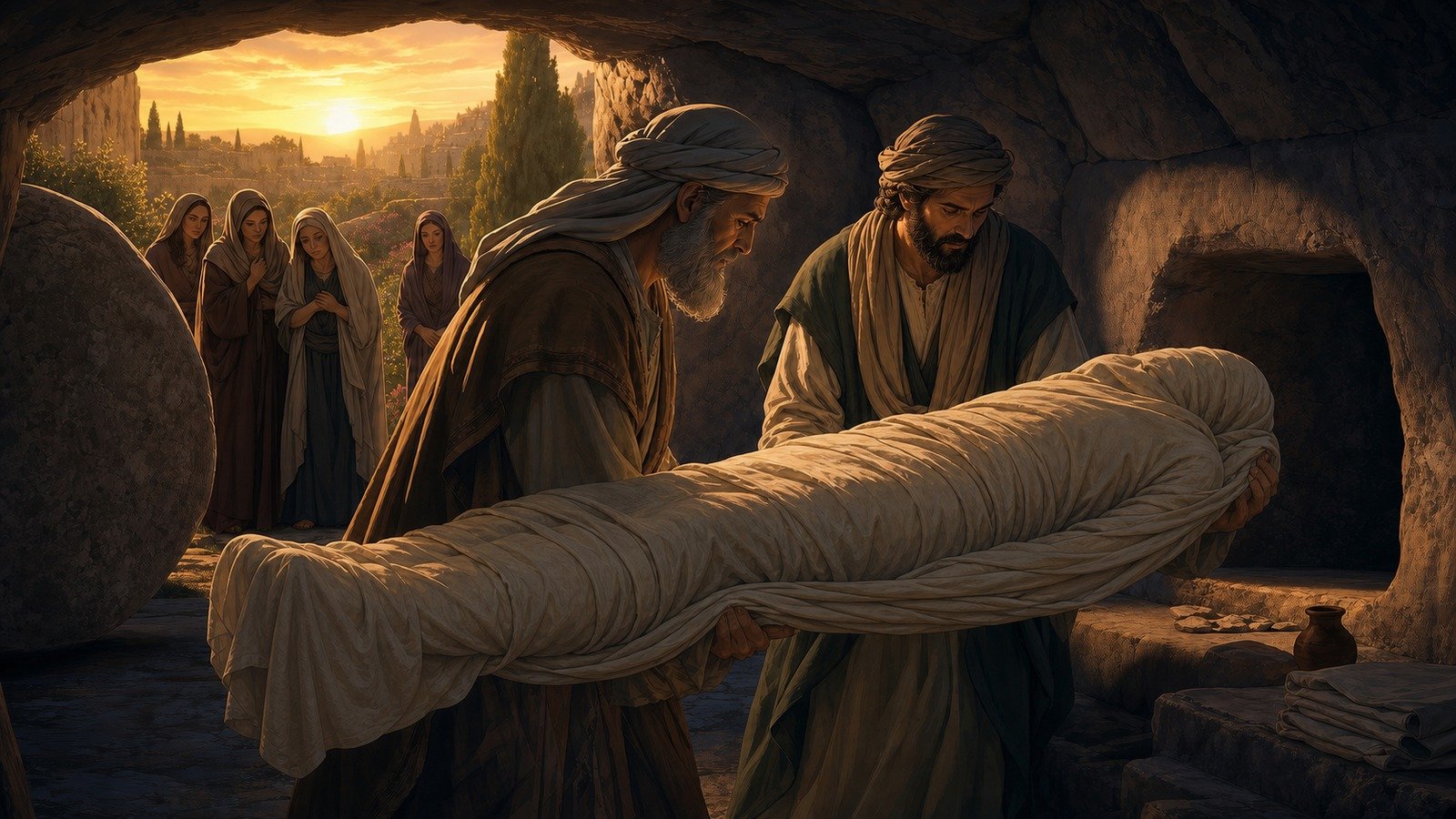
Joseph of Arimathea, a wealthy member of the Sanhedrin who had not consented to Jesus' condemnation, requests the body from Pilate and lays it in his own new rock-cut tomb before the Sabbath begins, with Nicodemus assisting and women disciples watching where the body was placed.
Further context
2 min readJoseph of Arimathea goes boldly to Pilate and asks for the body.
Everything about that request is dangerous. He is a member of the council that had just condemned the man, described as a good and upright man who had not consented to their decision, and as someone waiting for the kingdom of God. Asking a Roman governor for the corpse of an executed rebel identified him publicly with the condemned.
Normal Roman practice was to leave crucified bodies on the cross for days as a deterrent, and then to throw them into a common grave. That is what makes the request unusual and what makes it necessary: Jewish law required a body hanged on a tree to be buried the same day, and the Sabbath began at sunset, a few hours away.
Pilate is surprised that he is already dead and summons the centurion to confirm it before releasing the body.
Nicodemus comes too, the man who had first visited at night, bringing a mixture of myrrh and aloes weighing about thirty-four kilograms. That is an enormous quantity, of a kind used at royal funerals, and the two men are between them spending a great deal of money in public on a condemned criminal.
The body is wrapped in linen with the spices, according to Jewish burial customs, and placed in a new tomb cut out of rock in a garden near the execution site, in which no one had yet been laid. A stone is rolled across the entrance.
Rock-cut tombs of this kind are well known archaeologically around Jerusalem. They consisted of a low entrance, an antechamber, and shelves or niches cut into the walls where a body was laid out. After a year, when the flesh had decayed, the bones were gathered into a limestone box and the shelf reused, which is why so many ossuaries survive. A round blocking stone rolling in a channel was used at some wealthy tombs and is what the wording describes.
The women who had come with him from Galilee follow and see the tomb and how the body is laid in it, then go home to prepare spices and perfumes, and rest on the Sabbath in obedience to the commandment.
That detail about the women watching is the reason the location was not in doubt afterwards. Two of them are named, and they are named again as the first people at the tomb on the Sunday morning.
Arimathea has not been identified with certainty, and the usual candidate is Ramathaim, in the hills north-west of Jerusalem.
Joseph's tomb being new and unused mattered later. A body laid where no other had been laid could not be confused with anyone else's remains, which is the objection an empty tomb would otherwise invite, and the same point is made about the colt nobody had ridden.
The women's presence at both the burial and the discovery is what ties the two events together, and it is one of the reasons the location was never in dispute in the first-century argument.