

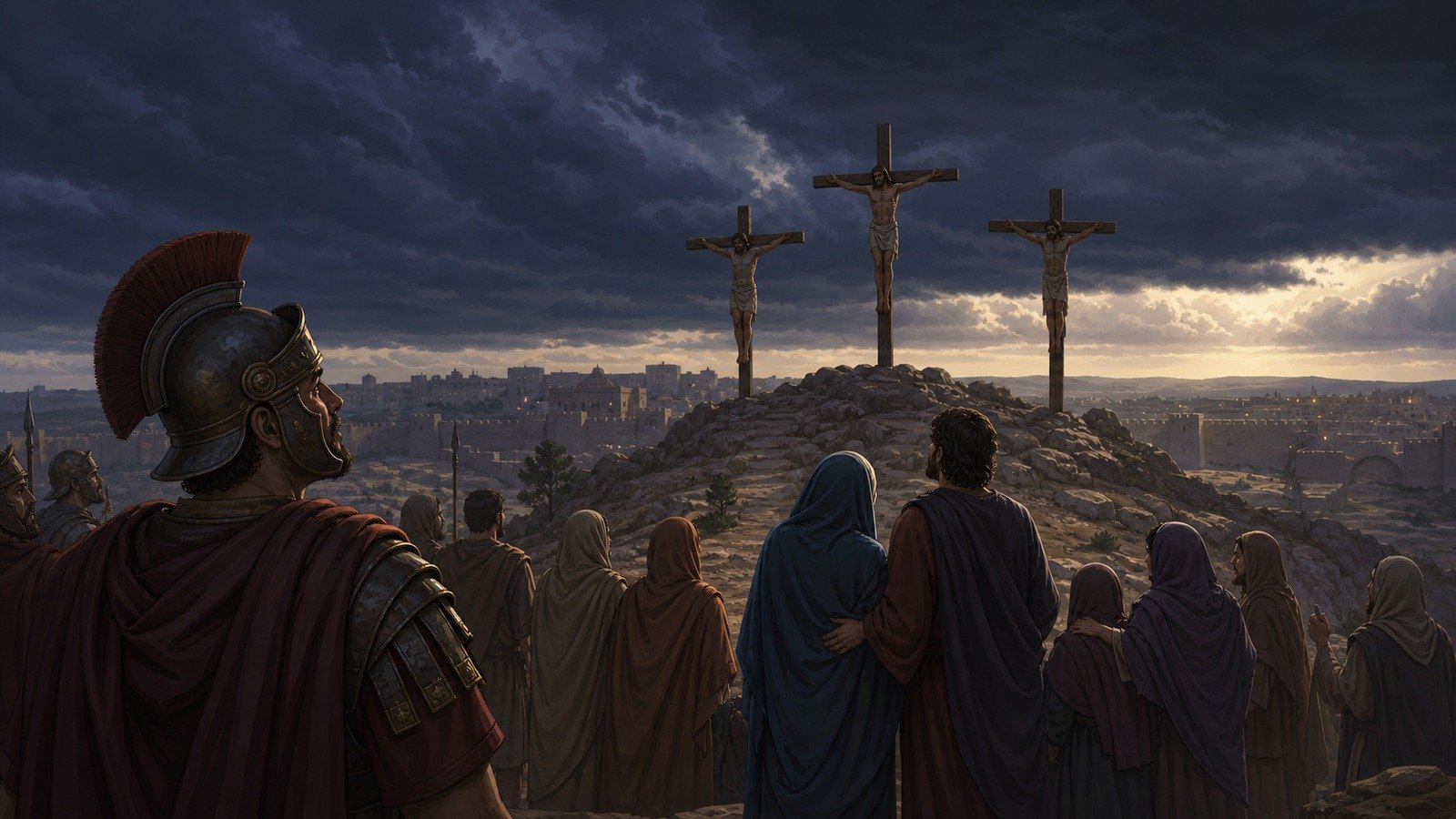
Jesus is mocked, flogged and crucified between two criminals outside Jerusalem's walls; darkness covers the land for three hours, the Temple curtain tears in two at his death, and a Roman centurion overseeing the execution declares, "Surely this man was the Son of God."
Further context
2 min readThe flogging came first, and Jesus was subjected to it before anything else. Roman scourging used a short whip of leather thongs weighted with lead or bone, applied to a man stripped and tied to a post, and it opened the flesh. Men died under it. Josephus describes prisoners flogged until their bones were exposed.
Then the mockery: a purple robe, a crown twisted from thorns, a staff, and soldiers kneeling in front of him saying hail, king of the Jews.
The condemned man carried the crossbeam, not the whole cross, to the execution site outside the walls, with a placard stating the charge. He is unable to carry it, and a passer-by is pressed into service, named as Simon from Cyrene in north Africa, whose two sons are named as though the readers knew them.
The place is Golgotha, which means the place of the skull.
Crucifixion was designed for maximum deterrence: public, slow and humiliating, reserved for slaves, rebels and non-citizens. Nails were driven through the wrists and heels; a heel bone with an iron nail still through it was found in a Jerusalem tomb in 1968, the only physical evidence of the practice yet recovered. Death came by asphyxiation as the body sagged, and could take days.
He is crucified between two criminals at nine in the morning. The charge above his head reads, in three languages, Jesus of Nazareth, the King of the Jews. The soldiers divide his clothes by lot.
Seven short sentences spoken from the cross are preserved across the four accounts. Father, forgive them, for they do not know what they are doing. To one of the criminals, today you will be with me in paradise. To his mother and to a disciple, words placing each in the other's care. My God, my God, why have you forsaken me, which is the opening line of a psalm. I thirst. It is finished. Father, into your hands I commit my spirit.
From noon until three darkness comes over the whole land. What caused it is unknown; a solar eclipse is impossible at Passover, which falls at full moon.
He dies at about three in the afternoon, after roughly six hours, which struck Pilate as unusually quick.
The curtain of the temple is torn in two from top to bottom. It separated the innermost sanctuary, which one man entered once a year.
A centurion standing there says: surely this man was the Son of God.
The location is now inside the walls, because Herod Agrippa extended them about a decade later, which is the main reason a site in the middle of the Old City can be a plausible candidate for a place of execution outside it.
Two of the details reported are checkable in principle and neither is confirmed elsewhere. Thallus, a first-century writer whose work survives only in quotation, apparently explained a darkness at that period as an eclipse, and a later Christian writer objects that an eclipse at full moon is impossible. What that quotation is worth is disputed, since it survives at third hand.