

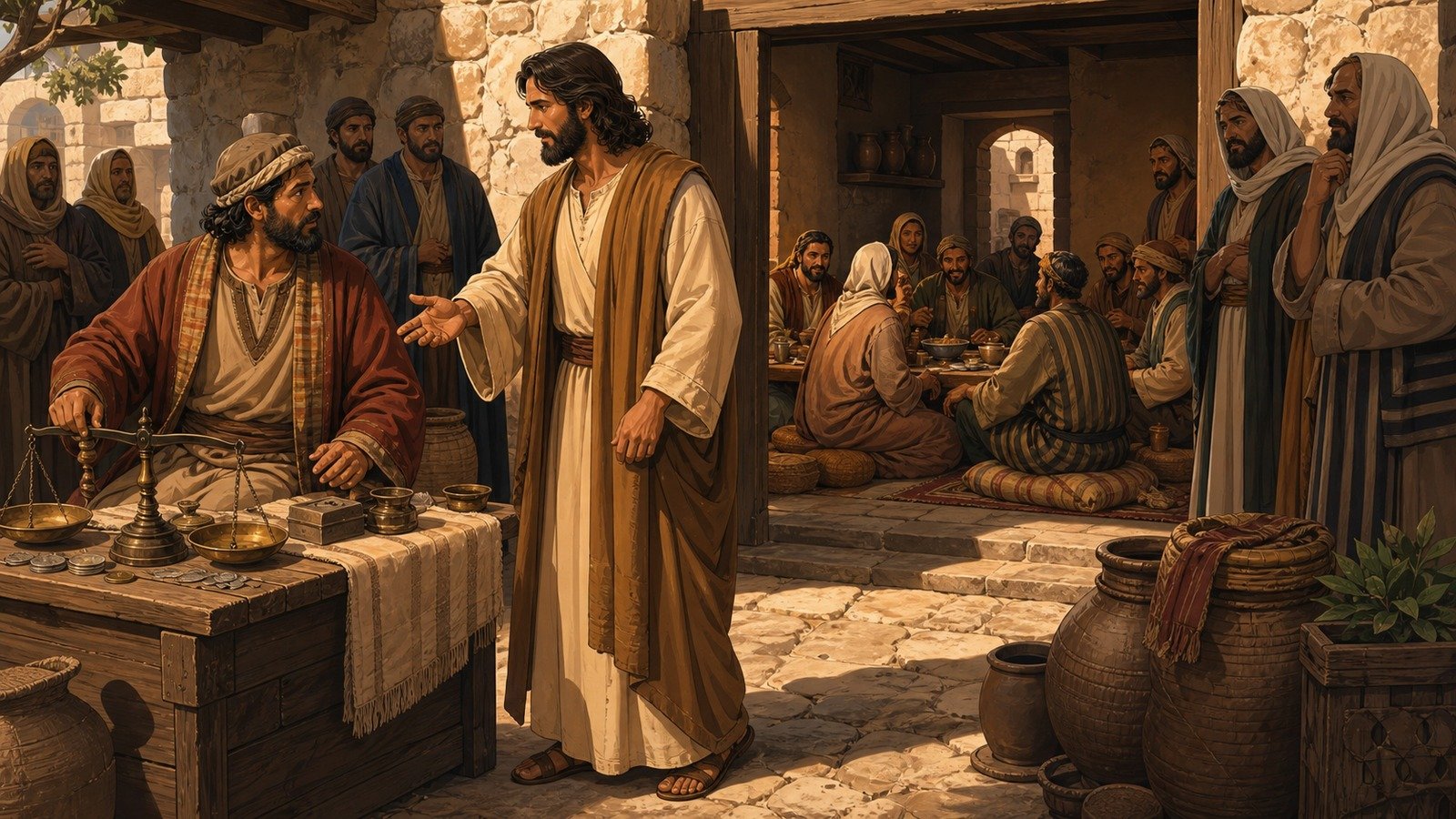
Jesus calls the tax collector Matthew directly from his booth, then eats at his house with other tax collectors and "sinners," drawing criticism he answers with, "It is not the healthy who need a doctor, but the sick."
Further context
3 min readMatthew is sitting at a tax collector's booth, which in Capernaum meant a customs post on the road from Damascus to the coast, collecting duty on goods passing through Antipas's territory.
The system explains the hatred. Rome and its client rulers farmed out collection rights to the highest bidder, and the collector recouped his bid and his profit from whatever he could extract above the required amount. Everyone knew the margin was arbitrary, and there was no appeal. Beyond the extortion, the job meant handling the coinage of an occupying power and working on its behalf, which put a man outside respectable society entirely. Tax collectors are grouped with sinners, with prostitutes, and with Gentiles in the ordinary speech of the period, and their testimony was not accepted in court.
He is called with two words: follow me. He gets up and follows, and the call is more final than the fishermen's. Boats and nets can be returned to; a collection franchise abandoned in the middle of the day does not come back.
He is called Levi in two of the accounts and Matthew in the third, and a man carrying two names in that world is unremarkable.
Then a banquet at his house with a large crowd of tax collectors and others, which means the guest list is his own professional circle.
The objection is put to the disciples rather than to him: why does your teacher eat with tax collectors and sinners? Eating with somebody was not a neutral act. A shared meal signalled acceptance and association, which is exactly why it was worth objecting to, and the question is a serious one about how a teacher's associations reflect on his teaching.
The answer comes in three parts. A proverb: it is not the healthy who need a doctor, but the sick. A quotation from Hosea aimed at religious professionals: go and learn what this means, I desire mercy, not sacrifice. And a statement of purpose: I have not come to call the righteous, but sinners.
One detail about the setting is worth adding. Excavation at Capernaum has uncovered a first-century village of basalt houses built around shared courtyards, with a customs post on the road, which is a settlement of a few hundred to a thousand people. Everyone at that banquet knew everyone else's business, and a teacher who had been drawing crowds in the synagogue was now eating in the house of the man who took their money.
The instruction to go and learn what a text means is the standard rabbinic formula for telling a student to go back and study, and it is being addressed to the teachers of the law.
The booth was a customs post rather than a tax office in the modern sense. Capernaum sat on the road running from Damascus to the Mediterranean coast, near the border between Antipas's Galilee and Philip's territory, and duty was collected there on goods in transit.
Men in that trade bid for the contract and made their living from whatever they could extract above it, which is why the word for them became a byword.
The call is two words in Greek, follow me, and the response is immediate. Luke adds that he left everything, and unlike fishermen, who could go back to a boat, a man who walked away from a customs franchise could not have it back.
The dinner that follows is at his house, with a large crowd of tax collectors and others, and the complaint is put to the disciples rather than to him.
The answer quotes Hosea: I desire mercy, not sacrifice.