

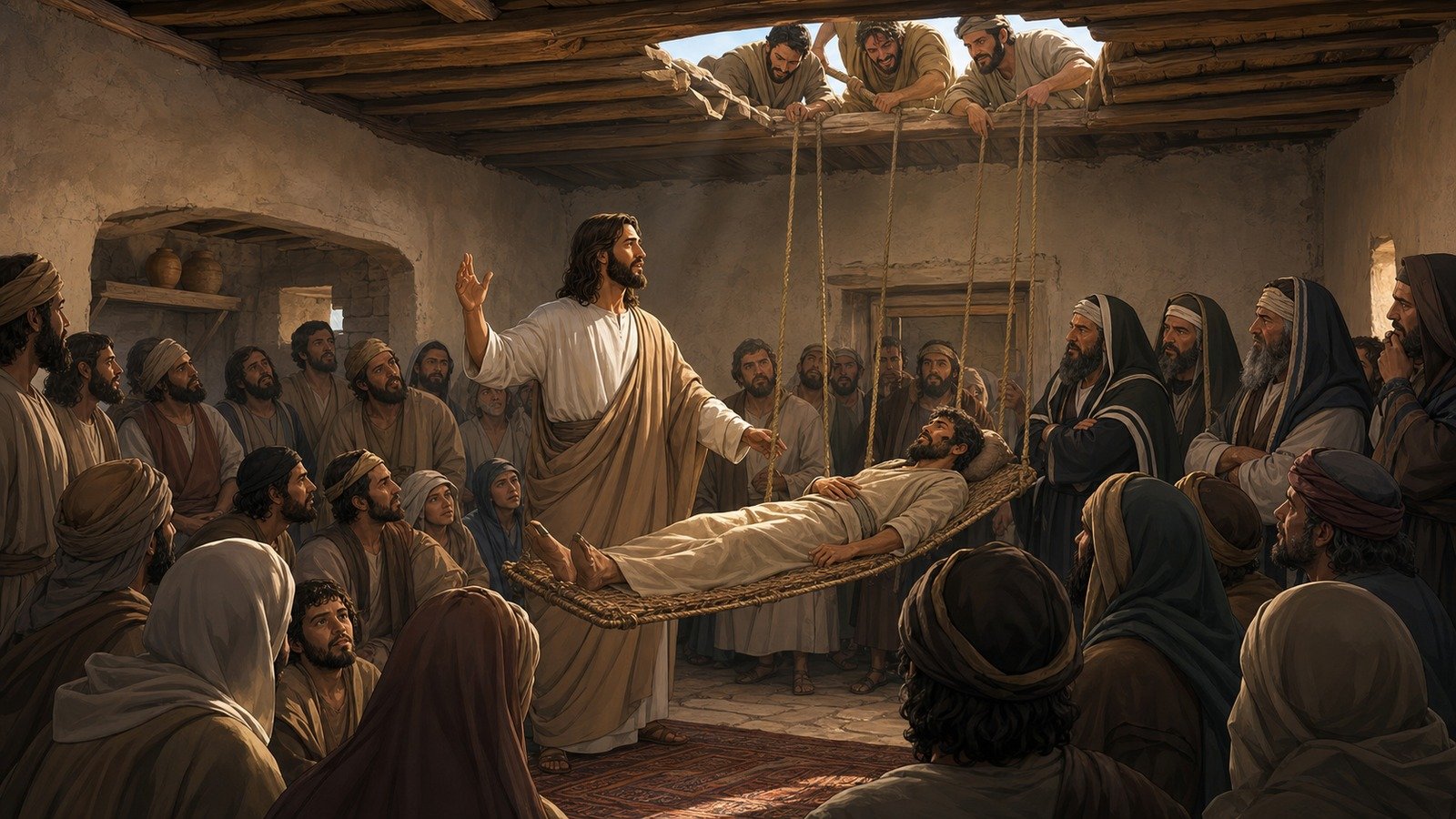
Friends lower a paralysed man through a roof to reach the crowded house where Jesus is teaching; Jesus first declares his sins forgiven, provoking accusations of blasphemy from religious teachers, then heals him physically as evidence of his authority to do both.
Further context
3 min readJesus is back in Capernaum, at home, and so many people gather that there is no room left, not even outside the door.
Four men arrive carrying a paralysed friend on a mat and cannot get near. What they do next is the detail everybody remembers. They go up onto the roof, dig through it and lower the man down on his mat in front of everyone.
Galilean village houses had flat roofs reached by an outside stair, made of wooden beams laid across the walls with brushwood and packed mud on top, rolled smooth and re-laid each year. Digging through one is destructive, messy and entirely repairable, and it would have rained debris onto the heads of the people below.
The first thing said is not what anyone in the room expects, including the man on the mat: when Jesus saw their faith, he said to the paralysed man, son, your sins are forgiven. The faith noticed is that of the four on the roof.
Teachers of the law sitting there think it through silently and reach the correct conclusion: why does this fellow talk like that? He is blaspheming! Who can forgive sins but God alone? That is not obtuseness. It is exactly the right question, and everything in the scene depends on it being asked.
The reply concedes the difficulty and turns it into a test. Which is easier, to say your sins are forgiven, or to say get up, take your mat and walk? Saying the first is easier because nobody can check it. The second is verifiable within seconds.
But I want you to know that the Son of Man has authority on earth to forgive sins. So he said to the paralysed man, get up, take your mat and go home.
The man gets up, takes his mat and walks out in full view of them all, and everyone is amazed and praises God, saying they have never seen anything like this.
One detail about the house is worth adding. He is described as being at home, which most naturally means the house in Capernaum he was using as a base, very probably Simon's. The four men were not vandalising a public building; they broke through somebody's roof, in front of him, while he was speaking, and nothing is said about the damage by anyone.
Two things follow from the episode. It is the first time in Mark's Gospel that opposition is recorded, and the ground of it is a claim about identity rather than a dispute about Sabbath practice or company. And the title Son of Man, which he uses of himself more than any other and which simply means a human being in ordinary Aramaic, is used here for the first time attached to an authority that the objectors have just said belongs to God alone.
The roof is the detail that makes the scene physical. Galilean village houses had flat roofs of beams laid across the walls, filled in with branches, reeds and packed mud, reached by an outside stair and used for sleeping and drying grain. Opening one meant digging through that layer, and the debris fell into the room below on the people sitting in it.
The four men carried a man on a mat up an outside staircase and dismantled someone else's ceiling.
What is said first is not what anybody was expecting: son, your sins are forgiven. Nothing in the request had mentioned sins.
The objection raised silently by the teachers of the law is theologically correct and they are not misrepresented: who can forgive sins but God alone?
The question put back to them is a trap with no exit. Which is easier to say? One claim cannot be checked and the other can, so he does the one that can.