

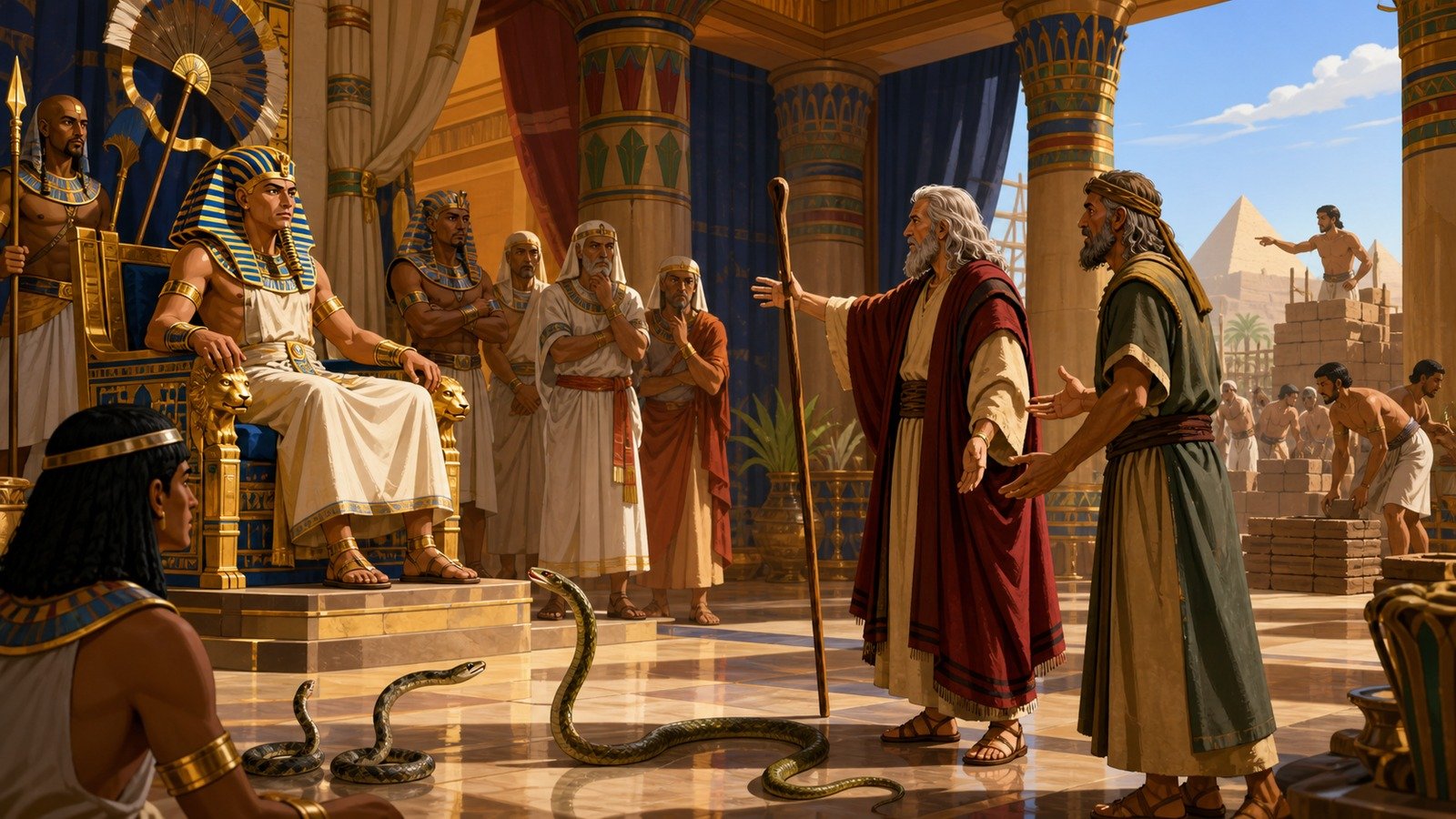
Moses and Aaron demand Israel's release; Pharaoh refuses and increases the Israelites' workload instead. As a first sign, Aaron's staff becomes a snake before Pharaoh, and his own magicians replicate the feat, hardening Pharaoh's resolve.
Further context
2 min readThe opening request is modest: the God of Israel says let my people go, so that they may hold a festival to me in the wilderness. Three days' journey, a religious observance, and a return. Pharaoh's answer sets the terms for everything that follows. Who is the LORD, that I should obey him and let Israel go? I do not know the LORD and I will not let Israel go.
His counter-move is administrative and effective. The Israelites are making bricks, and until now the straw has been supplied to them. Straw was mixed into Nile mud to bind the clay, and Egyptian brick production is well documented, including tomb paintings of Semitic labourers making them and administrative records complaining about shortages. He withdraws the supply and keeps the quota unchanged. The workers scatter across Egypt to gather stubble, output falls, and the Israelite foremen are beaten for the shortfall.
Those foremen go to Pharaoh, get nowhere, and turn on Moses and Aaron as they come out. May the LORD look on you and judge you. You have made us obnoxious to Pharaoh and his officials and have put a sword in their hand to kill us.
Moses takes the complaint straight back to God, and his words are as blunt as the foremen's. Why have you brought trouble on this people? Is this why you sent me? Ever since I went to Pharaoh to speak in your name, he has brought trouble on this people, and you have not rescued your people at all.
The answer is a statement about identity before it is a plan. I am the LORD. I appeared to Abraham, to Isaac and to Jacob as God Almighty, but by my name the LORD I did not make myself known to them. Whether that denies knowledge of the name itself, which those three certainly use, or denies experience of what it means, is a long-standing question, and the emphasis on what is about to be done supports the second reading.
Four undertakings follow, each beginning with I will: bring you out, free you from being slaves, redeem you with an outstretched arm, and take you as my own people. A fifth adds the land. Those four clauses are the basis of the four cups of wine in the later Jewish Passover meal.
The response is recorded honestly: they did not listen to him because of their discouragement and harsh labour. A promise of freedom is not persuasive to people whose workload has just doubled.
The roles are then restated, with Moses made like God to Pharaoh and Aaron acting as his prophet, and the first confrontation is staged. Aaron's staff becomes a serpent. Pharaoh's magicians produce the same effect by their secret arts, and Aaron's staff swallows theirs. Egyptian religion supported an extensive professional class of ritual practitioners, and the contest is presented as a real one that is decisively lost. Two of those men are named in a New Testament letter, Jannes and Jambres, drawing on a Jewish tradition that appears nowhere in Exodus itself.