

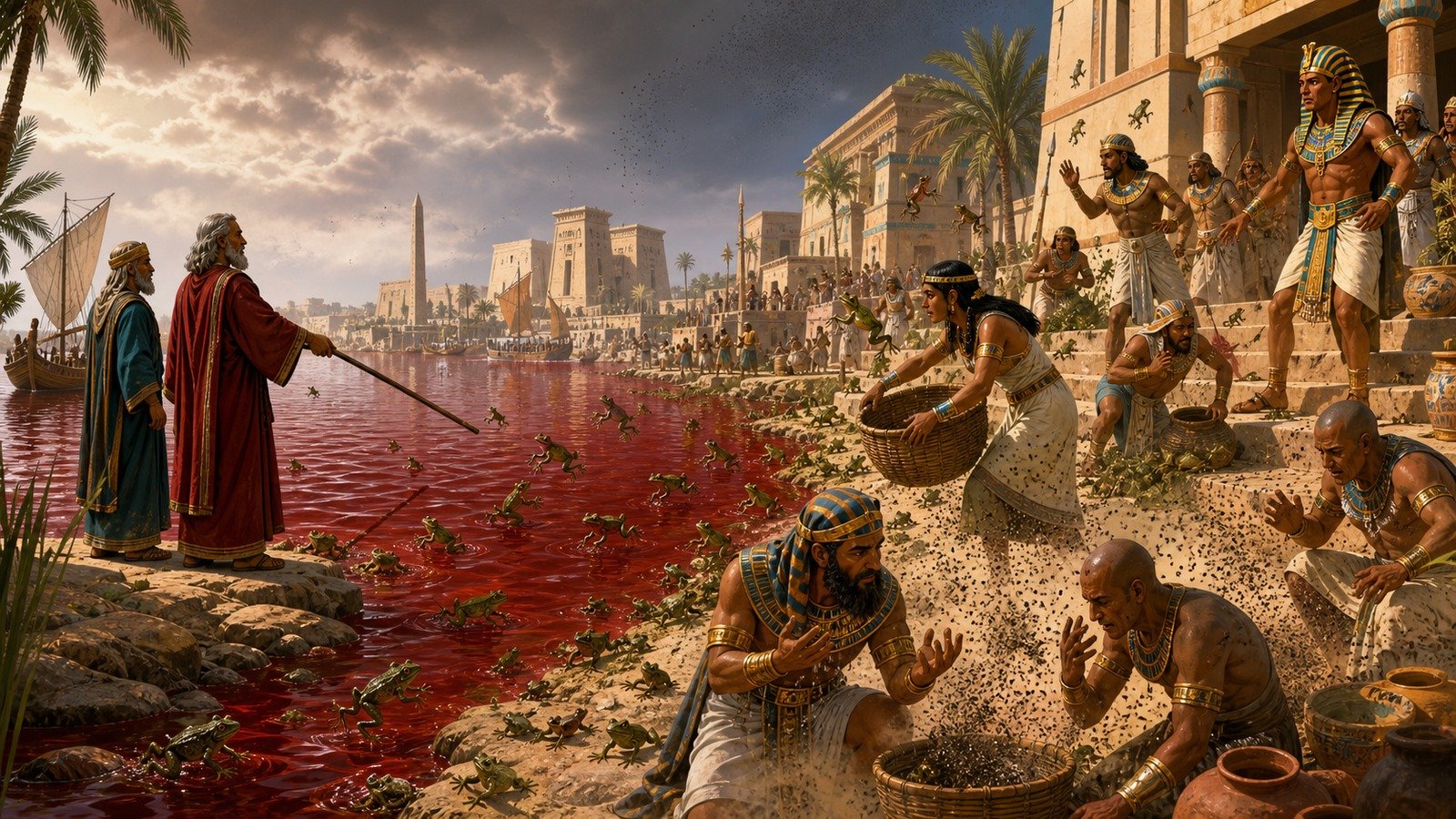
The Nile turns to blood, frogs overrun the land, and dust becomes gnats, each plague striking directly at an aspect of Egyptian life or religion; Pharaoh's magicians can replicate the first two but not the third.
Further context
3 min readThe ten disasters fall into three groups of three with a tenth standing alone, and the grouping follows a pattern. Within each set of three, the first two come with a warning and the third arrives unannounced, and the first of each set is delivered to Pharaoh in the morning at the water.
It begins at the Nile. Aaron strikes the water with the staff and it turns to blood. The fish die, the river stinks, and the Egyptians cannot drink from it and dig along the banks for water instead. The Nile was not one resource among many. It was the entire agricultural and drinking supply, the transport network and an object of religious devotion, and the country existed because of its annual flood. A strike on the Nile is a strike on the foundation of Egyptian life.
The frogs come next, up out of the river into houses, bedrooms, beds, ovens and kneading troughs. Pharaoh asks Moses to pray for their removal, and Moses lets him name the time. He says tomorrow. A man surrounded by frogs in his bed chooses to spend one more night with them rather than concede immediately, and the answer is reported without comment. When the relief comes the frogs die in heaps and the land reeks, and he hardens his heart.
The gnats arrive without warning, produced from the dust of the ground, and here the pattern of the contest breaks. The magicians try by their secret arts to produce gnats and cannot, and they say to Pharaoh, this is the finger of God. The professionals concede in the third round and are never mentioned as rivals again.
Their role in these first rounds repays attention. They match the opening sign and the first two disasters, so their skill is conceded rather than dismissed as fraud. What they cannot do is reverse anything. Duplicating a plague of blood adds to the problem and does not solve it, and no account exists of them removing frogs or restoring a river. Their function is to establish that the contest is real and then to lose it publicly, which is why their concession carries weight.
Attempts to reconstruct the sequence as a chain of natural events have been made repeatedly, usually starting from an unusually heavy flood carrying red sediment or a toxic algal bloom that kills the fish, driving frogs out of the water, whose deaths then multiply the insect population. Reconstructions of that kind can produce a plausible order. What they cannot produce is what the story is actually interested in: that each event begins and ends on a stated word, that Moses can be asked to set the time, and that Goshen is exempted from the later ones while Egypt is not.
The first three also establish the pace. Blood lasts seven days. Frogs are removed on a stated timetable at Pharaoh's own request. Gnats arrive without notice. Nothing is continuous and nothing is random, and between each one there is an interval in which he can change his mind and does not. That structure is what turns a sequence of disasters into a negotiation, and it is why as much space goes to the conversations between them as to the disasters themselves.
The framing given to the whole series is a claim about Egypt's gods rather than about weather. Readers have often matched individual disasters to individual deities, and those correspondences are inferences rather than statements. What is claimed is general: judgement on all the gods of Egypt.