

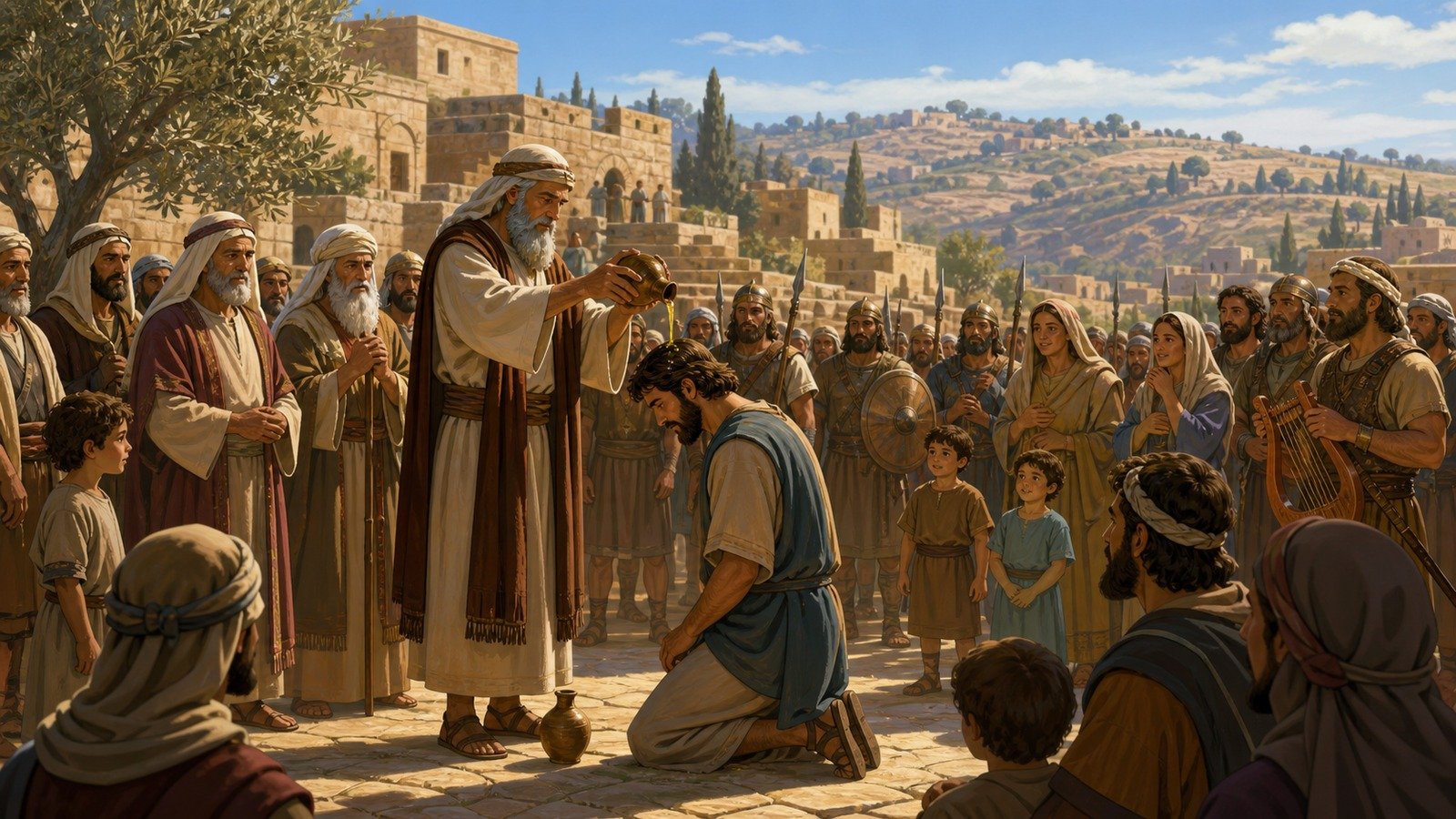
Following Saul's death, David is anointed king by the tribe of Judah at Hebron, while the rest of Israel initially remains loyal to Saul's surviving son Ish-Bosheth under the general Abner.
Further context
2 min readDavid's first move after Saul's death is to ask rather than act. Shall I go up to one of the towns of Judah? The answer is yes, and when he asks which one, he is told Hebron.
That is the right answer for several reasons. Hebron is the principal town of the southern hill country, the burial place of Abraham, Isaac and Jacob, and the centre of the district his wife Abigail married him into. It is also thirty kilometres from Jerusalem, which is still a Jebusite town and not yet anybody's capital.
He goes up with his two wives and with his men and their families, and they settle in Hebron and its surrounding villages. The men of Judah come and anoint him king over the house of Judah, which is one tribe out of twelve. He is thirty years old.
Asking before acting is the pattern that separates him from his predecessor throughout these years. He asks whether to go up, and then which town. He asks before pursuing the Amalekites at Ziklag, before attacking the Philistines at Keilah, and twice before engaging in the valley outside Jerusalem, and on the second occasion is told to wait and circle round. Saul, by contrast, is last recorded enquiring on the night before Gilboa and receiving nothing.
His first act as king is a diplomatic message to Jabesh Gilead, the town that had recovered Saul's body. The LORD bless you for showing this kindness to Saul your master by burying him. May the LORD now show you kindness and faithfulness, and I too will show you the same favour because you have done this. Now then, be strong and brave, for Saul your master is dead, and the people of Judah have anointed me king over them.
Read carefully, that is a recruitment letter. He praises them for loyalty to the previous king, offers to be the source of their reward, and mentions in the last clause that there is a new king in the south. Jabesh Gilead sits in Transjordan, in territory the house of Saul still controls, and this is the first move in a seven-year contest.
The house of Saul does not concede. Abner, Saul's cousin and the commander of his army, takes Ish-Bosheth, one of Saul's surviving sons, across the Jordan to Mahanaim and makes him king over Gilead, Ashuri, Jezreel, Ephraim, Benjamin and all Israel. The relocation east of the river is itself an admission: the Philistines hold the western valleys after Gilboa, and the rump of Saul's kingdom is governing from the far side.
Two kings are now anointed in the same country, one in the south with one tribe and one in the north with the rest, and one of them is a real king while the other is being run by his general.
David rules in Hebron for seven and a half years, which is not a footnote. The greatest king in Israel's history spends the first fifth of his reign as a regional ruler in a hill town, negotiating and waiting, while the other side runs itself into the ground.