

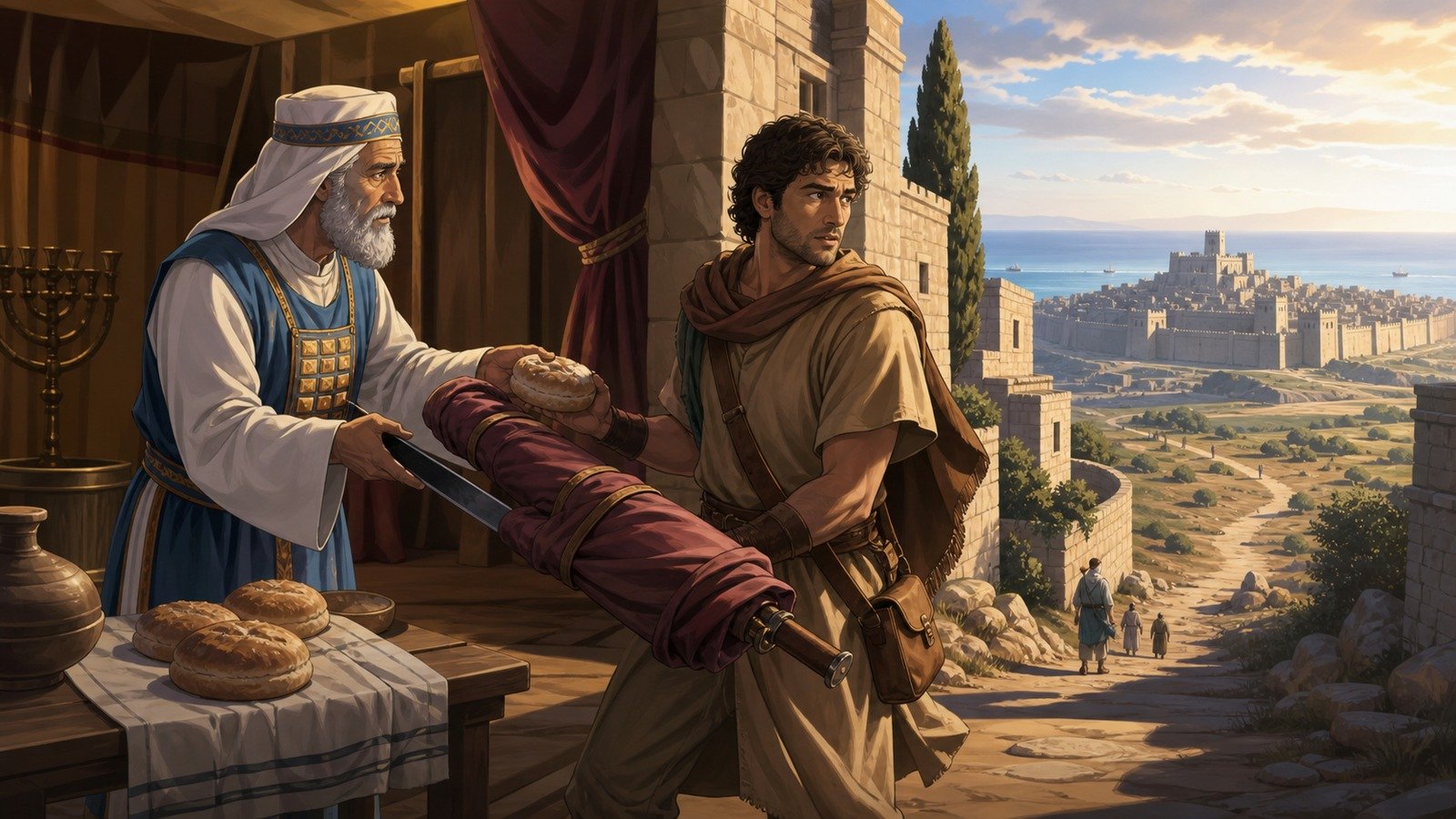
Fleeing Saul, David receives consecrated bread and Goliath's sword from the priest Ahimelech at Nob, an act itself transgressing purity taboos, then feigns madness before the Philistine king of Gath to escape recognition.
Further context
2 min readDavid arrives at Nob, a priestly settlement near Jerusalem where the sanctuary was after Shiloh's destruction, with no supplies and no weapon, and lies to the priest about why he is there. Ahimelek trembles when he sees him alone and asks why nobody is with him, and David says the king has sent him on a secret mission and that his men are meeting him elsewhere.
There is no ordinary bread available, only the consecrated bread that had been removed from the sanctuary table when it was replaced by fresh loaves, and which by law belonged to the priests. Ahimelek gives it to him on condition that the men have kept themselves from women.
Jesus refers to that incident centuries later, in an argument with Pharisees about his disciples picking grain on the Sabbath, and uses it to make a point about the purpose of a regulation against its letter.
David also asks whether there is a spear or sword, and is told that the only one there is Goliath's, kept wrapped in a cloth behind the ephod. He takes it, and the man who once refused Saul's armour walks out of a sanctuary carrying the sword he took off a corpse in the Valley of Elah.
One detail sits in the middle of the scene like a warning. Doeg the Edomite, Saul's head shepherd, was there that day, detained before the LORD. He says nothing and does nothing, and he reports the whole thing to the king afterwards.
From Nob David goes to Gath, which is Goliath's home town, and it is difficult to say what he expected. The servants of Achish recognise him immediately and quote the song about tens of thousands back at him. Very much afraid, he pretends to be insane, making marks on the doors of the gate and letting saliva run down his beard, and Achish asks his men whether he lacks madmen, that they have brought this one to rave in front of him.
The pretence works and he gets out alive.
Several psalms carry superscriptions locating them in this stretch of his life, including one attached to the escape from Achish which speaks of seeking the LORD and being delivered from all fears, and another attached to the flight to the cave. The antiquity of those superscriptions is debated, and they are absent or different in some ancient versions, but they show that the fugitive years were understood early on as the period this poetry belonged to.
The consecrated bread is worth explaining because the exchange turns on it. Twelve loaves stood on a table inside the sanctuary, replaced weekly, and the old loaves belonged to the priests and were to be eaten in a holy place. What Ahimelek does is hand over the sanctuary's own reserved food to armed men on the road, on the strength of a ritual condition about the men keeping themselves from women, and it is the only bread in the building.
What the two episodes have in common is that he lies in both. He deceives a priest who then dies for helping him, and he feigns madness in front of a foreign king. The anointed successor spends this stretch of his life doing whatever keeps him alive.