
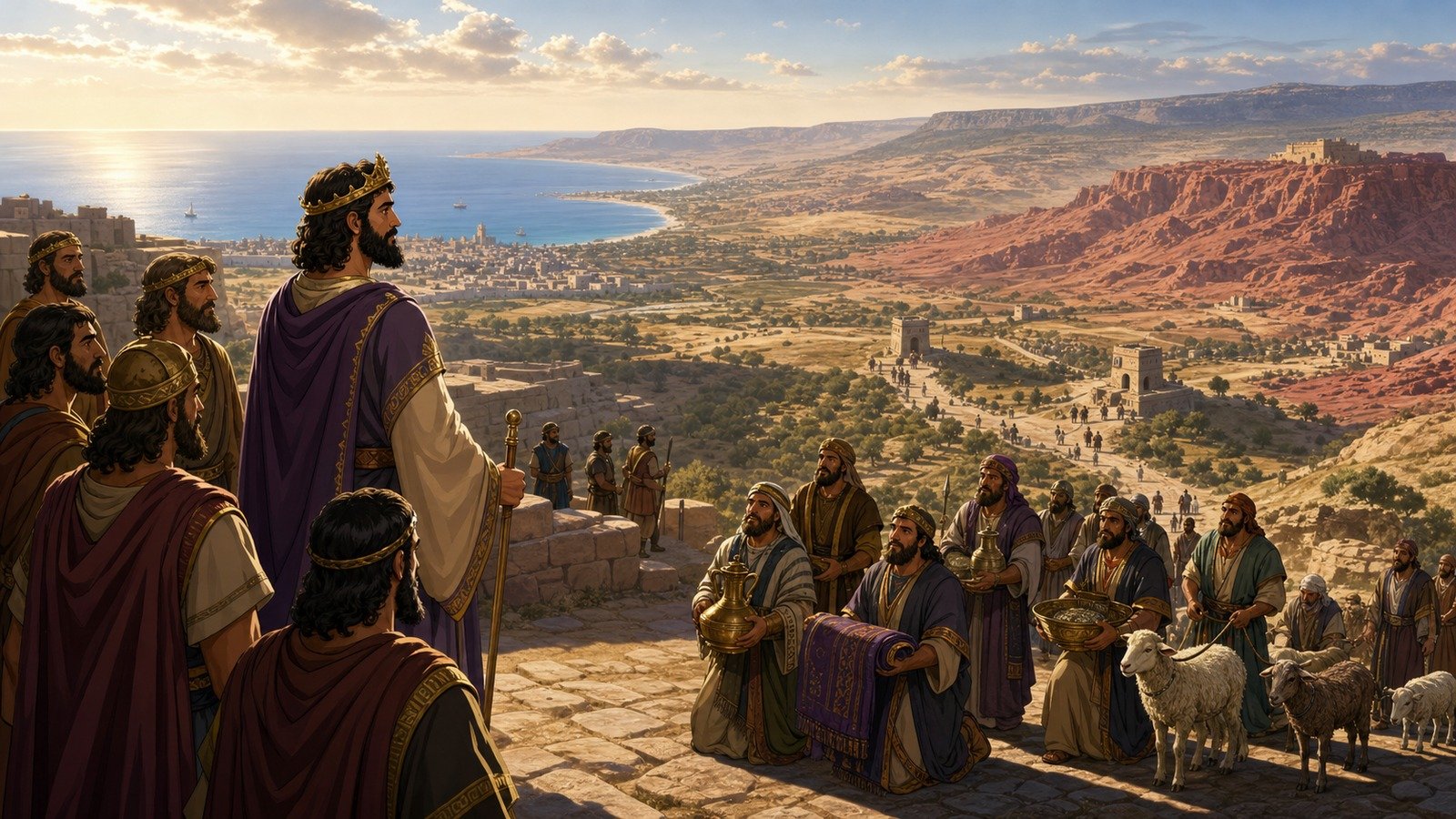
David subdues the Philistines, Moab and Edom, extending Israel's borders and securing tribute from surrounding kingdoms; the chapter closes with a summary list of his administration.
Further context
2 min readThe campaigns are grouped by opponent rather than by date, which is how ancient royal annals were usually organised, so the order here is topical and not a timeline.
The Philistines are dealt with first and decisively, and the phrase used is that David took Metheg Ammah from their control. That is the end of the pressure that had shaped the whole previous century: the people who had banned blacksmiths, captured the ark, killed Saul on Gilboa and forced David himself into exile stop being a strategic threat and become a border problem.
Moab is next, and what happens there is reported without a word of explanation. He makes the defeated lie down on the ground and measures them off with a length of cord, two lengths to be put to death and one length to be allowed to live. No reason is offered for a policy of executing two thirds of the prisoners, and it is the same Moab where he had placed his parents for safekeeping while he was a fugitive. Nothing anywhere accounts for the change.
Then Hadadezer king of Zobah, an Aramean state in the Beqaa valley, and the Arameans of Damascus who come to help him. Twenty-two thousand of them fall. Garrisons are placed in Aram and it becomes tributary. Gold shields are taken from Hadadezer's officers and a great quantity of bronze from two of his towns, and that bronze is specified later as the material for the temple's bronze fittings.
Edom follows, with a large defeat in the Valley of Salt at the southern end of the Dead Sea, and garrisons throughout the territory. Edom controlled the copper deposits of the Aravah and the caravan route north from the Gulf of Aqaba, so holding it is worth more than the fighting suggests.
One item in the plunder has a long afterlife. The bronze taken from Hadadezer's towns is set aside rather than spent, and it becomes the raw material for the enormous bronze basin, the two pillars and the fittings of the temple a generation later. A war fought in the Beqaa valley pays for the plumbing of a building its commander was not permitted to construct.
The summary sentence is repeated twice: the LORD gave David victory wherever he went.
What emerges from all of this is a small empire. Israel now runs from the Egyptian frontier to the upper Euphrates, controlling the trade corridor between Egypt and Mesopotamia, with tributary states on three sides. That is the largest extent the kingdom ever reaches, and it lasts about two generations.
The administrative list that closes the section is easy to skip and is the more interesting half. Joab commands the army. Jehoshaphat is recorder. Zadok and Ahimelek are priests. Seraiah is secretary. Benaiah commands the Kerethites and Pelethites, who are the royal bodyguard and are almost certainly Cretan and Philistine mercenaries, which means the king's personal security is foreign and has no local loyalties to complicate it.
And one line covers what the whole thing was for: David reigned over all Israel, doing what was just and right for all his people.